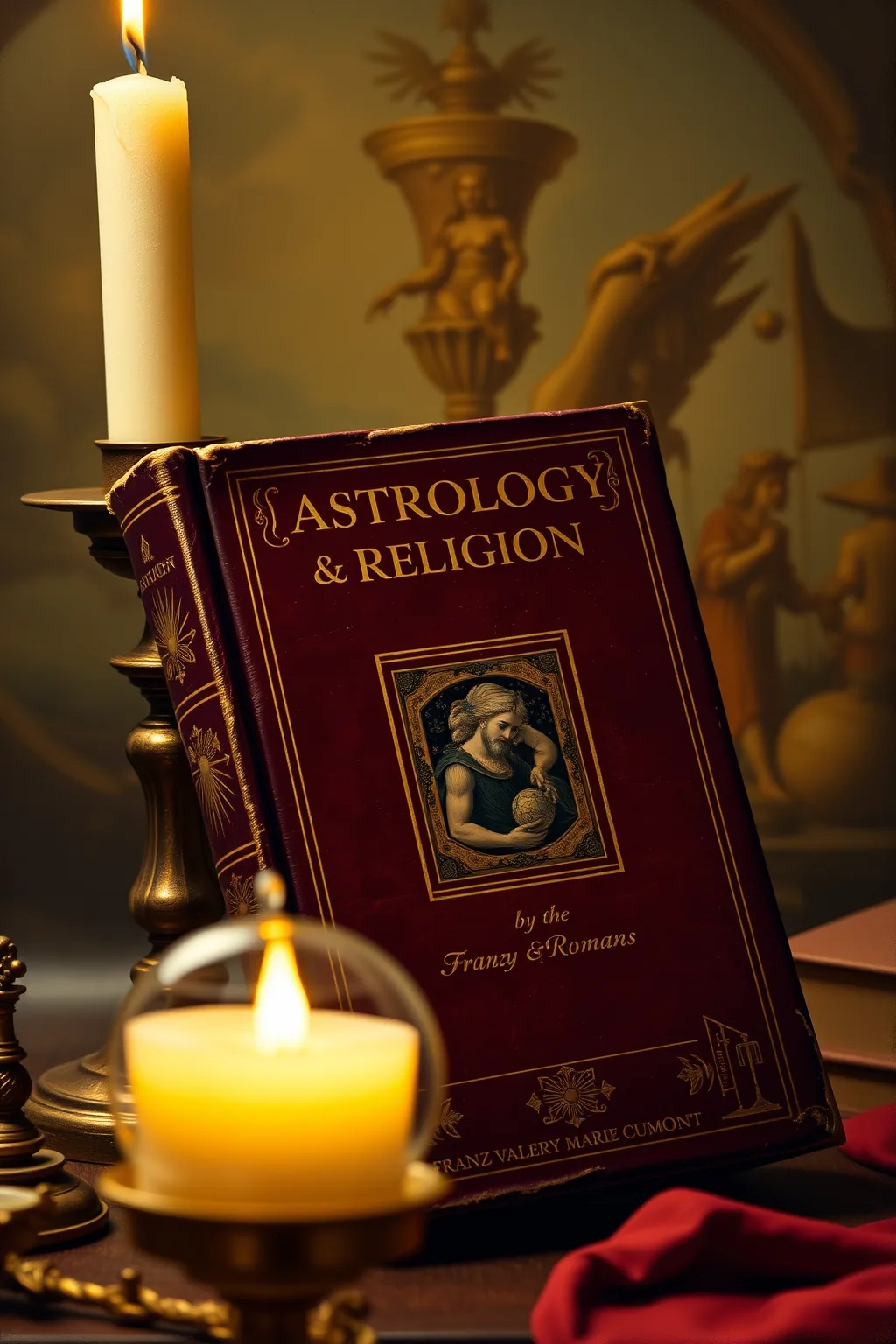
Astrology and Religion Among the Greeks and Romans
 83
83

Astrology and Religion Among the Greeks and Romans
Franz Cumont’s "Astrology and Religion Among the Greeks and Romans" offers a scholarly, if somewhat dated, examination of a crucial intersection in ancient thought. The strength of the work lies in Cumont's meticulous tracing of influences, particularly the Babylonian origins of astrological concepts and their subsequent adoption and adaptation by Greek and Roman thinkers. His discussion on how celestial omens shaped imperial policy and personal piety provides a concrete glimpse into the lived experience of ancient beliefs. However, the prose, while precise, can feel dense for the uninitiated, a characteristic of scholarship from its era. A notable limitation is the book's focus on the *history* of the belief rather than its lived practice or psychological impact. The section detailing the Hellenistic fusion of planetary deities with existing Greek gods is particularly illuminating, demonstrating the syncretic nature of ancient religion. Ultimately, it serves as a vital historical document on the scholarly understanding of astrology's ancient role.
📝 Description
83
Franz Cumont delivered lectures across the United States in 1912, which became the basis for 'Astrology and Religion Among the Greeks and Romans'.
Franz Cumont's "Astrology and Religion Among the Greeks and Romans" originated from his 1912 lecture tour in the United States. The book examines how celestial observation and religious belief were interconnected in the ancient Mediterranean world. Cumont, a respected classical scholar, traces the history of star veneration from its Mesopotamian roots to its incorporation into Greek and Roman spiritual systems. This work is not a guide to astrological practice but a historical and comparative analysis of astrology's widespread influence.
Published in 1912, the book reflects a growing academic interest in the history of religions and ancient Near Eastern studies during the late 19th and early 20th centuries. Cumont's research questioned standard views by emphasizing the substantial impact of Babylonian and Persian ideas on Greek and Roman religious customs. This perspective generated significant scholarly discussion and influenced scholars like James George Frazer. While some of Cumont's specific interpretations have been updated by later research, the book remains a valuable study of ancient belief systems.
Cumont's work situates astrology not as a modern divinatory practice, but as an integral component of ancient religious and philosophical thought. It highlights the historical development of cosmic correspondences and the belief that celestial events held sway over earthly affairs. This perspective connects to broader traditions of hermeticism and Neoplatonism, which sought to understand the universe through symbolic relationships between the heavens and the human realm. The book details how these ideas shaped religious cults and personal belief systems in antiquity.
💡 Why Read This Book?
• Gain insight into the Babylonian origins of astrology, understanding how Mesopotamian astronomical observations directly influenced early Greek and Roman cosmological frameworks, as detailed in Cumont's analysis. • Learn about the concept of astral determinism, exploring how ancient peoples perceived the stars as directly dictating earthly events and human destiny, a core theme examined throughout the lectures. • Understand the historical integration of planetary cults into Greco-Roman religious life, recognizing how figures like Jupiter and Venus were understood not just as gods but as celestial bodies with specific influences, as presented in the text.
⭐ Reader Reviews
Honest opinions from readers who have explored this book.
❓ Frequently Asked Questions
What is the primary focus of Franz Cumont's "Astrology and Religion Among the Greeks and Romans"?
The book primarily examines the historical relationship between celestial observation and religious beliefs in the ancient Greek and Roman worlds, tracing the influence of astrology from its Babylonian roots.
When were Franz Cumont's lectures, which form this book, originally delivered?
The lectures collected in this volume were delivered across the United States in 1912.
Does this book explain how to practice astrology?
No, this is a historical and scholarly work analyzing the cultural and religious impact of astrology in antiquity, not a guide to astrological practice.
What is one key concept discussed regarding the influence of stars?
A key concept is astral determinism, the belief that celestial bodies and their movements directly influenced or dictated events on Earth and the fate of individuals.
Who was Franz Cumont?
Franz Cumont was a preeminent Belgian classical scholar and historian of ancient religions, known for his groundbreaking work on the history of religions and the diffusion of Hellenistic culture.
What ancient civilization's astronomical practices are highlighted as influential?
The book specifically highlights the astronomical practices and astrological systems of ancient Babylonia as foundational influences.
🔮 Key Themes & Symbolism
Babylonian Astral Origins
Cumont meticulously details the genesis of astrological thought in ancient Babylonia, demonstrating how Mesopotamian astronomers' sophisticated observations and mathematical systems provided the bedrock for later Greco-Roman celestial interpretations. This section emphasizes the transmission of cuneiform-based astronomical knowledge and its early theological framing, showing how the stars were initially perceived as divine manifestations or instruments of divine will, influencing the very structure of early cosmological understanding.
Determinism and Fate
A central theme is the concept of astral determinism, where the configuration of stars and planets at birth or significant moments was believed to preordain an individual's destiny and worldly events. Cumont explores how this belief system permeated philosophical discourse and everyday life, shaping perceptions of free will versus divine or celestial necessity within the Hellenistic and Roman periods. The work illustrates how this deterministic outlook provided a framework for understanding cosmic order and human place within it.
Planetary Cults and Deification
The book examines the process by which celestial bodies, particularly the visible planets, became objects of worship and were identified with various deities in the Greek and Roman pantheons. Cumont charts the syncretic evolution of these astral cults, showing how planetary deities like Jupiter, Mars, and Venus acquired distinct characteristics and spheres of influence, often blending Babylonian, Egyptian, and Hellenistic religious traditions. This integration highlights the pervasive influence of celestial phenomena on religious practice and theology.
Astrology as Intellectual Framework
Cumont analyzes how astrology served not merely as a predictive tool but as a comprehensive intellectual and cosmological framework for ancient societies. It offered explanations for natural phenomena, social order, and individual psychology, deeply embedded within philosophical schools like Stoicism. The work illustrates how this system provided a coherent, albeit non-scientific by modern standards, understanding of the universe and humanity's relationship to the divine and the cosmos.
💬 Memorable Quotes
Direct passages from the work, attributed to the author.
“The reverence of the stars...”
— This opening phrase sets the stage, indicating that the book's core subject is the historical worship and veneration of celestial bodies, framing astrology as a religious phenomenon.
“the origins of astrology in ancient Babylonia”
— This points to the book's foundational exploration of Mesopotamian astronomical and astrological traditions as the source from which later Western systems evolved.
“why ancient science perceived a correspondence between the heavens and the earth.”
— This highlights the book's focus on the ancient worldview that saw direct causal links or symbolic parallels between celestial events and terrestrial occurrences, a key tenet of ancient astrology.
“the influence of astral omens on Roman imperial policy.”
— This suggests a concrete, historical application of astrology, demonstrating its impact on significant political decisions and the governance of the Roman Empire.
“the deification of the planets.”
— This refers to the process by which celestial bodies were identified with divine beings, a significant aspect of how astrology was integrated into religious practice and belief systems.
🌙 Esoteric Significance
Tradition
This work primarily engages with the historical roots of Western esotericism, particularly the Hermetic and Neoplatonic traditions that heavily incorporated astrological principles. While Cumont approaches the subject from a secular, academic perspective, his meticulous documentation of ancient beliefs and practices provides essential source material for understanding the historical development of astrological cosmology, which is foundational to many esoteric systems.
Symbolism
Key symbols explored include the zodiacal constellations, which served as a cosmic map dictating fate and character, and the planets (e.g., Mars, Venus), which were not only celestial bodies but also personified deities embodying specific forces and influences. Cumont discusses how these celestial symbols were interpreted as divine messages and integral components of a divinely ordered universe.
Modern Relevance
Contemporary practitioners of Western esotericism, including astrologers, occultists, and students of Hermeticism, draw upon Cumont's research to ground their understanding in historical context. His work remains a reference point for tracing the lineage of astrological thought and its integration into philosophical and religious systems that continue to influence modern esoteric movements and comparative religious studies.
👥 Who Should Read This Book
• Scholars of ancient history and religion: To understand the pervasive role of celestial beliefs in Greco-Roman societies and the scholarly debates surrounding their origins. • Students of comparative mythology: To explore the cross-cultural transmission of religious ideas, particularly from Mesopotamia to the Mediterranean world. • Researchers into Western esotericism: To gain historical context for the development of astrological principles foundational to Hermeticism and other mystical traditions.
📜 Historical Context
Franz Cumont's "Astrology and Religion Among the Greeks and Romans" emerged from the fertile ground of late 19th and early 20th-century scholarship dedicated to the history of religions and ancient Near Eastern studies. As a leading figure, Cumont challenged prevailing Eurocentric views by emphasizing the lasting impact of Babylonian and Persian cultures on the Hellenistic world. His 1912 lectures, collected in this volume, arrived at a time when scholars like James George Frazer were exploring the roots of magic and religion, and when archaeological discoveries were rapidly expanding the understanding of ancient civilizations. Cumont’s work, particularly his focus on the diffusion of religious ideas and practices, contributed significantly to the academic discourse, though his emphasis on Mesopotamian influence was sometimes debated by contemporaries who favored more purely Hellenistic explanations for certain phenomena.
📔 Journal Prompts
The Babylonian origins of astrology, as presented by Cumont, and their integration into Greek thought.
The concept of astral determinism and its implications for ancient notions of free will.
The historical process of planetary deification and its connection to religious practices.
Cumont's evidence for the influence of celestial omens on Roman political decisions.
The role of astrology as a comprehensive intellectual framework in antiquity.
🗂️ Glossary
Astral Determinism
The belief that celestial bodies and their movements directly determine or preordain events on Earth, including human fate and character.
Zodiac
A band of the celestial sphere, divided into twelve constellations or signs, through which the sun, moon, and planets appear to move.
Hellenistic Period
The historical period following the conquests of Alexander the Great (roughly 323 BCE to 31 BCE), characterized by the spread of Greek culture and influence throughout the Mediterranean and Near East.
Mesopotamia
An ancient region in Western Asia, situated within the Tigris–Euphrates river system, considered one of the cradles of civilization, noted for its early astronomical and astrological developments.
Syncretism
The merging or blending of different, often contradictory, religious or cultural beliefs, ideas, and practices.
Omens
Events or phenomena believed to portend future occurrences, particularly in ancient times where celestial observations were interpreted as divine messages.
Planetary Deities
Gods and goddesses associated with and often identified as the visible planets in the sky, such as Jupiter, Mars, and Venus.