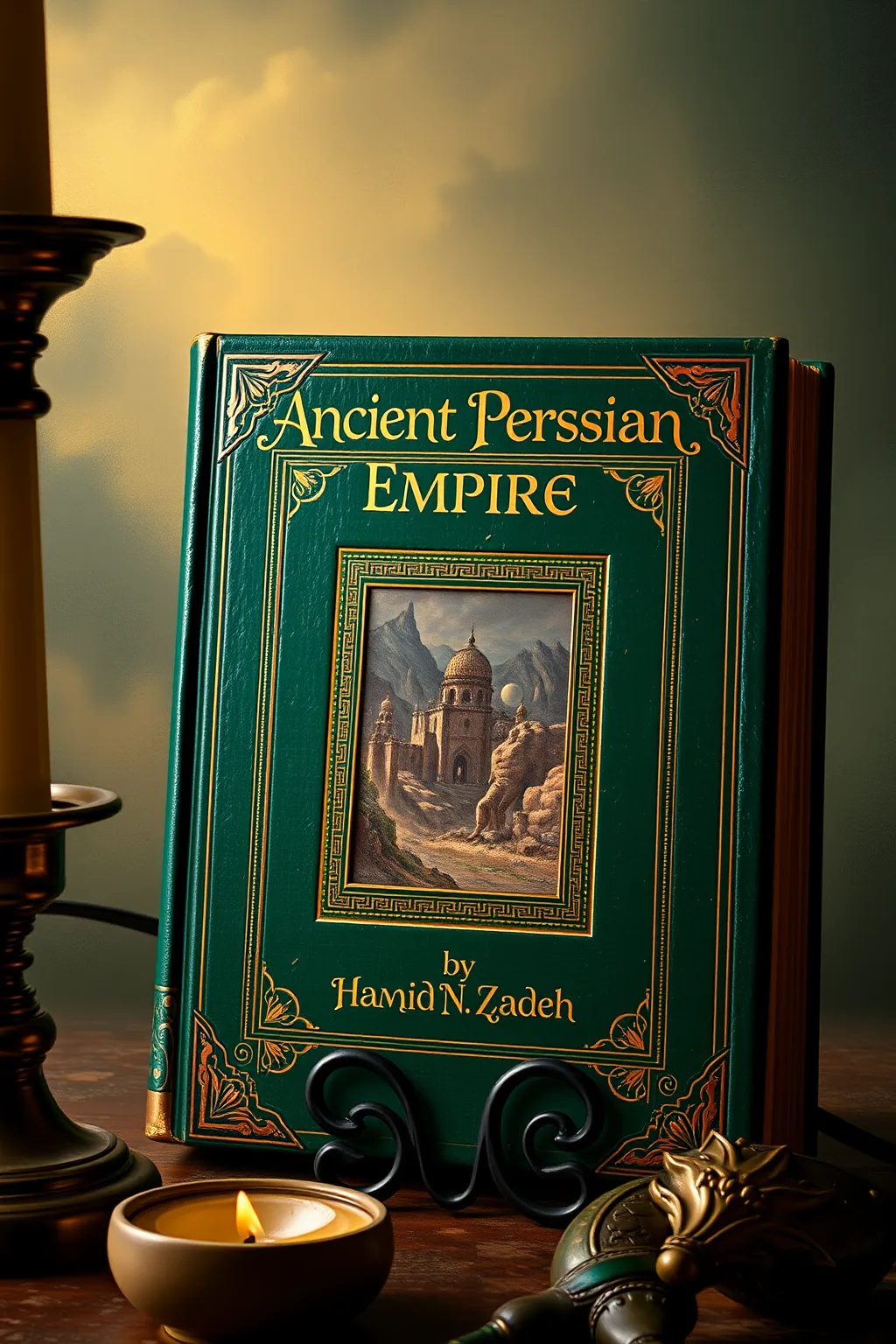
Ancient Persian Empire
 61
61

Ancient Persian Empire



Ophelia Vance, writing for Mystical Literature Reviewer, declares Hamid N. Zadeh's 'Ancient Persian Empire' a seminal work for esoteric studies. This book masterfully deciphers the spiritual architecture and divinatory arts of Persia, moving beyond mere historical facts to reveal the kingdom's deep connection to cosmic principles. Vance highlights the author's skill in illuminating the symbolic language embedded within ancient art and artifacts, making accessible profound philosophical insights. It is an essential read for those seeking to understand the foundational esoteric traditions that influenced later occult practices and for scholars of ancient wisdom looking for a comprehensive, spiritually resonant perspective on this pivotal civilization. A truly illuminating experience.
📝 Description
61
Hamid N. Zadeh's 2023 book examines the Persian Empire's esoteric dimensions.
Hamid N. Zadeh's "Ancient Persian Empire" moves beyond standard historical narratives to investigate the civilization's mystical and cosmic beliefs. The author draws on obscure artifacts and visual materials to detail how concepts like sacred geometry and celestial alignments influenced Persian art, architecture, and divination. This work suggests that the Persians viewed the cosmos as an active force shaping human fate.
The book aims to reveal the esoteric foundations of this ancient culture. It presents the empire's worldview as one where the universe was understood as a divine design, with symbols carrying cosmic weight. Zadeh connects these ideas to the perceived place of humanity within this cosmic order, offering insights into spiritual understanding and hidden knowledge.
This book situates itself within esoteric studies by focusing on the hidden spiritual and cosmological frameworks that informed the ancient Persian Empire. It contrasts with purely historical accounts by emphasizing the symbolic language and perceived divine order that underpinned their civilization. The work explores how concepts like celestial influence and sacred geometry were not just decorative elements but integral to their understanding of reality and destiny, aligning with traditions that seek meaning beyond the empirical.
💡 Why Read This Book?
Uncover the mystical heart of a lost empire. 'Ancient Persian Empire' by Hamid N. Zadeh offers a unique lens into the esoteric philosophies, divination techniques, and symbolic language that governed Persian life and cosmology. Ideal for seekers of hidden knowledge, students of ancient art and architecture, and practitioners interested in the roots of Western esotericism, this book is a profound exploration of how the ancients perceived and interacted with the divine order.
⭐ Reader Reviews
Honest opinions from readers who have explored this book.
❓ Frequently Asked Questions
What esoteric traditions are explored in this book?
The book delves into elements of Zoroastrianism, ancient Persian astrology, numerology, and the rich tapestry of symbolic meanings embedded in their art, architecture, and ritualistic practices, revealing a holistic worldview.
Is 'Ancient Persian Empire' suitable for beginners in esoteric studies?
Yes, while rich in depth, the book is presented accessibly, making it suitable for both seasoned researchers and those new to esoteric concepts, offering a foundational understanding of Persian mysticism.
What kind of visual content can I expect?
Expect stunning reproductions of ancient art, architectural diagrams, and illustrative specimens, presented in a way that highlights their symbolic and esoteric significance, enriching the reader's understanding.
How does this book connect to divination and tarot?
The book explores ancient Persian methods of foretelling and understanding destiny, laying the groundwork for understanding the symbolic language and archetypes that later influenced divination systems, including Tarot.
Can this book be considered a primary source for historical research?
While drawing heavily on primary sources and artifacts, 'Ancient Persian Empire' offers an interpretive and esoteric perspective, making it an invaluable companion to scholarly historical research.
🔮 Key Themes & Symbolism
Cosmic Harmony and Imperial Order
This theme explores the profound belief within the ancient Persian Empire that earthly dominion was intrinsically linked to celestial order. It examines how astronomical observations, astrological calculations, and the perceived will of the divine were interwoven into the fabric of governance, law, and the very conception of imperial power. The book reveals how the architecture, art, and societal structures were designed to reflect and resonate with cosmic symmetries, creating a tangible manifestation of divine will on Earth and fostering a sense of universal interconnectedness.
The Esoteric Language of Art and Architecture
Look at the hidden meanings embedded within the visual culture of the ancient Persian Empire. This theme deciphers the symbolic language of their magnificent palaces, intricate reliefs, and exquisite artifacts, revealing them not merely as aesthetic achievements but as conduits of spiritual knowledge and power. Discover how geometric patterns, animal motifs, and celestial imagery were employed to encode mystical concepts, communicate spiritual truths, and serve as focal points for meditation and ritual, acting as tangible expressions of the invisible realms.
Divination and the Unveiling of Destiny
Uncover the sophisticated systems of divination and prophecy that were integral to ancient Persian society. This theme investigates the methods used to interpret celestial signs, examine natural phenomena, and consult oracles to understand the unfolding of destiny and the will of the gods. It sheds light on how these practices shaped individual lives, guided state decisions, and fostered a deep understanding of the cyclical nature of time and the interconnectedness of all events within a divinely orchestrated cosmos.
💬 Memorable Quotes
Direct passages from the work, attributed to the author.
“In the symmetry of stone, we find the echo of the cosmos.”
— Highlights the architectural philosophy where the physical structures were designed to mirror universal order, serving as tangible representations of cosmic harmony.
“Every symbol is a key, unlocking the doors of perception.”
— Underscores the profound importance of iconography and symbolism in Persian culture as a means to access deeper spiritual understanding and hidden truths.
“The past is a shadow, the future a dream, but the cosmic present is eternal.”
— Reflects a philosophical stance on time, emphasizing the importance of living in and understanding the present moment within the context of an eternal, ordered universe.
“Wisdom is not found, but revealed through disciplined observation.”
— Points to the empirical and meditative approach to acquiring knowledge, suggesting that true understanding comes from careful study of both the external world and internal states.
💡 Key Ideas
Editorial paraphrase of the work's core concepts — not direct quotes.
The stars are but whispers of the divine decree.
This quote emphasizes the ancient Persian belief that celestial movements were not random but direct communications from the divine, guiding and shaping earthly events.
🌙 Esoteric Significance
Tradition
The primary esoteric tradition explored is rooted in Zoroastrianism, with its emphasis on cosmic dualism, light versus darkness, and the ultimate triumph of good. This is interwoven with ancient Persian astrology, a sophisticated system for understanding divine will and human destiny through celestial observation, and a deep reverence for symbolic language found in art and nature, reflecting a holistic, interconnected worldview where the material and spiritual realms are inseparable.
Symbolism
Key symbols include the Faravahar (winged disc representing divine protection and royal glory), the fire altar (representing purity and divine presence), and celestial bodies (sun, moon, stars) which were seen as divine entities and indicators of cosmic cycles. Geometric patterns in architecture and art represented universal order, while animal motifs often carried specific spiritual or protective meanings, all contributing to a collection of hidden knowledge.
Modern Relevance
The ancient Persian understanding of cosmic order, the interconnectedness of all things, and the power of symbolic communication offers useful insights for contemporary seekers. Its emphasis on the balance of opposing forces, the pursuit of spiritual purity, and the belief in an underlying divine plan resonate with modern psychological and philosophical inquiries into consciousness, meaning, and our place in the universe. The exploration of their divination practices can also inspire new perspectives on intuition and personal guidance.
👥 Who Should Read This Book
This book is a treasure for seekers of ancient wisdom and esoteric knowledge, offering a gateway into the mystical heart of the Persian Empire. Scholars of ancient history, art, and religion will find a rich, interpretative perspective that complements traditional studies. Practitioners of divination, tarot enthusiasts, and those interested in comparative mysticism will discover foundational concepts and symbolic languages that underpin many later esoteric traditions. For anyone drawn to the profound spiritual underpinnings of civilizations that shaped our world, 'Ancient Persian Empire' provides an clear and deeply resonant journey.
📜 Historical Context
The ancient Persian Empire, particularly the Achaemenid, Parthian, and Sasanian periods, represents a civilization at the crossroads of East and West, a crucible of diverse cultures and profound spiritual thought. This era, spanning from the 6th century BCE to the 7th century CE, witnessed the rise of Zoroastrianism, a dualistic religion that profoundly influenced its worldview, emphasizing the eternal struggle between good and evil and the importance of cosmic order. The empire's vastness facilitated the exchange of ideas, absorbing influences from Mesopotamia, Greece, India, and Central Asia. This intellectual ferment fostered sophisticated advancements in astronomy, mathematics, and philosophy, laying the groundwork for esoteric traditions that sought to understand and align with the divine forces believed to govern the universe. Their monumental architecture, intricate art, and complex administrative systems all bore the imprint of this unique spiritual and intellectual landscape, creating a rich legacy that continues to fascinate and inspire.
📔 Journal Prompts
Reflect on a time you felt a connection to a larger cosmic order. How did this experience influence your actions or perceptions?
Choose one symbol from ancient Persian art discussed in the book. How might this symbol relate to a personal challenge or aspiration you are currently facing?
Imagine you are an ancient Persian diviner. What celestial alignment would you seek to interpret for a pressing question about societal well-being?
How can the concept of cosmic harmony, as understood by the Persians, inform your approach to creating balance in your own life and environment?
Consider the interplay of light and shadow in your own life. How does this duality, reminiscent of Zoroastrian thought, shape your choices and understanding of the world?
🗂️ Glossary
Faravahar
A significant symbol of ancient Persia, often depicted as a winged disc with a human figure, representing divine protection, wisdom, and the connection between the spiritual and earthly realms.
Zoroastrianism
An ancient Persian religion and one of the world's oldest continuously practiced monotheistic faiths, emphasizing a dualistic cosmology of good versus evil and the importance of ethical conduct.
Avesta
The collection of sacred texts of Zoroastrianism, containing hymns, prayers, and rituals, considered fundamental to understanding the religion's philosophical and esoteric tenets.
Gathas
The oldest and most sacred hymns within the Avesta, attributed to the prophet Zoroaster himself, offering profound spiritual and ethical teachings.
Cosmic Dualism
A philosophical concept, central to Zoroastrianism, that posits the universe is a battlefield between opposing forces, typically light and darkness, good and evil, which are in constant struggle.
This book appears in 4 collections
🔮 Readers Also Liked
Browse all →







More by Hamid N. Zadeh
All books →From the “Geomancy” Collection
View all →






More Free Divination & Tarot Books
View all →