Ymir
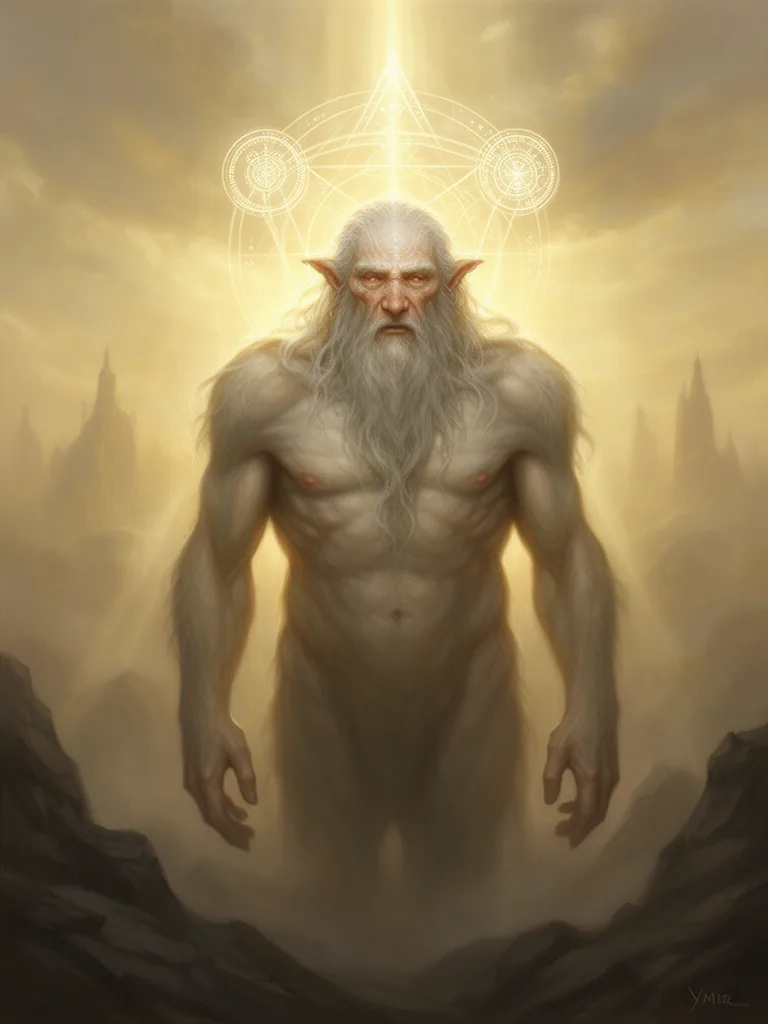
Ymir is the primordial giant in Norse cosmology whose body was used to create the world. His death by the gods represents the ordering of chaotic, primal matter into a structured cosmos, illustrating the emergence of form from undifferentiated potential.
Where the word comes from
The name Ymir is Old Norse. Its precise etymology is debated, but it is generally understood to be related to the Proto-Germanic word ajimr, meaning "to roar" or "to scream," suggesting a being of immense, chaotic power. It first appears in the Poetic Edda and Prose Edda, foundational texts of Norse mythology.
In depth
The i)ersonified matter of our globe in a seething condition. The co.smie monster in the form of a giant, who is killed in the cosmogonical allegories of the Eeldas by the three creators, the sons of Bor, Odin, Wili and We, who are said to have conquered Ymir and ereated the world out of his body. This allegory shows the three principal forces of naturt — separation, fornuition and growth (or evolution) — conquering the unruly, raging "giant" matter, and forcing it to become a world, or an inhabited globe. It is curious that an ancient, primitive and uncultured pagan people, so philosophical and scientifically correct in their views about the origin and formation of the earth, .should, in order to be regarded as civilized, have to accept the dognui that the world was created out of nothing!
How different paths see it
What it means today
The figure of Ymir, the cosmic giant from Norse mythology, presents a potent and visceral image for the genesis of existence. Blavatsky's definition rightly points to him as "personified matter," a seething, unruly force that must be tamed and shaped. This isn't a gentle, benevolent shaping, but a violent dismemberment, as described in the Eddas. Odin, Vili, and Vé, the sons of Bor, conquer Ymir and fashion the world from his cadaver: his flesh becomes the earth, his blood the seas, his bones the mountains, his skull the sky. This stark imagery, reminiscent of the Purusha Sukta in Hindu tradition where the cosmic man Purusha is sacrificed to create the universe, speaks to a fundamental understanding of creation as a process of transformation through destruction.
Mircea Eliade, in his extensive work on myth and ritual, would likely see Ymir as an archetype of the primordial chaos that precedes all ordered existence. The act of killing Ymir is not merely a violent episode but a cosmogonic ritual, establishing the boundaries and structures of the world by imposing form upon the formless. It is the necessary sacrifice that enables being to emerge from non-being, or more accurately, from a state of undifferentiated potential. For the modern seeker, Ymir's story is a powerful reminder that the ordered world we inhabit, our very sense of self and reality, is built upon the remnants of a wilder, more elemental power. It invites contemplation on the often-unacknowledged substratum of chaos that underlies all apparent stability, and the inherent tension between the desire for form and the primal urge of formlessness.
Carl Jung might interpret Ymir as a manifestation of the primordial shadow, the untamed, instinctual aspect of the psyche that must be integrated or at least acknowledged for psychic wholeness. The gods' victory over Ymir is not an annihilation but a sublimation, a channeling of raw energy into creative potential. This myth, therefore, offers a powerful metaphor for the human condition: the ongoing struggle to impose meaning and structure upon the often-overwhelming forces of our own inner and outer worlds. It suggests that creation, whether cosmic or personal, is an act of profound, even violent, differentiation.
RELATED_TERMS: Purusha, Chaos, Primordial Matter, Cosmogony, Archetype, Sacrifice, Differentiation
Related esoteric terms
Books on this concept



No reflections yet. Be the first.
Share your interpretation, experience, or question.
