Vayu
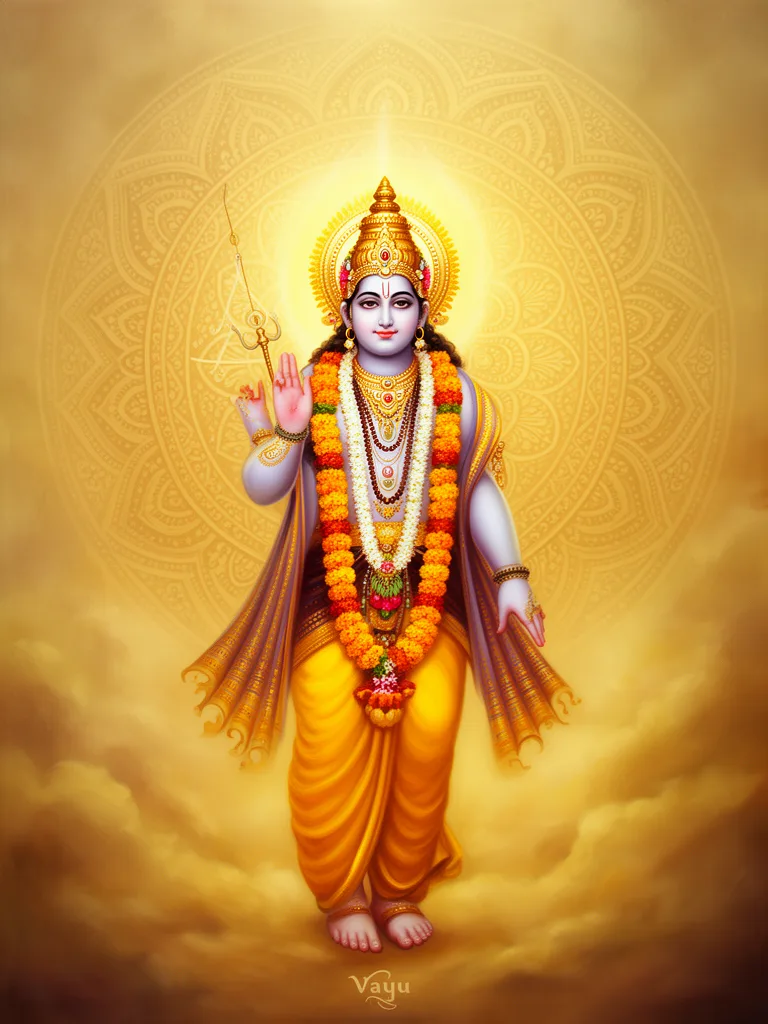
Vayu is the Sanskrit word for air or wind, considered one of the five fundamental elements (Pancha Mahabhutas) in Hindu philosophy. It represents the principle of motion and breath, governing both cosmic atmospheric phenomena and the vital life force (prana) within living beings.
Where the word comes from
Vayu originates from the Sanskrit root vā, meaning "to blow" or "to move." The term first appears in ancient Vedic texts, notably the Rigveda, where Vayu is personified as a powerful deity. It is cognate with the Avestan vayu, indicating an ancient Indo-Iranian linguistic connection.
In depth
Air: the god and sovereign of the air; one of the five states of matter, namely the ffas( ous; one of the five elements, called, as wind, Vdta. The Vishnu rurdna makes Vayu King of the Gandharvas. He is the father of Ilanuman, in the lidrndyoixi. TIh' trinity of the mystic j;od.s in Kusmos eloseh' related to each otlu-r, are "Agiii (fire) whose place is on earth ; Vavu (air, or one of the forms of Indra), whose place is in the air; and Surya (the sun) whose place is in the air". (Nirukta.) In esoteric interpretation, these three cosmic principles, correspond witli tlie three ImiiKin principles, Kama, Kama-Manas and ]\ranas, tlie sun of the intellect.
How different paths see it
What it means today
The term Vayu, meaning air or wind in Sanskrit, transcends its literal meteorological interpretation to become a profound philosophical and spiritual concept within Hinduism. Mircea Eliade, in his exploration of sacred time and space, often highlighted how elemental forces in ancient cultures were not merely observed phenomena but potent divine agents. Vayu, as the god of the atmosphere, embodies this dynamic principle of movement, breath, and life itself. He is the unseen force that fills the lungs, the gust that rustles leaves, and the cosmic wind that shapes the heavens.
Blavatsky's definition points to a crucial esoteric understanding: Vayu is not just an external element but also an internal one, intimately linked to prana, the vital life force. This connection is central to yogic practices, where the regulation of breath (pranayama) is a direct means of influencing Vayu, and by extension, the mind and consciousness. Carl Jung's concept of the anima mundi, or world soul, finds a resonance here, as Vayu represents a fundamental, animating principle pervading all existence, connecting the physical and the subtle.
The association of Vayu with the Gandharvas, celestial musicians, and his fatherhood of Hanuman, the devoted and powerful monkey god, further enriches his symbolic tapestry. Hanuman's ability to fly, his immense strength, and his unwavering devotion all speak to the power and purity of the Vayu principle when rightly harnessed. In the grand cosmic play, Vayu is the breath of the universe, the unseen current that carries existence forward. To contemplate Vayu is to acknowledge the profound significance of the invisible forces that govern our lives, both within and without, urging us to perceive the sacred in the very act of breathing.
RELATED_TERMS: Prana, Pancha Mahabhutas, Air, Wind, Breath, Life Force, Vital Energy, Agni ---
Related esoteric terms
Books on this concept







No reflections yet. Be the first.
Share your interpretation, experience, or question.
