Thor
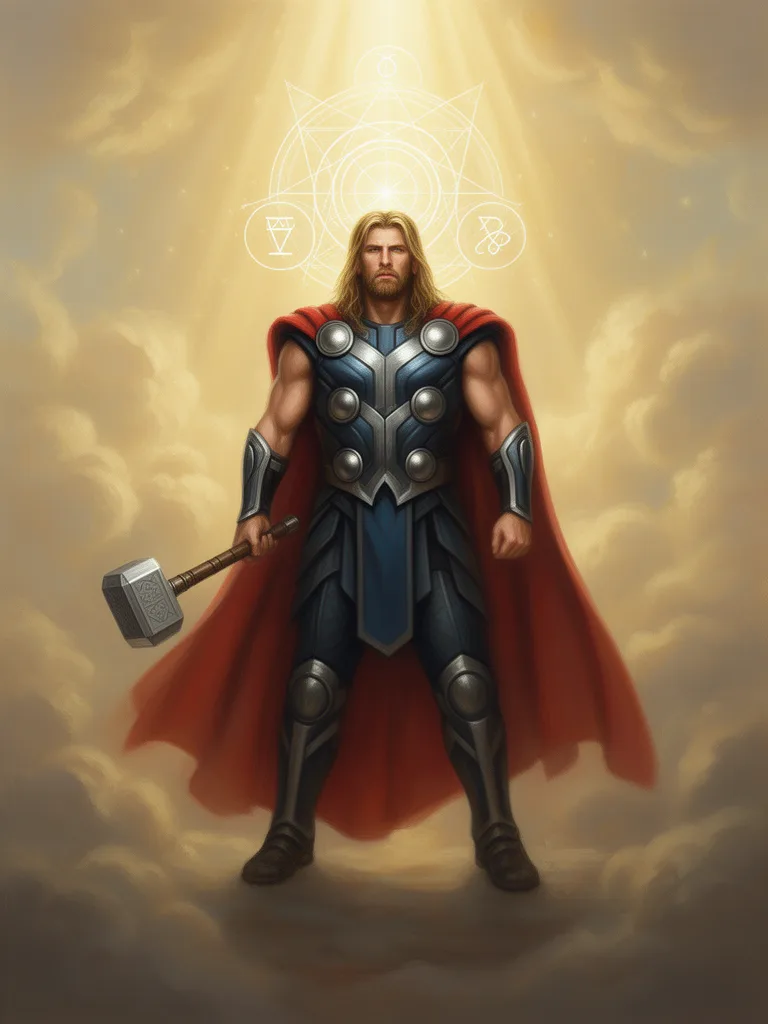
Thor, derived from Germanic roots meaning "thunder," is a prominent deity in Norse mythology, associated with storms, strength, and the protection of humanity. He wields Mjolnir, a powerful hammer, and rides a chariot pulled by goats. His name is linked to the day Thursday.
Where the word comes from
The name "Thor" originates from Old Norse "Þórr," likely derived from Proto-Germanic "*þunraz," meaning "thunder." This root is cognate with words for thunder in other Germanic languages. The term's linguistic lineage clearly points to its association with atmospheric phenomena.
In depth
From Thonar to "thunder". The son of Odin and Freya. and the chief of all Elemental Spirits. The god of thunder, Jupiter Tonans. The word Thursday is named after Thor. Among the Romans Thursday was the day of Jupiter, Jovis dies, Jcudi in French' — the fifth day of the week, sacred also to the i)lanet Jupiter. Thorah fllrh.). "Law", written down from the transposition of the letters of the Hebrew alphabet. Of the "hidden Thorah'' it is said that before At-tee-kah (the "Ancient of all the Ancients") had arran*red Itself into limbs (or members) preparinpr Itself to manifest. It willed to create a Thorali ; the latter upon beinjr produced addressed It in these words: "It, that wishes to arranjre and to appoint other thinprs. should first of all, arranjje Itself in Its proper Forms". In other words, Thorah. the Law, snubbed its Creator from the moment of its birth, according to the above which is an interpolation of some later Talmudist. As it ^rew and developed, the mystic Law of the primitive Kabbalist was transformed and made by the Rabbins to supersede in its dead letter .-Vfry metaphysical conception ; and tluis the Rabbinical and Talmudistic Law makes Ain So])h and every divine Principl<> subservient to itself, and turns its back upon the true esoteric interpretations. Thor's Hammer. A weapon which had the form of the Svastika : called by Euroi)ean Mystics and Masons the "Hermetic Cross", and also "Jaina Cross", croix cramponntc \ the most archaic, as the most sacred and universally respected symbol. (See "Svastika".)
How different paths see it
What it means today
The figure of Thor, the thunder god of Norse lore, offers a potent archetype for understanding humanity's relationship with the sublime and the chaotic. His name, echoing the very sound of thunder, connects him inextricably to the raw, elemental power of the cosmos. In a world where the forces of nature often felt overwhelming and unpredictable, Thor represented not just the storm's fury, but also its potential for cleansing and renewal, and crucially, a bulwark against the encroaching chaos of giants and monsters. Mircea Eliade, in his seminal works on the history of religions, often explored how ancient peoples sought to comprehend and integrate the divine into the fabric of their daily lives, imbuing natural phenomena with spiritual significance. Thor’s hammer, Mjolnir, is more than a weapon; it is a symbol of consecration and protection, capable of hallowing and defending. This resonates with Jungian archetypes of the warrior and the protector, figures who confront the shadow and defend the light. While Blavatsky's definition attempts a complex etymological and theological link to the Hebrew "Thorah," the core essence of Thor remains rooted in the Germanic pantheon's portrayal of a god who embodies strength, courage, and the defense of the human realm against existential threats, a figure whose thunderous pronouncements echo the awe and respect inspired by the heavens themselves. His enduring presence in popular culture speaks to a persistent human need for symbols of power and resilience in the face of life's tempests.
The very act of naming a day of the week after him, "Thursday," a practice shared by other cultures with their own thunder deities, highlights the deep-seated human impulse to align temporal cycles with divine forces, seeking order and meaning in the passage of time.
RELATED_TERMS: Indra, Jupiter, Mjolnir, Thunder, Archetypes, Chaos, Order, Divine Power
Related esoteric terms
Books on this concept




No reflections yet. Be the first.
Share your interpretation, experience, or question.
