Space
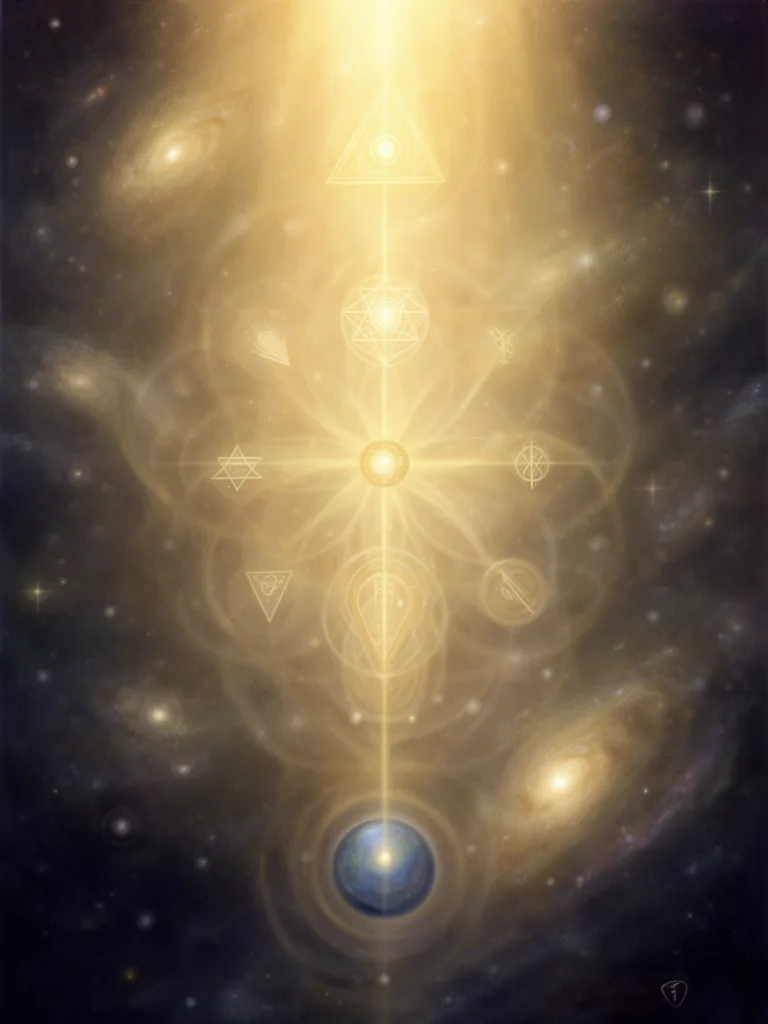
Space, in its most fundamental esoteric sense, refers to the boundless, undifferentiated substratum of existence from which all phenomena arise and into which they dissolve. It is the primordial canvas, the silent ground of being, often conceived as both the container and the contained.
Where the word comes from
The concept of "space" as an esoteric principle predates specific linguistic origins, arising from universal human experience. Philosophically, it is linked to the Greek topos (place) and chora (receptacle), and in Sanskrit, akasha (ether, space). These terms denote a fundamental dimension of reality.
In depth
Nargal (Chald.). The Chaldean and Assyrian chiefs of the Magi (Rah Mag).
How different paths see it
What it means today
The term "Space" as an esoteric concept is a profound recalibration of our everyday perception. We tend to view space as the passive, empty stage upon which physical events unfold. However, in traditions as diverse as Hermeticism and Buddhism, space is imbued with an active, generative quality. It is not merely the absence of matter, but the primordial substance, the Akasha of the Hindus, the chora of Plato, or the boundless potentiality of shunyata.
Mircea Eliade, in his studies of sacred space, highlights how certain locations become imbued with a cosmic significance, acting as "hic et nunc," here and now, a point where the earthly and divine intersect. This suggests that space itself can be a conduit, a sacred geography that mirrors the infinite. For the Sufi mystic, the annihilation of the ego, the fana, opens a spiritual space within the heart, a boundless expanse where the Divine Presence can be apprehended. This is not a physical void but a qualitative emptiness, a receptivity that allows for direct experience of the ineffable.
Carl Jung's concept of the collective unconscious, a vast, archetypal reservoir of human experience, can also be seen as a form of psychic space, a dimension that transcends individual consciousness and connects us to a universal heritage. In this sense, space becomes a metaphor for the infinite potential of the human psyche, a realm of symbols and archetypes that shape our reality. The Kabbalistic concept of Ayin, the divine nothingness, further emphasizes this idea of a primordial space that is not a mere void but the fertile ground from which all creation springs, a divine emptiness that is the ultimate source.
The esoteric understanding of space invites us to consider the universe not as a collection of discrete objects in a void, but as a unified field, a boundless awareness that is both the container and the contained. It challenges us to perceive the sacred in the seemingly mundane, to recognize the infinite within the finite, and to understand that our own consciousness is a reflection of this primordial, generative space. This perspective encourages a shift from a spatial awareness of separation to a profound sense of interconnectedness and presence.
Related esoteric terms
Books on this concept







No reflections yet. Be the first.
Share your interpretation, experience, or question.
