Seb
Seb is the ancient Egyptian primordial deity of the Earth, often depicted as a male figure with a goose or swan on his head, symbolizing the cosmic egg of creation. Esoterically, he represents the singular principle preceding existence, akin to the ultimate divine essence before manifestation.
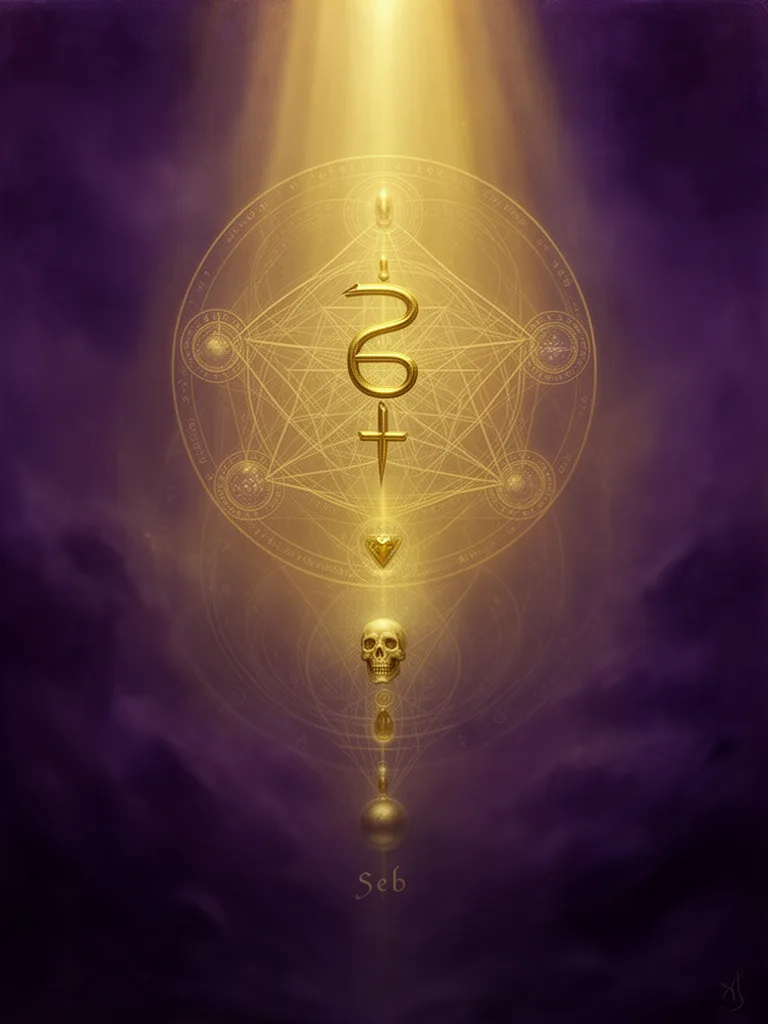
Where the word comes from
The name "Seb" (or Keb) originates from ancient Egyptian, likely meaning "earth" or "ground." Its earliest known appearances date to the Second Dynasty (circa 2890–2686 BCE). The symbol of the goose, associated with Seb, is thought to represent the primordial sound or cosmic egg from which all existence hatched.
In depth
The Egyptian Saturn; the father of Osiris and Isis. E-soterically, tlie sole principle before creation, nearer in meaning to Parabrahm than Brahma. From as early as the second Dynasty, there were records of him, and statues of Seb are to be seen in the museums represented with the goose or black swan that laid the egg of the world on his head. Nout or Neith, the "Great Mother" and yet the "Immaculate Virgin", is Seb's wife; she is the oldest goddess on record, and is to be found on monuments of the first dynasty, to which ^lariette Bey assigns the date of almost 7000 years n.C. Secret Doctrine. The general name given to the esoteric teachings (•f anti(]uity. Sedecla (H(b.). The Obeali woman of Endor. Seer. One who is a clairvoyant; who can see things visible, and invisible — for others — at any distance and time witli his spiritual or inner sight or perceptions. Seir Anpin, or Zauir Anpin (Hcb.). In the Kabbalah, "the Son of the eoiK'caled Father", he who unites in himself all the Sephirotli. Adam Kadmon, or the first manifested "Heavenly Man", the Logos.
How different paths see it
What it means today
The figure of Seb, the ancient Egyptian god of the Earth, offers a profound meditation for the modern seeker on the nature of foundations. Often visualized with a goose or swan upon his head, from which the cosmic egg hatches, Seb is not merely a passive ground but an active, generative force. Mircea Eliade, in his seminal works on myth and religion, often highlighted how primal deities embody the totality of existence at its inception, and Seb is a prime example. He is the fertile soil, the silent witness to the unfolding drama of creation, yet also the very cradle of that unfolding.
This imagery challenges our modern tendency to view the material world as separate from or lesser than the spiritual. Seb reminds us that the earth, the tangible realm, is intrinsically linked to the divine spark, to the cosmic egg from which all possibilities emerge. It is a concept that finds echoes in various traditions. In Hinduism, the Hiranyagarbha, the golden egg, represents the primordial cosmic being and the source of all creation, a generative principle that mirrors Seb's symbolism. For the Hermeticist, Seb embodies the solidified principle of the divine, the manifest aspect of the One, a grounding force that allows for the expression of higher realities.
The esoteric interpretation of Seb as the "sole principle before creation" places him in proximity to concepts like the Kabbalistic Ain Soph, the boundless, unmanifest divine. Yet, unlike the abstract infinity, Seb is visualized, grounded, and associated with the very substance of our reality. This makes him a particularly potent symbol for contemplation. He is not an unattainable distant God but the divine immanent in the very ground beneath our feet. This connection between the immanent and the transcendent, between the material and the spiritual, is a perennial quest for those seeking deeper understanding. Seb's presence, therefore, invites us to see the sacred not only in the heavens but also in the earth, in the very act of being present and grounded. He teaches that the deepest truths may be found not by escaping the material world, but by understanding its divine genesis and its inherent potential for perpetual renewal.
Related esoteric terms
Books on this concept








No reflections yet. Be the first.
Share your interpretation, experience, or question.
