Races
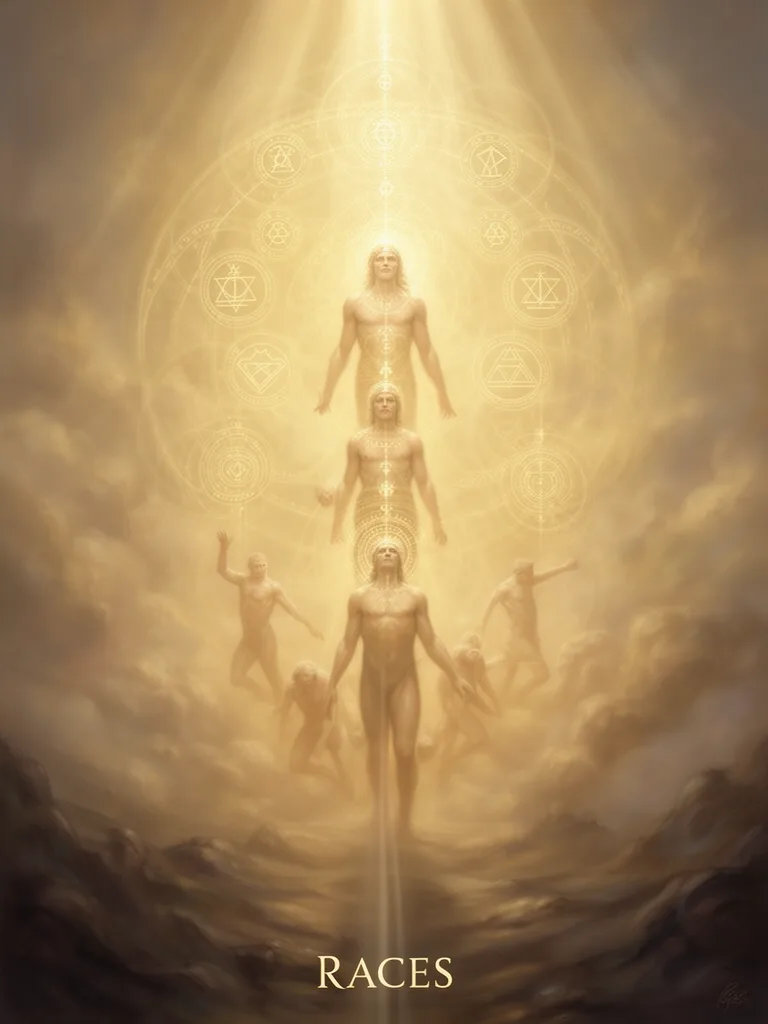
A term used in esoteric traditions, particularly by Helena Blavatsky, referring to distinct stages or evolutionary cycles of humanity, not biological races. These "Root Races" represent fundamental shifts in consciousness and physical form across cosmic epochs.
Where the word comes from
The term "Race" in this context is a metaphorical extension from biological classification. In Blavatsky's Theosophy, "Root Races" are conceptual divisions of humanity's evolutionary journey, stemming from Sanskrit concepts of Manvantaras (cosmic cycles) and Yugas (ages). The idea of distinct human lineages predates Blavatsky, appearing in earlier occult literature.
In depth
Martinists. A Society in France, founded by a great mystic called the :\larquis de St. Martin, disciple of :Martinez Pasqualis. It was first establislied at Lyons as a kind of occult ^Masonic Society, its members believing in the possibility of communicating witii Planetary Spirits and minor Gods and genii of the ultramundane Spheres. Louis Claude de St. Martin, born in 1743, had commenced life as a brilliant officer in the army, but left it to devote himself to study and the belles lettres, • ■nding his career by becoming an ardent Theosophist and a disciple of
How different paths see it
What it means today
Helena Blavatsky’s use of "Races" in her esoteric lexicon, particularly the concept of "Root Races," is a potent, albeit often misunderstood, metaphor for human evolution. It is crucial to distinguish this from the biological and often fraught understanding of race in the modern world. For Blavatsky and her followers, these were not distinct ethnic groups as we understand them today, but rather successive, planetary stages of humanity's development, each characterized by a unique physical form, consciousness, and spiritual capacity. These "Root Races" are akin to geological strata of human existence, laid down over immense cosmic epochs, or Manvantaras.
The First Root Race, for instance, was described as ethereal and sexless, existing in a state of pure spirit. Subsequent races progressively manifested denser physical bodies, developed distinct sexes, and experienced a descent into greater materiality, accompanied by a corresponding dimming of their innate spiritual awareness. This evolutionary arc, from spirit to matter and the eventual spiritual re-ascension, echoes ancient cosmologies and philosophical systems that view existence as cyclical and humanity as a participant in a grand, unfolding drama. Mircea Eliade, in his studies of comparative religion, often highlighted the cyclical nature of time and the human quest for meaning within these vast cosmic frameworks.
The later Root Races, including the Lemurian and Atlantean, are depicted as possessing different physiologies and psychic abilities, and their eventual demise is linked to spiritual or karmic transgressions. The current Fifth Root Race, which Blavatsky believed we inhabit, is characterized by the development of intellect and individuality, but also by a significant degree of forgetfulness regarding our spiritual heritage. The purpose of understanding these "Races" is not to categorize or divide, but to grasp the vast sweep of human potential and the inherent spiritual trajectory of our species, a journey from primal unity through diverse manifestation back to conscious, reintegrated wholeness. This perspective offers a cosmic context for our present existence, inviting us to see ourselves not as isolated beings but as part of an ongoing, magnificent evolutionary process.
Related esoteric terms
Books on this concept







No reflections yet. Be the first.
Share your interpretation, experience, or question.
