Nebo
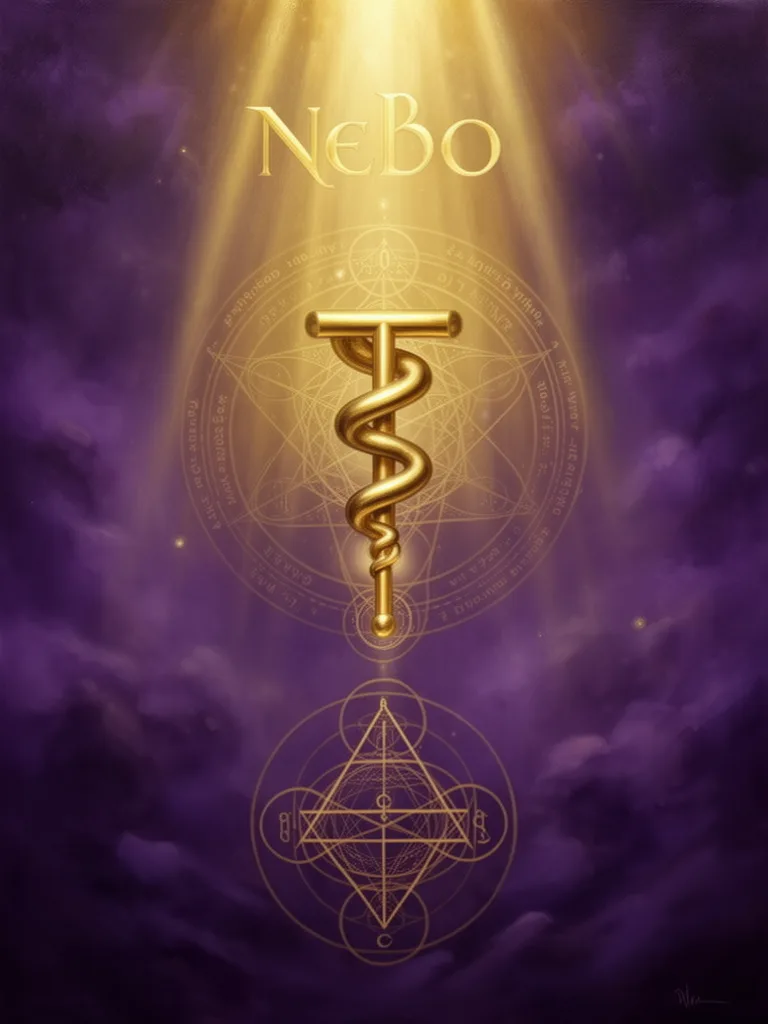
Nebo, also known as Nabu, is the Babylonian god of wisdom, writing, and scribal arts, often associated with the planet Mercury. He is depicted as the divine scribe, recording destinies and imparting knowledge, embodying the power of the written word and intellectual clarity.
Where the word comes from
The name Nebo derives from the Akkadian "Nabû," meaning "to announce" or "to prophesy." It is an ancient Mesopotamian epithet, linked to the god of the planet Mercury, which itself was named for the Roman messenger deity. The term signifies divine pronouncement and the transmission of sacred knowledge.
In depth
The same as the Hindu Budha, son of Soma the :\Iooii, and Mercury the planet. (See "Nabu".)
How different paths see it
What it means today
Nebo, the celestial scribe of Babylonian lore, offers a potent emblem for the modern seeker grappling with the deluge of information and the clamor of opinion. His domain, encompassing wisdom, writing, and the planet Mercury, speaks to a sophisticated understanding of knowledge not as inert data, but as a living, divinely animated force. In the ancient world, the act of writing was imbued with a sacred gravity, a means by which the cosmic order was etched into existence and made legible to humanity. Nebo, as the divine recorder of destinies, reminds us that the written word carries an inherent power, capable of shaping reality and illuminating the hidden currents of fate.
Mircea Eliade, in his explorations of archaic techniques of ecstasy, would likely see in Nebo the archetypal figure of the shaman or seer, one who accesses otherworldly knowledge through disciplined mental faculties, much like the scribe who masters the intricate symbols of language. The association with Mercury, the swift messenger of the gods, further emphasizes the transactional nature of wisdom – it is received, interpreted, and transmitted. For the Hermetic tradition, Nebo is a clear parallel to Hermes Trismegistus, the thrice-great, who bridges the chasm between the material and the spiritual, imparting gnosis through eloquent discourse and inscribed texts. This connection underscores the universal recognition of a divine intelligence that communicates through the very fabric of existence, accessible through the disciplined cultivation of the mind.
The practice of Nebo, therefore, is not merely about accumulating facts, but about engaging in a sacred dialogue with the cosmos. It involves the meticulous cultivation of one's intellect, akin to the painstaking work of a scribe illuminating a manuscript, where each stroke of the pen is a deliberate act of creation and revelation. This process transforms the individual from a passive recipient of knowledge into an active participant in its unfolding, a conduit through which the divine whispers can be heard and transcribed. In a world often characterized by ephemeral digital ephemera, Nebo’s legacy calls for a return to the enduring power of considered thought and the profound resonance of the written word, urging us to record not just what we see, but what we discern of the deeper truths.
Related esoteric terms
Books on this concept



No reflections yet. Be the first.
Share your interpretation, experience, or question.
