Hermes Trismegistus
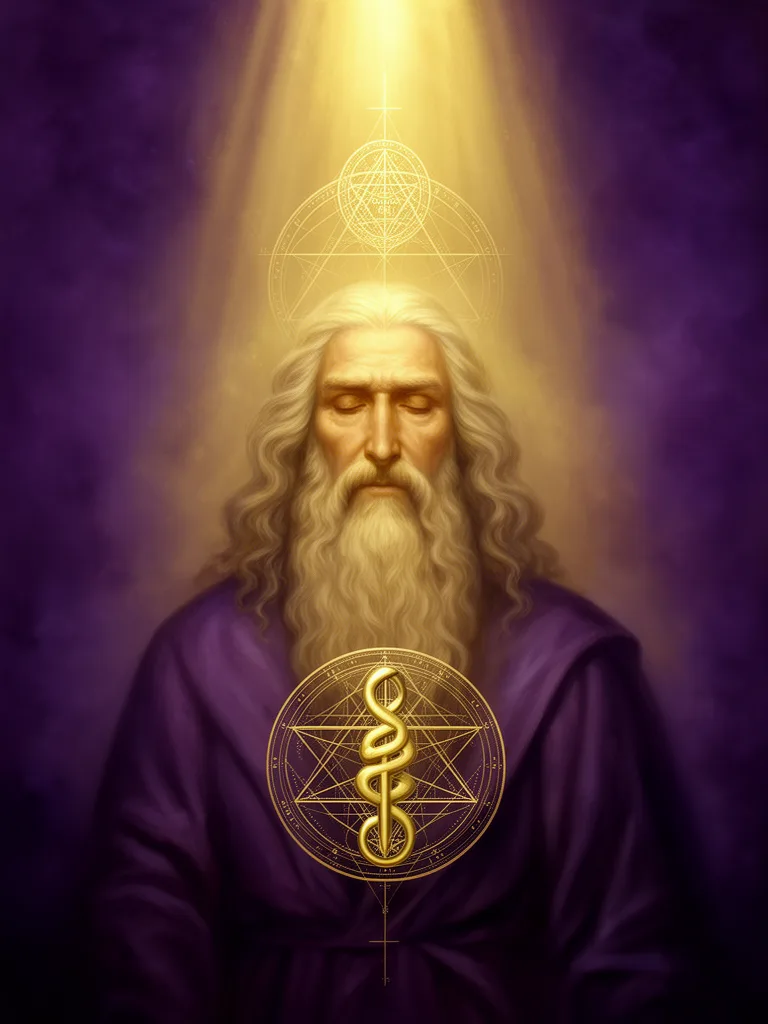
Hermes Trismegistus, "thrice great Hermes," is a legendary syncretic figure embodying ancient Greek and Egyptian wisdom traditions. He is associated with alchemy, astrology, theology, and magic, serving as the purported author of the Hermetic Corpus, a foundational text of Western esotericism.
Where the word comes from
The name is a Greek appellation, meaning "Hermes, thrice great." It derives from the Greek god Hermes, messenger of the gods, and the Egyptian deity Thoth, god of wisdom, writing, and magic. The epithet "Trismegistus" suggests a supreme, triple embodiment of wisdom, possibly appearing in texts from the 2nd or 3rd century CE.
In depth
The "thrice great Hermes", the Kgyptian. Tli<' mythical personage after whom the Hermetic philosophy was named. In Egypt the God Thoth or Thot. A generic name of many ancient Greek writers on philosophy and Alchemy. Hermes Trismegistus is the name of Hermes or Thoth in his human aspect, as a god he is far more than this. .l.sHermes-Thoth-Aah, lie is Thoth. the moon, i.e., his symbol is the bright side of the moon, supposed to contain the essence of creative Wisdom, "the elixir of Hermes". As sucli lie is 130 TJIKi).S()l'JIKAL associated with tinI'ynoci'jilialus. the (lojr-licadi'il inoiikoy. for tlio sann^ reason as was Aiiuhis, one of tlie aspi'fts of Thotli. (See "Ilcnnamibis",) The same idea underlies tlie form of the Hindu God of Wisdom, the elephaut-lieaded Ganesa. or Ganpat, the son of Parvati and Siva. (See "Ganesa".) When lie has the head of an ibis, he is the sacred seribe of the gods; but t'ven then he wears the erown aiff and the luiuir disk. He is the most mysterious of {^ods. As a serpent. Hermes Thoth is the diviiH' ert-ative Wisdom. The Church P^athers sjxmU ;it length of Thoth-Hermes. (See "Hermetic".) Hermetic. Any doctrine or writing i-onneeted with the esoteric teachings of Hermes, who. whether as the Egyptian Thoth or the Gn'ek Hermes, was the God of Wisdom with the Ancients, and, according to Plato, "discovered numbers, geometry, astronomy and letters". Though mostly considered as spurious, nevertheless the Hermetic writings were highly prized by St. Augustine, Lactantius, Cyril and others. In the words of Mr. J. Bonwick, "They are more or less touched up by the Platonie i)hilosophers among the early Christians (such as Origen and Clemens Alexandriiuis) who souglit to substantiate their Christian arguments by ai)peals to these heathen and revered writings, though they could not resist the temptation of making them say a little too much". Though represented by some clever and interested writers as teaching jnire monotheism, the Hermetic or Trisme
How different paths see it
What it means today
The figure of Hermes Trismegistus, "thrice great Hermes," is less a man than a confluence, a legendary sage whose name became synonymous with a vast body of esoteric wisdom that shaped Western thought for centuries. Mircea Eliade, in his studies of shamanism and archaic techniques of ecstasy, recognized such figures as archetypal mediators, bridging the terrestrial and the celestial, the known and the unknowable. Blavatsky's expansive definition hints at this multifaceted nature, connecting him to Thoth, the Egyptian god of wisdom, whose ibis head and lunar associations speak to a profound, cyclical understanding of creation.
This syncretism is key. The Greeks, encountering the sophisticated Egyptian pantheon, found a resonance in Thoth with their own Hermes, the swift messenger, the guide of souls. The epithet "Trismegistus" itself, implying a triple greatness, suggests an ultimate mastery over philosophy, alchemy, and theology, as later elaborated in the Hermetic Corpus. These texts, often presented as dialogues between Hermes and his disciple Tat, or between Hermes and his divine father, Thoth, are not mere philosophical treatises; they are initiatory texts, designed to guide the reader toward a gnosis, a direct apprehension of divine reality.
Carl Jung, in his exploration of the collective unconscious, would find in Hermes Trismegistus a potent archetype of the wise old man, the psychopomp, and the alchemical adept. The alchemical symbolism, so central to the Hermetic tradition, is not just about transmuting base metals; it is a metaphor for the spiritual transformation of the human soul, a process of purification and integration. The "elixir of Hermes" Blavatsky mentions echoes this, pointing toward a spiritual medicine, a restorative wisdom.
The modern seeker might find in Hermes Trismegistus an invitation to reclaim a holistic worldview, one where the rational mind, the intuitive heart, and the embodied experience are not in opposition but in harmony. The Hermetic texts, with their emphasis on "As above, so below," urge a recognition of the interconnectedness of all things, from the celestial spheres to the humblest atom, and crucially, within the human microcosm. This ancient wisdom offers a potent antidote to the fragmentation of modern consciousness, suggesting that true understanding lies in recognizing the divine spark within oneself and in the world. It is a call to remember that the secrets of the universe are not external to be discovered, but internal to be awakened.
RELATED_TERMS: Gnosis, Hermetic Corpus, Alchemy, Astrology, Theurgy, Sophia, Logos, As Above So Below
Related esoteric terms
No reflections yet. Be the first.
Share your interpretation, experience, or question.
