Naga
Nagas are serpentine beings prominent in South Asian mythologies, often associated with water, hidden treasures, and wisdom. In esoteric traditions, they symbolize enlightened beings or adepts possessing profound knowledge and magical abilities, transcending their literal serpentine form.
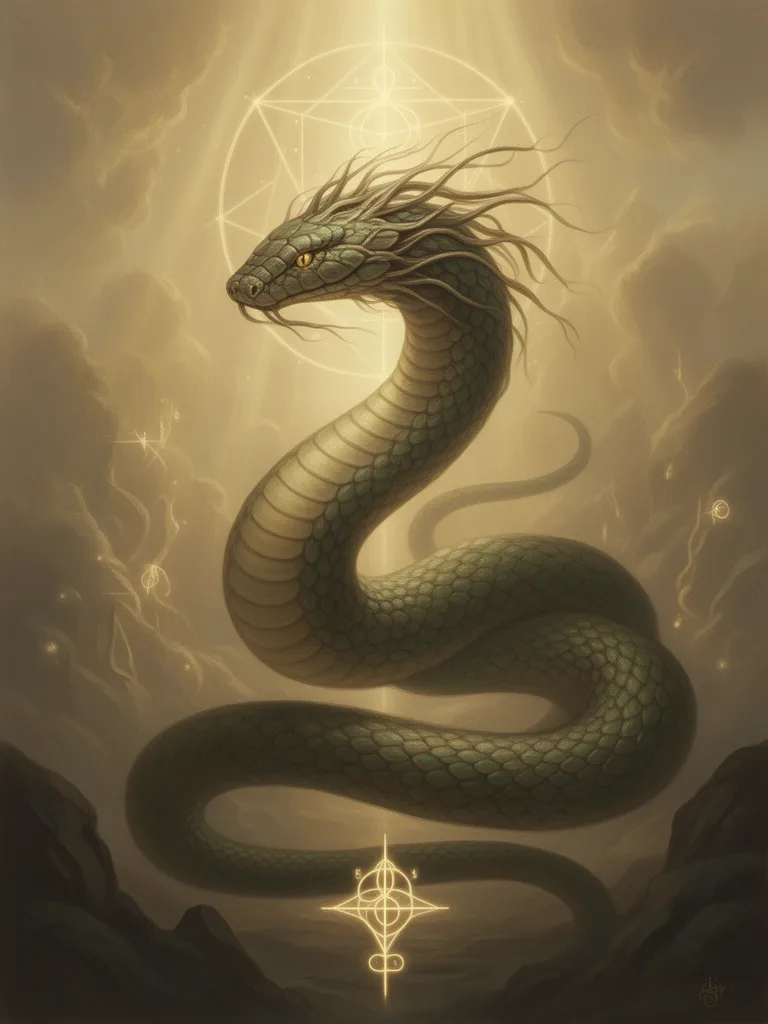
Where the word comes from
The term "Naga" originates from Sanskrit (नाग, nāga), meaning "serpent" or "dragon." It is deeply embedded in Indic languages and cosmologies. While Blavatsky suggests a link to Mexican "Nagals," the primary etymological root is clearly Indic, appearing in ancient Indian texts and spreading through Buddhist and Hindu traditions.
In depth
Literally "Serpent '*. The name in the Indian Pantheon of the Serpent or Drajjon Spirits, and of tiie inhabitants of Patala, hell. But as Patala means the aniipodr.s, and was the name griven to America by the ancients, who knew and visited that continent before Europe had ever heard of it, the terra is probably akin to the Mexican Nagals the (now) sorcerers and medicine men. The Napjas are the Burmese Nats, .serpent-gods, or "dragon demons". In Esotericism. however, and as already stated, this is a niok-name for the "wise men" or adepts. In Cliina and Tibet, the "Dragons" are regarded as the titulary deities of the world and of various spots on the earth, and the word is explained as meaning adepts, yogis, and narjols. The term has simply reference to their great knowledge and wisdom. This is also proven in the ancient Sutras and Buddha's biographies. The Ndga is ever a wise man, endowed with extraoi'dinary magic powers, in South and Central America as in India, in Chaldea as also in ancient Egypt. In China the "worship" of the Nagas was widespread, and it has become still more pronounced since Nagarjuna (the "great Naga", the "great adept" literally), the fourteenth Buddhist patriarch, visited China. The "Nagas" are regarded by the Celestials as "the tutelary Spirits or gods of the five regions or the four points of the compass and the centre, as the guardians of the five lakes and four oceans" (Eitel). This, traced to its origin and translated esoterically, means that the five continents and their five root-races had always been under the guardianship of "terrestrial deities", i.e., Wise Adepts. The tradition that Nagas washed Gautama Buddha at his birth, protected him and guarded the relics of his body when dead, points again to the Nagas being only wise men, Arhats, and no monsters or Dragons. This is also corroborated by the innumerable stories of the conversion of Nagas to Buddhism. The Naga of a lake in a forest near Rajagriha and many other "Dragons" were th
How different paths see it
What it means today
Blavatsky's interpretation of the Naga as a symbolic designation for "wise men" or adepts offers a profound lens through which to view this ancient archetype. Beyond the literal depiction of serpents, often associated with chthonic forces and the underworld, the Naga represents a profound mastery over the hidden currents of existence. Mircea Eliade, in his exploration of shamanism, often highlights the serpent as a symbol of renewal and initiation, a creature intimately connected to the earth's vital energies and the mysteries of rebirth. This resonates deeply with the Naga's role in Indic traditions, where they guard subterranean realms and treasures, suggesting a connection to the unconscious depths of the psyche, as explored by Carl Jung.
The Naga's wisdom is not merely intellectual; it is an embodied knowledge, a primal understanding that flows like water. This connection to water, a universal symbol of emotion, intuition, and the subconscious, further emphasizes the Naga's esoteric significance. In Sufism, for instance, the concept of the "heart" (qalb) as a wellspring of divine knowledge, often described as a luminous pearl or a hidden ocean, echoes this idea of deep, intuitive wisdom. The Naga, therefore, becomes a potent symbol for the individual who has plumbed these depths, who has integrated the primal energies within and emerged with extraordinary insight and power. Their serpentine form, far from being monstrous, becomes a signifier of fluidity, adaptability, and the ability to traverse realms both seen and unseen, a testament to the transformative potential inherent in the pursuit of esoteric knowledge. The Naga invites us to consider the wisdom that lies coiled within, waiting to be awakened.
Related esoteric terms
Books on this concept








No reflections yet. Be the first.
Share your interpretation, experience, or question.
