Mysta
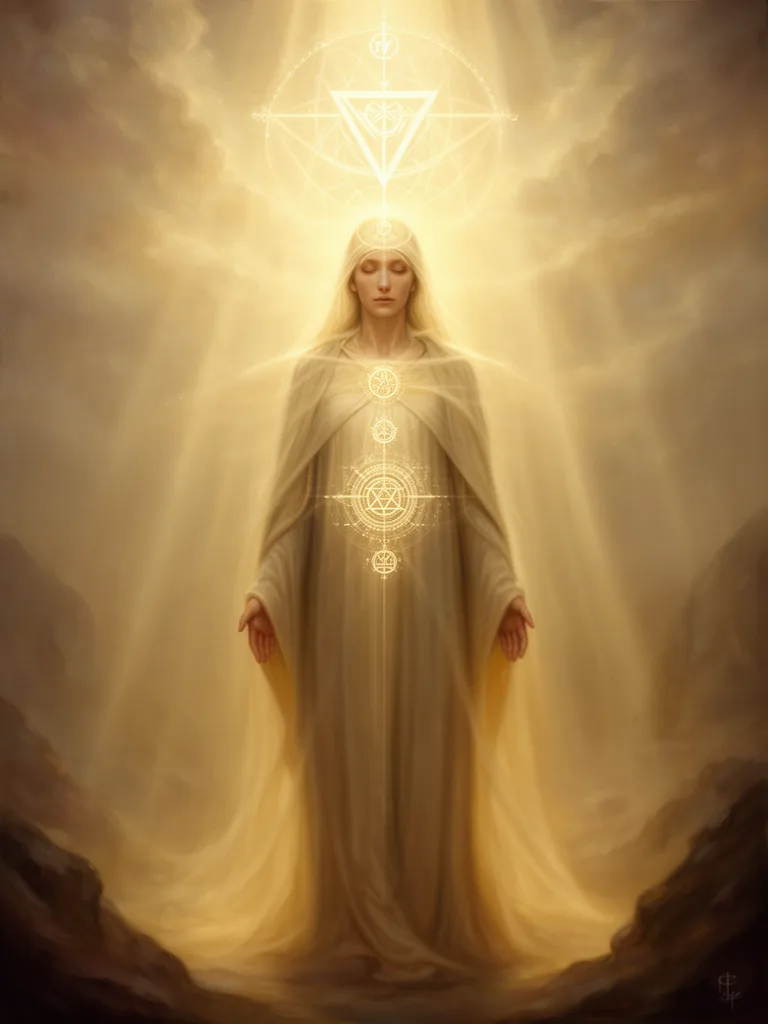
Mysta refers to a practitioner of ancient mystery religions, one initiated into sacred rites and esoteric knowledge. The term implies a profound, often transformative, inner experience gained through ritual and symbolic participation, setting them apart from the uninitiated.
Where the word comes from
The term "Mysta" derives from the ancient Greek word "mystes" (μύστης), meaning "one initiated." It stems from the verb "myzein" (μύειν), which signifies "to initiate" or "to close," possibly referring to the closing of the eyes or lips during the sacred rites. The related term "mysteria" (μυστήρια) denotes the secret rites themselves.
In depth
Mystica Vannus lacchi. Coinnionly translated the iiiy.stic Fun; but in an ancient tei-ra-cotta in tiie British ^Museum the fan is a Basket sucli as the Ancients' Mysteries displayed with mystic contents: Inman says with enil)]ematic testes, [w.w.w.] N. N. — The 14th letter in both the Englisli and the Hebrew alphabets. In the latter tongue the N is called Nun, and signifies a fish. It is the symbol of the female principle or the womb. Its numerical value is 50 in the Kabalistic system, but the Peripatetics made it equivalent to 900, and with a stroke over it (900) 9,000. With the Ilebr^'ws, however, the final Nun was 700.
How different paths see it
What it means today
The word "Mysta," rooted in the ancient Greek "mystes," speaks to a profound human impulse: the desire for initiation, for a deeper apprehension of reality beyond the veil of the ordinary. It conjures images not of dusty scrolls, but of hushed sanctuaries, of whispered incantations under starlit skies, of the solemn, life-altering moment when the profane is set apart from the sacred. Mircea Eliade, in his seminal works on religion, illuminated how these mystery cults of antiquity—the Eleusinian, the Orphic, the Dionysian—offered a potent antidote to the anxieties of existence, promising not merely a better afterlife, but a transformed present life.
To be a Mysta was to undergo a symbolic death and rebirth, a shedding of the old self to embrace a new, divinely informed identity. This was not a passive reception but an active participation, a ritual enactment that resonated with the deepest psychological and spiritual strata of the individual. Carl Jung, in his exploration of archetypes and the collective unconscious, would likely see in the Mysta a figure deeply engaged with the process of individuation, integrating the shadow and the divine into a more complete self. The secrets guarded by the Mysta were not necessarily propositional truths, but experiential ones, knowledge imprinted upon the soul through sensory engagement and symbolic immersion.
The very act of initiation, the "myzein" of closing the eyes or lips, suggests a turning inward, a silencing of the external world to hear the subtler whispers of the divine. This resonates across traditions. In Sufism, the disciple (murid) undergoes a spiritual journey under the guidance of a Shaykh, a path of unveiling (kashf) that mirrors the Mysta's journey. Similarly, the Buddhist concept of enlightenment, often achieved through rigorous practice and guidance, involves a profound shift in perception akin to mystical initiation. The Mysta, then, is a universal archetype of the seeker who dares to cross thresholds, to engage with the numinous, and to emerge forever changed. The pursuit of such profound inner knowing continues to beckon, a timeless call to those who sense there is more to existence than meets the eye.
Related esoteric terms
Books on this concept







No reflections yet. Be the first.
Share your interpretation, experience, or question.
