Mu
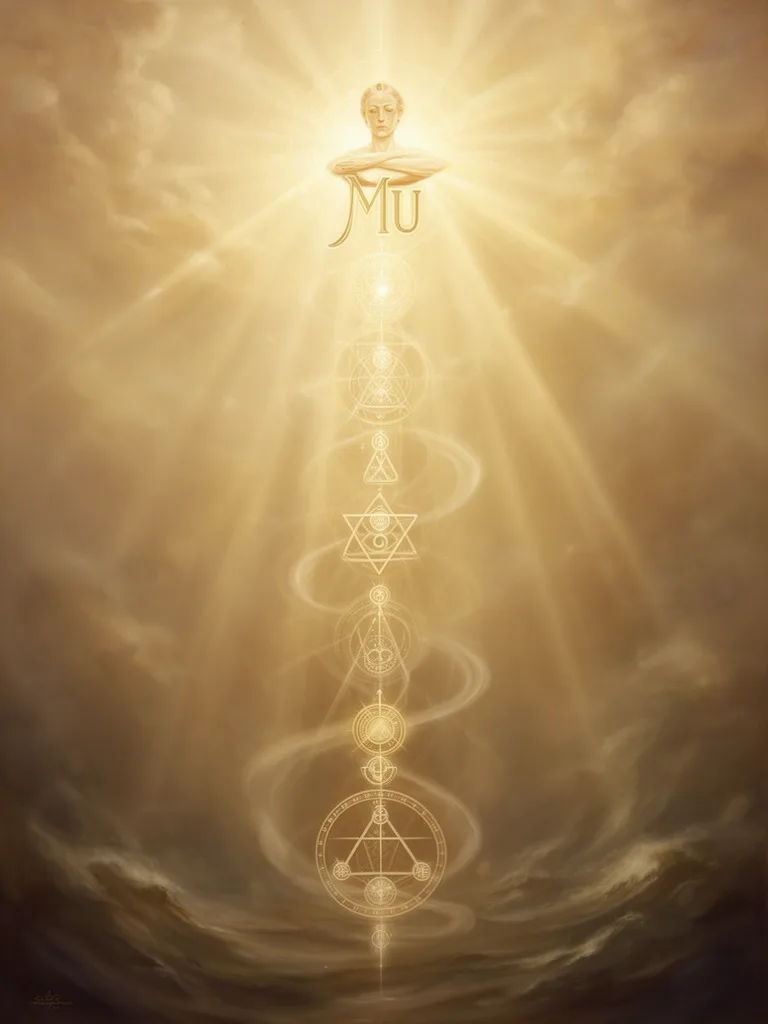
Mu is a concept of profound negation, often translated as "nothingness" or "emptiness," central to Zen Buddhist koans. It represents an ultimate reality beyond conceptualization, a state of pure potentiality that paradoxically contains all things. Its power lies in disrupting linear thought.
Where the word comes from
The term originates from the Chinese character "wu" (無), meaning "not have," "nothing," or "without." It was transliterated into Japanese as "mu" and became widely known through Zen koans. In its philosophical usage, it signifies a state of non-being or non-existence that is not mere absence but a fertile void.
In depth
Tlie mystic word (or rather a portion of it) in Northern Buddhism. It means the "destruction of temptation"' during the course of Yoga practice.
How different paths see it
What it means today
The monosyllabic "Mu" of Zen Buddhism is a koan in itself, a sonic key designed to unlock the mind from the prison of conceptual thought. Helena Blavatsky, in her 1892 definition, points to its role in the "destruction of temptation" during Yoga, a practice that seeks to quiet the incessant chatter of the ego. This "temptation" is, in essence, the mind's habitual reliance on dualistic distinctions: good and bad, being and non-being, self and other. Mu, as translated from the Chinese "wu," signifies a profound "nothingness," but this is not the void of nihilism. It is, as D.T. Suzuki eloquently described, a "non-being" that is the fertile ground from which all being arises, a state of pure potentiality antecedent to all phenomena.
When a Zen master poses the question, "Does a dog have Buddha-nature?" and the response is simply "Mu," the student is not meant to find a logical refutation or affirmation. Instead, the koan demands an experiential understanding that transcends the question's premise. Mircea Eliade, in his studies of shamanism and archaic religions, noted the power of paradoxical utterances and symbolic gestures to induce altered states of consciousness. Mu functions similarly, acting as an intellectual impasse that compels the practitioner to abandon discursive reasoning. It is akin to the alchemical opus, where the dissolution of the prima materia is a necessary precursor to the creation of the philosopher's stone. The practice associated with Mu is not about finding an answer, but about becoming the question, about embodying the radical negation that precedes all affirmation. It is an invitation to experience the unconditioned, the noumenal reality that lies beneath the surface of our everyday perceptions, a state of being that is neither something nor nothing, but an infinite, ungraspable presence. This radical emptiness, when truly embraced, is not an absence but an abundance, a boundless freedom from the constraints of fixed identity and dualistic perception.
RELATED_TERMS: Sunyata, Emptiness, Non-duality, Koan, Enlightenment, Nirvana, Wu Wei, Anatta
Related esoteric terms
No reflections yet. Be the first.
Share your interpretation, experience, or question.
