Cock
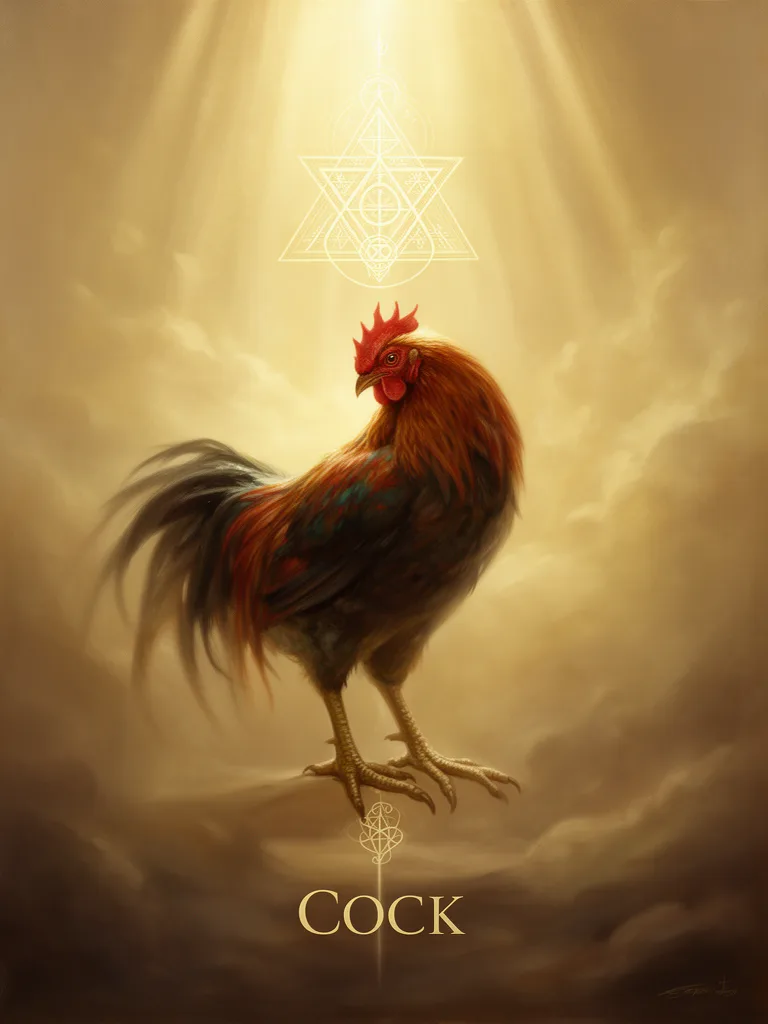
The cock, in esoteric traditions, symbolizes resurrection, vigilance, and the dawn of spiritual awakening. Its crowing signifies the dispelling of darkness and the herald of new beginnings, often linked to solar deities and prophetic warnings.
Where the word comes from
The English word "cock" derives from Old English "cocc." Its Greek name, alektruon, means "unconquered" or "defender," hinting at its vigilant nature. The bird's association with dawn and awakening is ancient and widespread across Indo-European cultures.
In depth
A very occult biivl. much a])pi"cciate(l in aiu-ient augury and symbolism. According to the Zohar, the cock crows three times before the death of a per.son ; and in Russia and all Slavonian countries whenever a person is ill on the premises where a cock is kept, its crowing is held to be a sign of inevitable deatli, unless tlie bird crows at the hour of midnight, or immediately afterwards, when its crowing is considered natural. As the cock was sacred to j!E.sculapius, and as the latter was called tiie Sotcr (Saviour) wiio raised the dead to life, the Socratic exclamation "We owe a cock to -^.sculapius", just before the Sage's death, is very suggestive. As the cock was always connected in symbology with the Sun (or solar gods), Death and Resurrection, it has found its appropriate place in the four Gospels in the prophecy about Peter repu80 THEOSOPHICAL diating his Master before the cock crowed thrice. The cock is the most inajriirtic and sfiisitivc of all birds, hence its Greek name alcctruon.
How different paths see it
What it means today
The humble cock, often overlooked in its barnyard ubiquity, carries a weight of symbolic meaning that resonates through millennia of human consciousness. Mircea Eliade, in his seminal work The Myth of the Eternal Return, highlights the cock's role as a cosmic announcer, its cry marking the renewal of time and the defeat of primordial chaos. This ancient bird, sacred to Asclepius, the healer who bridged life and death, becomes a potent emblem of resurrection. Its connection to the sun, that celestial engine of renewal, further amplifies its significance. The cock's crow is not just a sound; it is a command, a summons to consciousness.
In the esoteric traditions, this summons is profoundly spiritual. For the Hermeticist, it is the awakening of the intellect, the nous, to the divine light, cutting through the mists of ignorance. In Sufism, while less direct, the concept of fajr, the dawn prayer, carries a similar resonance of spiritual vigilance and the dispelling of the night of heedlessness. For the Christian mystic, the cock's crow is a stark, yet ultimately redemptive, reminder of human frailty and the ever-present possibility of repentance and renewed faith, as seen in the Gospel narrative of Peter. The very etymology of its Greek name, alektruon, meaning "unconquered," speaks to an inherent resilience, a refusal to succumb to darkness. It is the sentinel bird, standing guard against the encroaching shadows, its voice a herald of the inevitable dawn, not just of day, but of spiritual illumination. The cock, therefore, is more than an animal; it is a living metaphor for the soul's perennial struggle and triumph over the forces that seek to keep it asleep. It calls us, even now, to listen for the dawn within.
Related esoteric terms
Books on this concept








No reflections yet. Be the first.
Share your interpretation, experience, or question.
