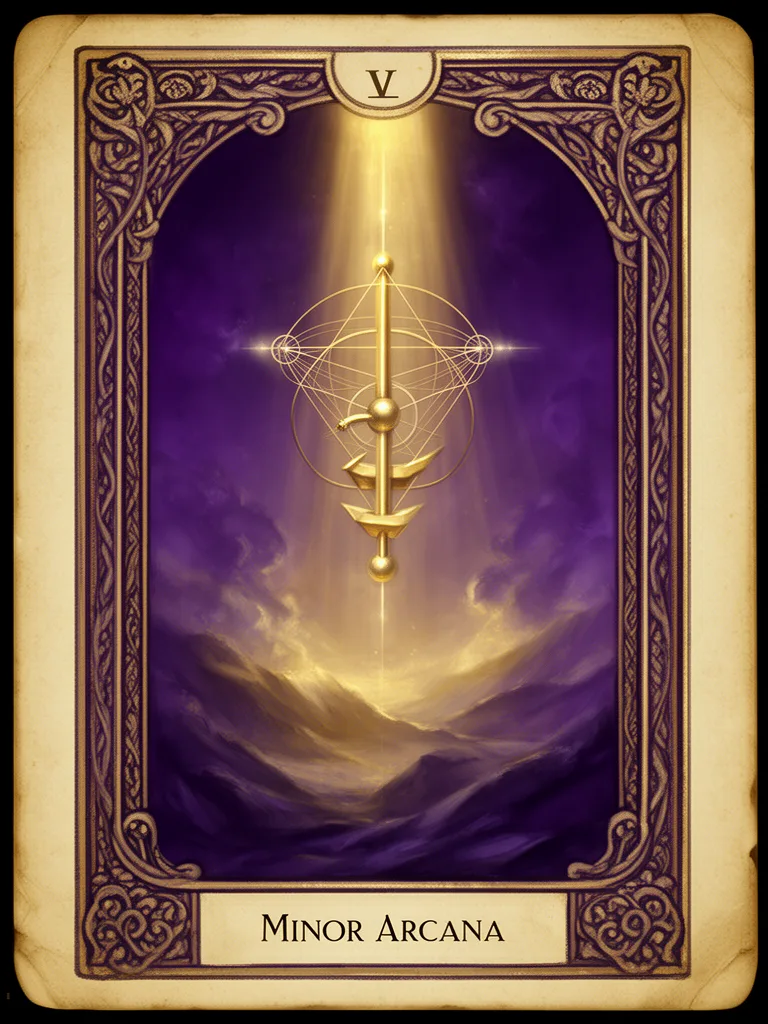
Minor Arcana
The Minor Arcana are the 56 suit cards within a Tarot deck, distinct from the 22 Major Arcana. They represent the mundane, everyday aspects of life, often categorized into four suits mirroring playing cards, and are used for divination and self-reflection on practical matters.
Where the word comes from
The term "Minor Arcana" is derived from Latin, with "minor" meaning "lesser" or "smaller" and "arcana" meaning "secrets" or "mysteries." It emerged in the context of Tarot as a way to differentiate these cards from the more profound and archetypal Major Arcana.
In depth
The Minor Arcana, sometimes known as the Lesser Arcana, are the suit cards in a cartomantic tarot deck. Ordinary tarot cards first appeared in northern Italy in the 1440s and were designed for tarot card games. They typically have four suits each of 10 unillustrated pip cards numbered one (ace) to ten, along with 4 court cards (face cards). Tarot games are still widely played in central and southern Europe; French Tarot is the second most popular card game in France after Belote. By contrast, cartomantic...
How different paths see it
What it means today
The Minor Arcana, often overlooked in favor of their more dramatic Major Arcana counterparts, serve as the vital connective tissue between the celestial and the terrestrial, the eternal and the ephemeral. Mircea Eliade, in his studies of myth and reality, highlighted how the sacred is often found not only in the extraordinary but also in the repetition of daily rituals, a principle that resonates deeply with the function of these cards. They are, in a sense, the grammar of the soul's interaction with the world.
Carl Jung, in his exploration of the collective unconscious, would likely see the suits—Wands, Cups, Swords, and Pentacles—as embodying fundamental human drives and modes of engagement: creativity and will (Wands), emotion and intuition (Cups), intellect and conflict (Swords), and material reality and practical application (Pentacles). These are not abstract principles but the very tools we use to shape and respond to our environment. The numbered cards, from Ace to Ten, then trace a developmental arc within each suit, mirroring the stages of growth, challenge, and resolution that characterize our personal journeys.
Unlike the grand pronouncements of the Major Arcana, which speak of destiny and cosmic forces, the Minor Arcana whisper of the everyday. They are the spilled milk, the unexpected promotion, the lover's quarrel, the quiet satisfaction of a task well done. They remind us that the path to wisdom is paved not only with epiphanies but also with the diligent, often uncelebrated, work of living. As Annemarie Schimmel observed in her work on Sufism, the divine is often revealed in the smallest of details, in the "thousand names" of God that permeate existence. The Minor Arcana, in their own way, offer a similar invitation to see the profound woven into the fabric of the commonplace, urging us to find the sacred in the mundane. They are the quiet hum of existence, the subtle yet persistent forces that shape our lives, waiting to be understood.
Related esoteric terms
Books on this concept








No reflections yet. Be the first.
Share your interpretation, experience, or question.
