Mehen
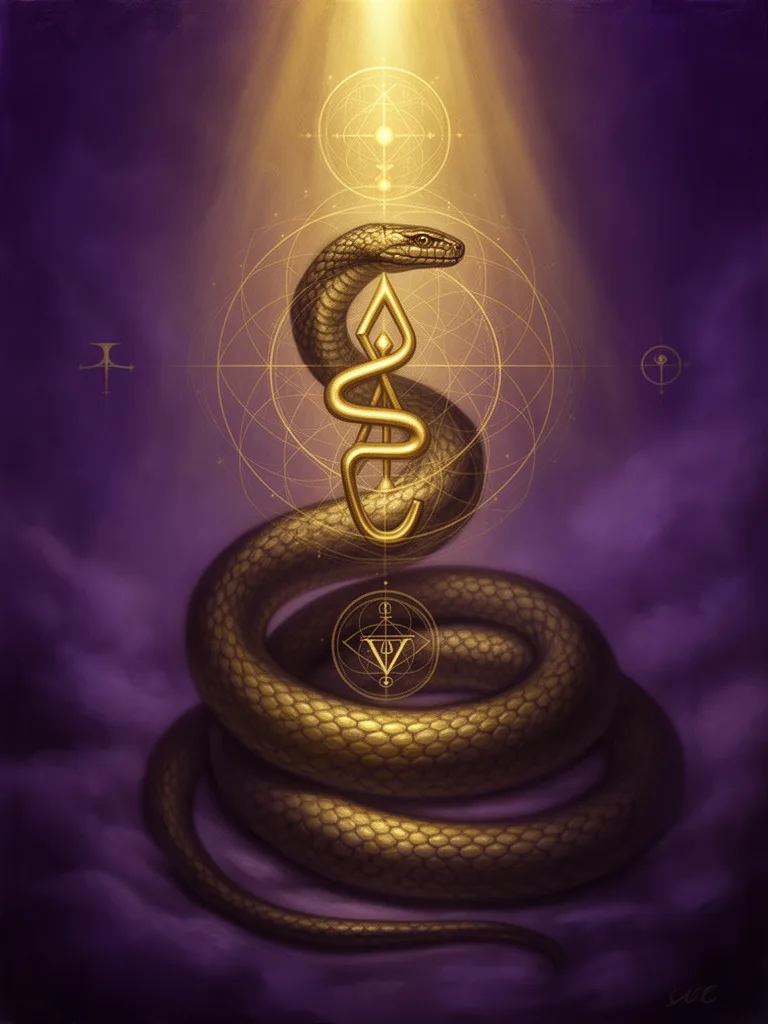
Mehen is the coiled serpent deity from ancient Egyptian mythology, symbolizing protection and cyclical renewal. It represents the primordial waters and the sun's nightly journey through the underworld, ensuring its rebirth. Mehen embodies the protective embrace of the divine.
Where the word comes from
The name "Mehen" (mḥn) originates from ancient Egyptian. Its precise etymological root is debated, but it is often associated with the concept of "coiling" or "rolling up," reflecting the serpent's form. The term appears in Old Kingdom funerary texts, notably the Pyramid Texts.
In depth
In popular myths, the great serpent wliich represents the lower atmosphere. In Occultism, the world of the Astral light, called symbolically the Cosmic Dragon and the Serpent. (See the works of Eliphaz Levi, who called this light le Serpent du Mai, and by other names, attributing to it all the evil infiences on the earth).
How different paths see it
What it means today
Mehen, the great coiled serpent of ancient Egypt, offers a profound counterpoint to our modern anxieties about finality and entropy. In the context of Hermetic thought, and indeed echoing through various spiritual traditions, Mehen embodies the cyclical nature of existence, a concept often obscured by our linear perception of time. Mircea Eliade, in his seminal work "The Myth of the Eternal Return," explored how ancient cultures understood time not as an irreversible march but as a recurring cosmic drama, a principle Mehen vividly illustrates. The serpent's nightly descent into the underworld, a journey through darkness and peril, culminating in its triumphant emergence with the sun, is a potent metaphor for the soul's own passage through trials and transformations. Eliphas Lévi, whom Blavatsky references, saw in such serpentine symbolism the astral light, a medium of occult forces, both creative and destructive, a duality Mehen encompasses. This coiled guardian, encircling the sun god Ra during his perilous nocturnal voyage, suggests that even in the deepest darkness, a protective, generative force is at work. It reminds us that endings are intrinsically linked to beginnings, that dissolution is a prelude to renewal, a cosmic rhythm that underpins all phenomena. The serpent's embrace is not one of entrapment but of preservation, a sacred containment within which life continually regenerates. To contemplate Mehen is to witness the universe breathing, a continuous exhalation and inhalation of being.
RELATED_TERMS: Ouroboros, Kundalini, Astral Light, Eternal Return, Cosmic Cycle, Regeneration, Primordial Waters, Divine Serpent ---
Related esoteric terms
Books on this concept





No reflections yet. Be the first.
Share your interpretation, experience, or question.
