Mahat
Mahat, meaning "The Great One" in Sanskrit, signifies the primordial cosmic intellect or Universal Consciousness, the first emanation from the unmanifest Absolute in Hindu cosmology. It is the foundational principle of intelligence that precedes individual ego and the material world.
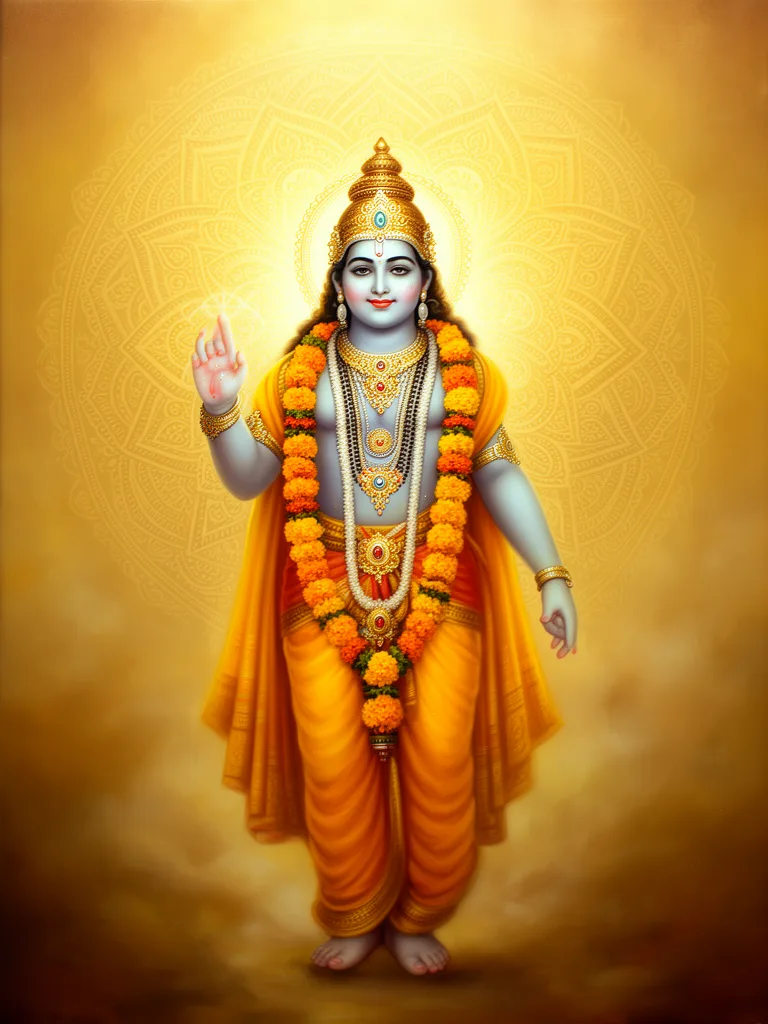
Where the word comes from
The term "Mahat" originates from Sanskrit, derived from the root mah meaning "great." It first appears in ancient Vedic texts and later becomes a central concept in Puranic and Samkhya philosophy, representing the cosmic mind or Universal Intellect, the first principle to emerge from the primordial substance.
In depth
Lit., "The great one". The tirst principle of Universal Intelligence and Consciousness. In the Puranic philosophy the first product of root-nature or Pradhana (the same as Mulaprakriti) ; the producer of Maiiaa tlie tliinking; principle, and of Ahankara, egotism or the feeling of "I am I"' (in the lower Manas). Mahatma. Lit., "great soul". An adept of the liighest order, pjxalted beings who, having attained to the mastery over their lower principles are thus living unimpeded by the "man of flesh", and are in possession of knowledge and power commensurate witli the stage they have reached in their spiritual evolution. Called in Pali Rahats and Arhats.
How different paths see it
What it means today
In the grand architecture of Hindu cosmology, particularly within the Samkhya system, Mahat stands as the luminous dawn after the profound silence of the unmanifest. It is not merely an abstract concept but the very first stirring of cosmic awareness, the primordial intellect that arises from the undifferentiated potential of Prakriti. Mircea Eliade, in his exploration of archaic cosmogonies, would recognize in Mahat the universal archetype of creation's initial impulse, the divine thought that precedes and organizes all existence.
This "Great One" is the progenitor of Ahankara, the ego-sense, a crucial distinction. It implies that our individual sense of "I" is a derivative, a ripple on the surface of a boundless ocean of consciousness. Carl Jung, in his work on the collective unconscious, might see Mahat as a macrocosmic echo of the archetypal Self, the unified center from which all individual psyches draw their being. It is the cosmic mind that dreams the universe into existence, and our own minds are but temporary constellations within that dream.
The implication for the modern seeker is a radical decentering of the individual ego. If Mahat is the source, then our pursuit of self-knowledge is not an isolationist project but a rejoining with the universal. The practice, though not explicitly detailed in the term itself, would involve cultivating an awareness of this underlying unity, a meditative turning inward not to find a solitary self, but to recognize the boundless intelligence that animates all things. This is not a passive surrender but an active attunement, a conscious participation in the cosmic intellect. It challenges the illusion of separation, suggesting that true wisdom lies in perceiving the singular source from which all manifold phenomena arise.
The concept of Mahat invites us to consider our own cognitive processes not as isolated events, but as localized manifestations of a cosmic intelligence. It is a profound invitation to recognize the interconnectedness of all being, a call to awareness that transcends the boundaries of individual perception and points towards a unified field of consciousness.
Related esoteric terms
Books on this concept








No reflections yet. Be the first.
Share your interpretation, experience, or question.
