Lodur
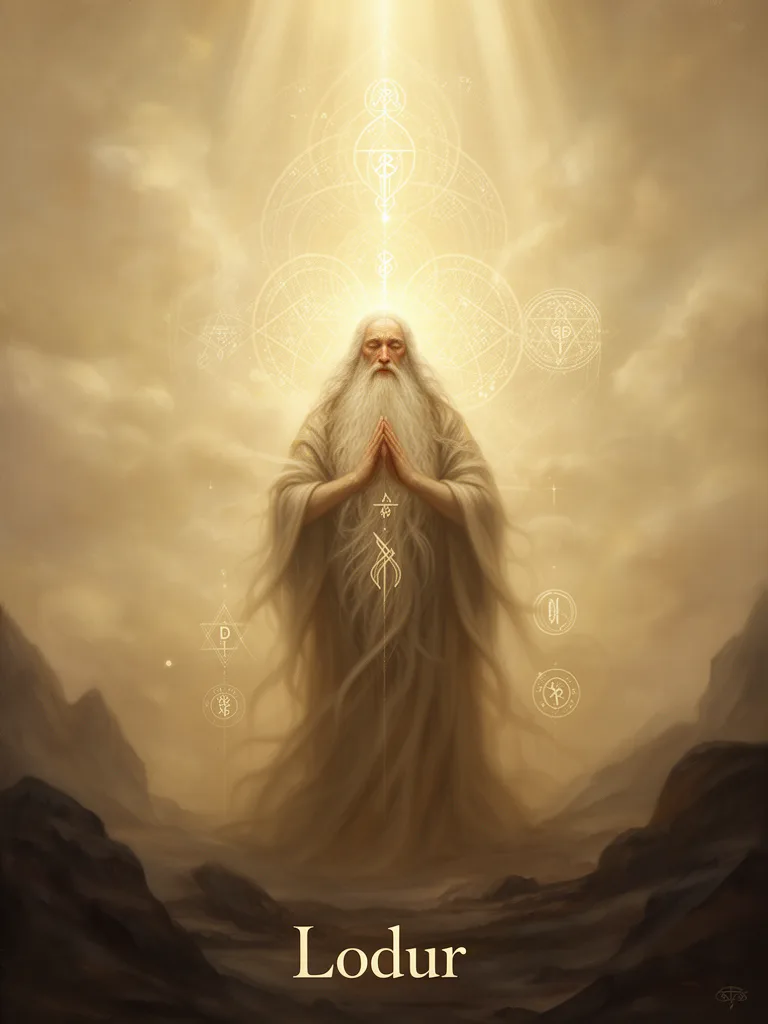
Lodur is a figure in Norse mythology, associated with the creation of humanity. He is part of a divine trinity and is credited with bestowing the vital essence of blood and color upon the first man, Ask, crafted from an ash tree.
Where the word comes from
The name Lodur is of Old Norse origin. Its precise etymology is debated among scholars, with some suggesting a connection to words related to "fire" or "heat," possibly linking him to the animating spark of life. The term appears in the Prose Edda, a foundational text of Norse literature.
In depth
The second per.sonage in the trinity of gods in the Edda of the Norsemen; and the father of the twelve great gods. It is Lodur who endows the first man-made of the ash-tree (Ask), with blood and color.
How different paths see it
What it means today
In the grand, often stark, cosmogonies of the Norse peoples, Lodur emerges not as a thunderous warrior god, but as a more subtle artisan of existence. His contribution to the creation of Ask, the first man, as described in the Eddas, is profound. He is the one who bestows "blood and color." This is not simply the donation of biological fluids; it signifies the gift of vitality, of sentience, and of the very capacity for experience that makes us human.
Mircea Eliade, in his seminal works on myth and religion, would likely see this act as a prime example of the "hierogamy," the sacred marriage or union that brings forth life. The ash tree, Ask, represents the raw, unformed material of existence, the cosmic tree Yggdrasil itself, perhaps. Lodur, along with his divine companions Odin and Hönir, represents different facets of the creative impulse. While Odin might represent intellect and Hönir the capacity for movement or form, Lodur embodies the vital spark, the "anima," the very essence of being alive and capable of perceiving the world in its manifold hues.
This act of bestowing color, in particular, is significant. It speaks to the aesthetic dimension of life, the capacity for beauty, for joy, for sorrow, for all the subjective experiences that color our reality. Without this infusion, Ask would be but an inert statue, a form devoid of the inner fire that makes life meaningful. It is a reminder that our existence is not solely a matter of biological function, but of a deeper, animating principle, a divine gift that allows us to participate in the vibrant, ever-changing panorama of the cosmos. The myth invites us to consider the sources of our own vitality and the inherent sacredness of the life force that flows through us, a force that connects us to the very act of creation.
RELATED_TERMS: Anima, Life Force, Vital Principle, Creation Myth, Divine Spark, Sentience, Prana, Hierogamy
Related esoteric terms
No reflections yet. Be the first.
Share your interpretation, experience, or question.
