Aour
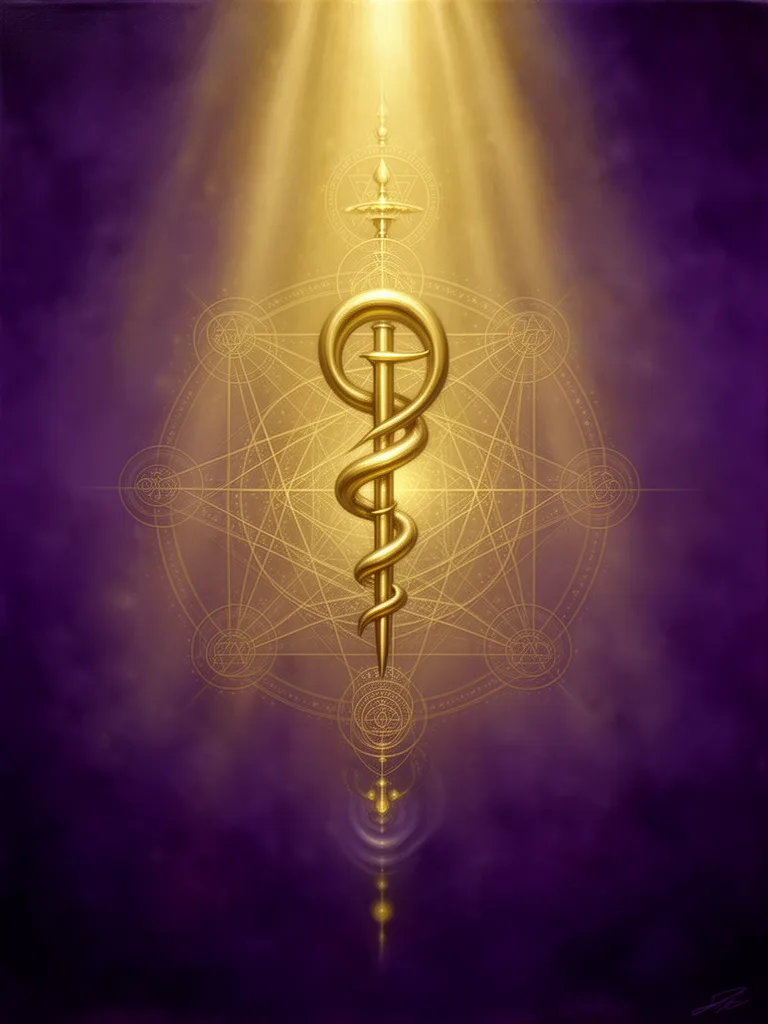
Aour represents the divine duality of light, encompassing both life-giving and death-giving aspects, symbolizing the cosmic synthesis of opposing forces. It is considered the "Son of the Waters," signifying its origin from the primordial ether.
Where the word comes from
The term "Aour" originates from Chaldean, likely derived from "aur," meaning "light." In its Avestan context, it is associated with Apam Napat, literally translating to "Son of the Waters," referring to the cosmic ocean of ether from which existence arises.
In depth
Tho synthesis of the two aspects of ustro-( tlurU li^'ht ; and the od — the life-«;ivinfr. and the ob — the death-jrivinp liplit. Apam Napat iZind). A mysterious heinfr, corresponding to the Fuhiit iif tlif Occultists. It is both a Vedic and an Avestian name. Literally, the name means the "Son of the Waters" (of space, i.r., Ether), for in the Avcsta Apam Napat stands between the flrc-yazatas and the wotcr-ifazatas (See Stent Doctrine, Vol. II., p. 400, note).
How different paths see it
What it means today
The Chaldean term Aour, as elucidated by Blavatsky, invites us to contemplate the universe not as a static arrangement of facts, but as a dynamic interplay of luminous energies. It speaks to a primordial light that is not merely illumination but also the very substance of being, holding within it the seeds of both genesis and dissolution. This echoes Mircea Eliade's observations on the sacred, where primordial times are not lost but are cyclically re-presented, and where the divine is often dual-natured, as seen in many creation myths.
The appellation "Son of the Waters" is particularly evocative, drawing a parallel to the ur-waters of creation found in numerous cosmogonies, a concept explored by Carl Jung in his archetypal psychology. These waters represent the undifferentiated potential from which all form emerges, a fluid, boundless medium. Aour, born from this, is the active principle that shapes and animates this potential, embodying the vital force that drives evolution. In its Hermetic context, this duality of light—life-giving and death-giving—mirrors the alchemical process, where purification often involves dissolution before transformation. The Occultists' "Fuhiit" (likely referring to a divine being or principle) finds a resonance here, suggesting a universal archetype of the active, generative deity.
The connection to Apam Napat in Vedic and Avestan traditions further anchors Aour in the Indo-Iranian spiritual heritage. Apam Napat is a powerful deity associated with fire and water, a paradox that underscores the term's inherent duality. He is often seen as a cosmic king, a bringer of light and life, but also a force that can consume. This perspective challenges our modern inclination to categorize forces as purely good or evil, instead presenting a more holistic, cosmic vision where even destructive potential is integral to the cycle of existence. It compels us to consider the divine not as a benevolent overseer, but as a fundamental principle that encompasses all aspects of reality, a perspective that resonates with the non-dualistic insights found in many contemplative traditions.
Aour, therefore, is not merely an ancient word but a lens through which to view the universe's inherent dynamism and the sacred nature of its opposing forces. It encourages a contemplation of the light that both sustains and transforms, a vital energy that permeates all existence.
Related esoteric terms
No reflections yet. Be the first.
Share your interpretation, experience, or question.
