Knight (playing card)
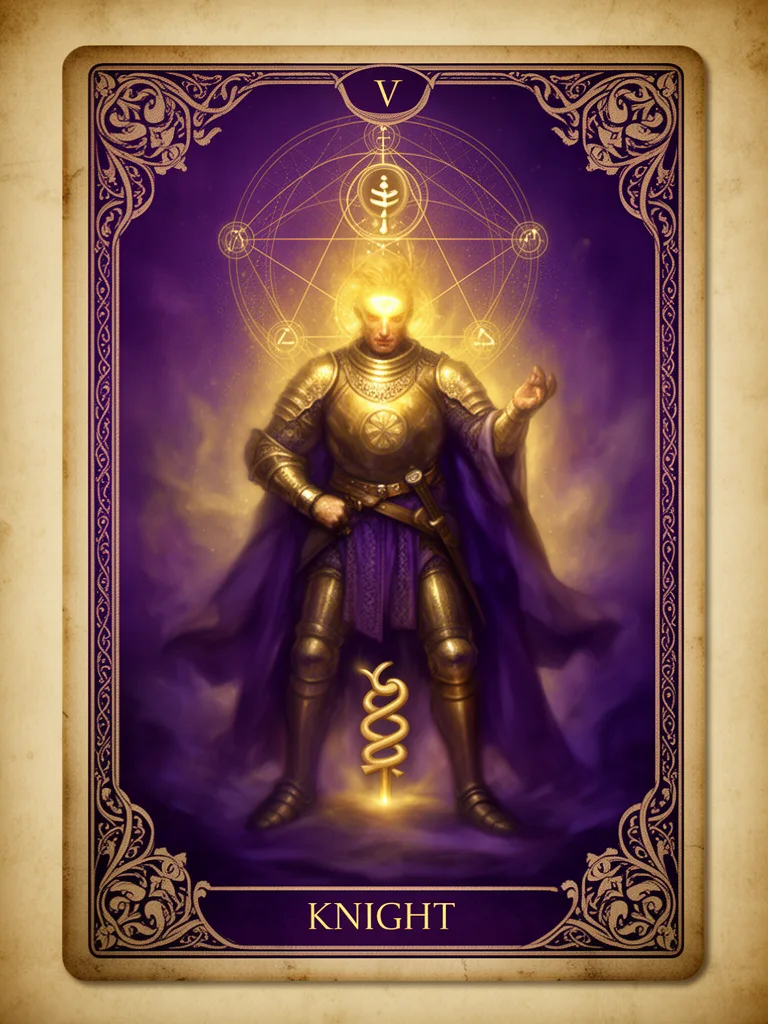
The Knight card in a deck, particularly in Tarot or traditional playing cards, represents a dynamic intermediary force. It embodies action, movement, and the transition between the potential of the Knave and the established authority of the King, often signifying a messenger or a developing journey.
Where the word comes from
The concept of a "knight" derives from the Old English "cniht," meaning "boy" or "servant," evolving to denote a mounted warrior of noble rank. In card traditions, its presence signifies a figure of action and progression, bridging the nascent energy of the Knave with the mature power of the King.
In depth
A knight or cavalier is a playing card with a picture of a man riding a horse on it. It is a standard face or court card in Italian and Spanish packs where it is usually referred to as the 'knight' in English, the caballo in Spanish or the cavallo in Italian. It ranks between the knave and the king within its suit; therefore, it replaces the queen, nonexistent in these packs. The card also features in tarot and tarock packs. In French-suited tarot packs it is usually called the 'cavalier' in English...
How different paths see it
What it means today
The Knight card, whether in a simple deck of playing cards or the more elaborate tapestry of Tarot, serves as a potent symbol of active engagement with the world. It is the embodiment of the journey, not merely the destination. Mircea Eliade, in his studies of myth and ritual, would recognize this figure as embodying the heroic impulse, the individual who steps forth from the ordinary to undertake a quest. Carl Jung’s concept of the anima or animus, the projected ideal of the masculine or feminine, might also find resonance here, representing a dynamic, often idealized, aspect of the psyche in motion.
In Hermetic thought, the Knight is akin to the Mercurial principle, the swift messenger, the alchemist’s active agent stirring the prima materia. It is the spark that ignites transformation, the force that propels the seeker forward. Unlike the passive Knave, who represents raw potential, or the King, who signifies established order, the Knight is the active principle of becoming. It is the disciplined energy that translates intention into action, the courage to ride forth into the unknown, carrying with it the seeds of future achievement. This card reminds us that progress is not always a grand, sweeping event, but often a series of determined movements, each step imbued with purpose.
Consider the imagery: a mounted figure, poised for movement, often depicted in mid-stride. This is not the contemplative sage or the passive recipient of fate. This is the agent of change, the one who takes initiative. In a world often characterized by inertia or overwhelming complexity, the Knight offers a model of focused intention and courageous action. It is the reminder that even the most profound transformations begin with a single, deliberate step, a commitment to the path ahead, no matter the perceived distance or the challenges that lie beyond the horizon. The Knight invites us to embrace our own agency, to become the active participants in the unfolding narrative of our lives.
Related esoteric terms
No reflections yet. Be the first.
Share your interpretation, experience, or question.
