Kalpa
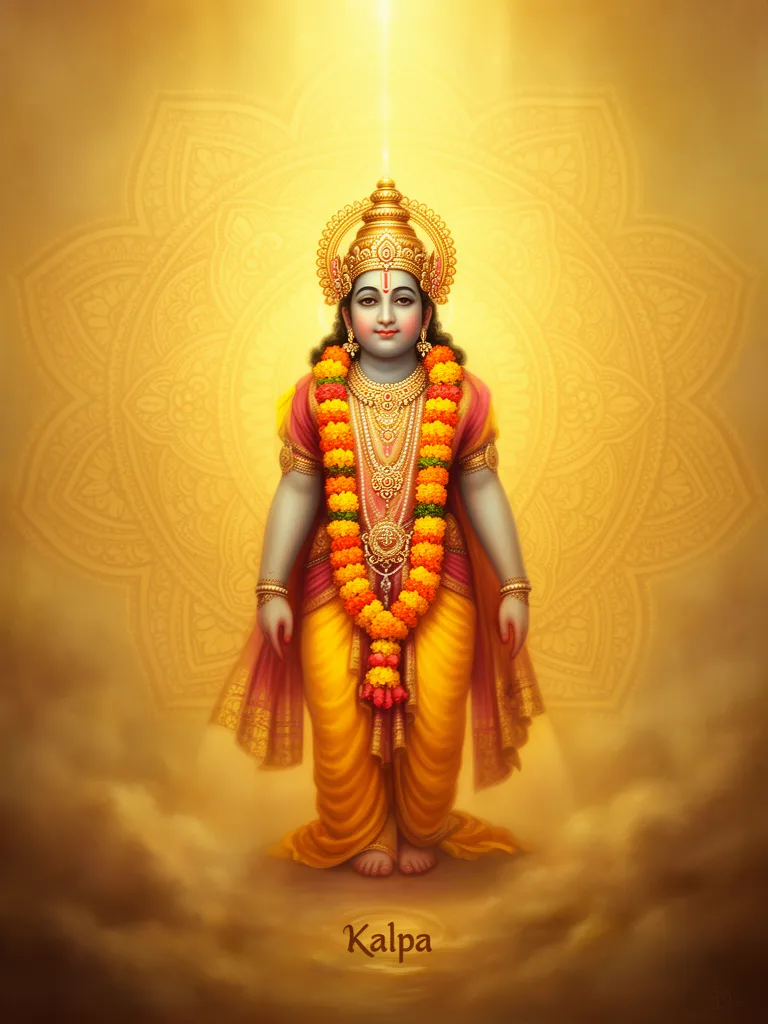
A kalpa is a vast cosmic cycle in Hindu cosmology, representing a day and night of Brahma, the creator deity. This immense period, lasting 4.32 billion human years, signifies the creation, existence, and dissolution of a universe, highlighting the cyclical nature of time and existence.
Where the word comes from
The Sanskrit term "kalpa" (कल्प) derives from the root "kal," meaning "to count" or "to measure." It signifies a unit of time, specifically a cosmic epoch. In Vedic literature, it refers to a period of time, later elaborated in Puranic cosmology as the immense duration of a universe's cycle.
In depth
The period of a mundane revolution, generally a cycle of time, but usually, it represents a "day" and "night" of Brahma, a period of 4,320,000,000 years.
How different paths see it
What it means today
The concept of the kalpa, a cosmic epoch stretching across billions of years, offers a potent antidote to the hurried anxieties of modern existence. It is not merely a measure of time, but a philosophical framework that recasts our understanding of creation and dissolution. As Mircea Eliade observed in The Myth of the Eternal Return, cyclical time, as embodied by the kalpa, provides a means of periodically renewing the world and human existence, escaping the linear progression towards decay.
In Hindu thought, the kalpa, a "day of Brahma," is a period of immense creative flourishing, followed by a "night of Brahma," a phase of cosmic rest and dissolution, before the cycle begins anew. This is not a nihilistic void, but a pregnant pause, a cosmic inhalation before the next exhalation of existence. The sheer scale of this temporal expanse—4.32 billion human years for a single day—renders human lifespans and even the existence of civilizations as fleeting sparks within a grand, ongoing cosmic drama.
The Puranas detail these cycles with meticulous, almost astronomical, precision, outlining the succession of Manvantaras and Yugas within a kalpa. This structured understanding of cosmic time suggests an underlying order, a divine rhythm that governs the universe’s breath. It invites contemplation on the nature of reality itself, questioning whether our perceived linearity is but a limited human perception of a vastly more intricate, cyclical unfolding. The kalpa encourages a detachment from the ephemeral, fostering a sense of participation in something immeasurably larger and more enduring. It is a call to recognize that even in dissolution, there is the promise of resurgence, a cosmic seed waiting for its season.
RELATED_TERMS: Yuga, Manvantara, Samsara, Brahma, Cosmology, Cyclic Time, Pralaya
Related esoteric terms
Books on this concept








No reflections yet. Be the first.
Share your interpretation, experience, or question.
