Jesod
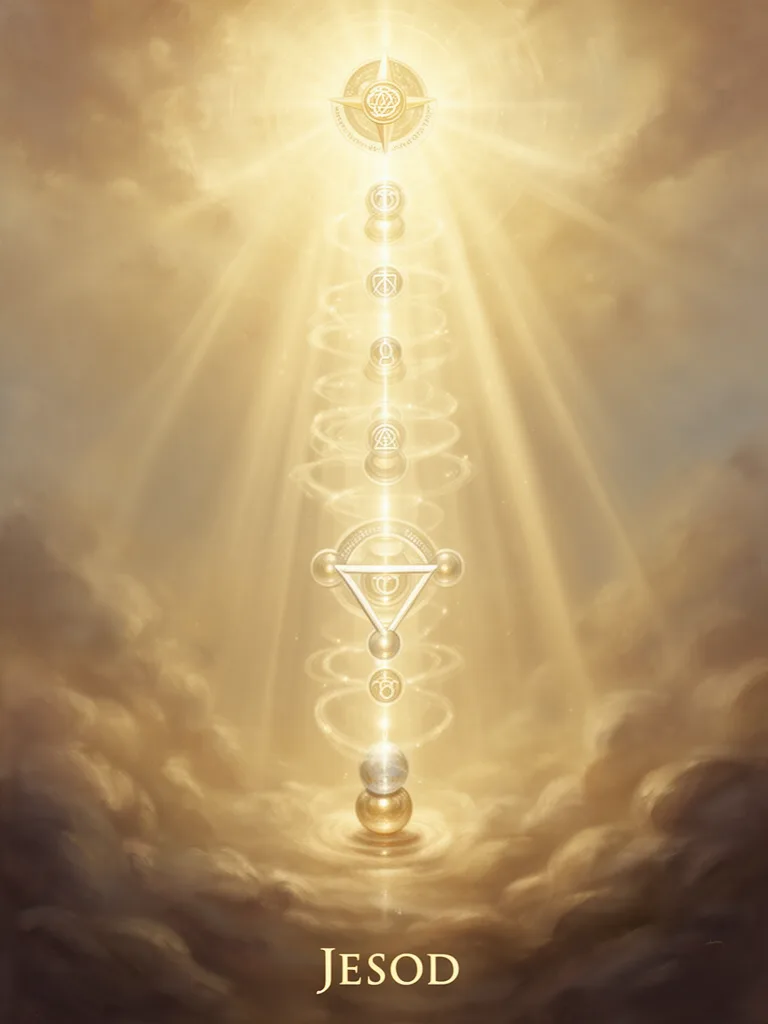
Jesod, meaning "foundation" in Hebrew, is the ninth Sephirah in Kabbalistic cosmology, representing the generative principle and the conduit through which divine energy flows to the manifest world. It is associated with the reproductive forces and the astral plane.
Where the word comes from
The term "Jesod" (יְסוֹד) originates from Hebrew, directly translating to "foundation" or "basis." In Kabbalistic literature, it specifically refers to the ninth of the Ten Sephiroth, first systematically elaborated in texts like the Zohar, which emerged in medieval Spain.
In depth
Foundation; the ninth of the Ten Sephiroth, a masculine active potency, completing the six which form the Microprosopus. [w.w.w.] Jetzirah filch.). Si'c "Yetzirah". Jetzirah, Srphrr; or Book of the Creation. The most occult of all the Kabalistic works now in the possession of modern mystics. Its alleged origin, of having been written by Abraham, is of course nonsense; but its intrinsic value is great. It is composed of six Perakim (chapters), subdivided into thirty-three short Mishnas or Sections; and treats of the evolution of the Universe on a system of correspondences and numbers. Deity is said therein to have formed ("created") the Universe by means of numbers "by thirty-two paths (or ways) of secret wisdom", these ways being made to correspond with the twenty-two letters of the Hebrew alphabet and the ten fundamental numbers. These ten are the primordial numbers whence proceeded the whole Universe, and these are followed by the twenty-two letters divided into Three Mbthrra, the seven double consonants and the twelve simple consonants. He wlio would well understand the system is advised to read tlie excellent little treatise upon Sepher Jetzirah, by Dr. W. Wynn Westcott. (See "Yetzirah".)
How different paths see it
What it means today
In the intricate architecture of the Kabbalah, Jesod, the ninth Sephirah, stands as a profound metaphor for the fundamental generative force that underpins reality. Blavatsky, referencing the Sepher Yetzirah, points to the cosmic creation through numerical and alphabetical correspondences, a system where Jesod plays a vital role as the conduit. It is not merely a static principle but an active potency, a masculine energy, as she notes, completing the Microprosopus, the lesser countenancethat is, the manifested divine form.
This concept resonates deeply with modern psychological inquiry, particularly the work of Carl Jung, who explored the archetypal power of the generative principle. The "foundation" is not inert earth but the fertile ground from which all things spring, the underlying matrix of potentiality. It is the astral light, the intermediary realm where abstract divine ideas begin to coalesce into forms that can be perceived. This Sephirah is often associated with the Moon, a celestial body that waxes and waxes, symbolizing cycles of creation and dissolution, and its connection to reproductive energies highlights the cosmic dance of generation and sustenance.
The Sepher Yetzirah itself, as Blavatsky observes, is a text of immense occult value, describing creation through "thirty-two paths of secret wisdom." Jesod is intrinsically part of this pathway, the channel through which the creative impulse, articulated by the divine letters and numbers, flows into manifestation. Understanding Jesod is akin to understanding the deep currents of life, the unseen forces that drive biological reproduction and, by extension, the continuous creation of the cosmos. It is a reminder that the universe is not a finished product but a perpetual becoming, sustained by an ever-present, generative foundation. The work of mystics across traditions, from the Hermetic emphasis on the generative power of the divine to Sufi concepts of divine love as the creative force, echoes this fundamental principle of cosmic fertility.
RELATED_TERMS: Malkuth, Tiphareth, Yesod, Shekhinah, Ein Sof, Sephiroth, Astral Light, Creative Power
Related esoteric terms
No reflections yet. Be the first.
Share your interpretation, experience, or question.
