Image
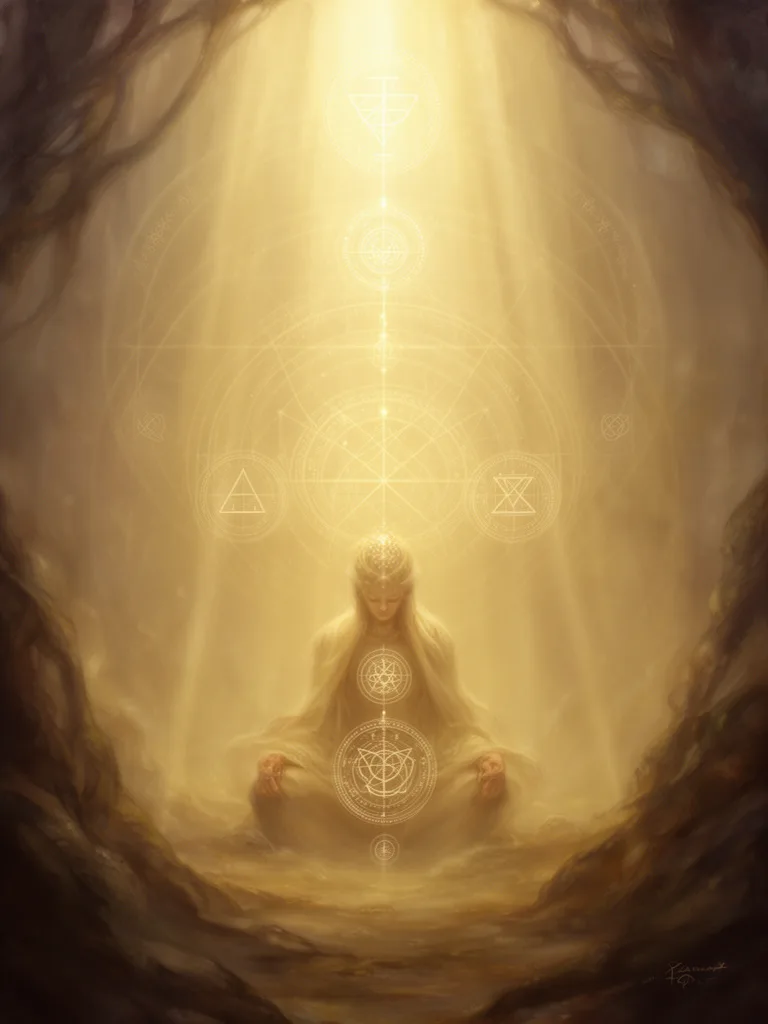
An "Image" in esoteric thought refers to a divine or archetypal representation, often a symbol of humanity or spiritual essence, distinct from the physical form. It signifies an underlying ideal or pattern that may be obscured or altered by material existence or moral corruption.
Where the word comes from
The English word "Image" derives from the Latin "imago," meaning likeness, picture, or resemblance. This, in turn, likely stems from an Indo-European root related to "mimicry" or "likeness," indicating a fundamental concept of representation and reflection across cultures.
In depth
Occultism pcnnits no other iinajrc than that of the livinjr iiiiajre of divine man (the symbol of Humanity) on earth. The Kahhnla teaches that this divine Imajje. the ct)py of the suhliiiK aud hohj upp<r Iniof/f (the Hlohim^ has now ehan<red into unothi r similituih , owinj? Ut the development of men's sin fid nature. It is only the upp«r divinr Image (the K(fu) which is the .same; the lower (personality) has chanped. and nmn. now fearinj; the wild beasts, has frrown to bear on his face the similitude of many of them. {Zohar I. fol. l\(i.) In the early period of Kfrypt there wen- no imajjes; but later, as Lenormand says. *'In the sanctuaries of Kjrypt they divided the pro|)erties of nature and conse- (juently of Divinity (the Klohim, or the Efpis), into seven abstract cjualities. characterized each by an emblem, which are matter, cohesion, fluxion, coagulation, acc\nnulation, station and division ". These were all attributes symbolized in various images.
How different paths see it
What it means today
The term "Image," as presented in this early occult definition, resonates with a profound dualism that has echoed through centuries of spiritual inquiry. It posits not a singular, static reality, but a dynamic tension between an eternal, divine archetype and its mutable, terrestrial expression. Blavatsky, drawing from sources like the Zohar, points to the Tzelem Elohim, the Image of God, as that which is fundamentally immutable, a celestial blueprint imprinted upon the human soul. Yet, she contrasts this with the "lower Image," the personality, which is susceptible to the "sinful nature" and can devolve into a similitude of "wild beasts." This is not merely a moralistic judgment but a recognition, akin to Carl Jung's concept of the shadow, that the unacknowledged or unintegrated aspects of the self can distort the divine likeness.
The ancient Egyptians, as referenced, sought to categorize and symbolize the divine attributes through emblems and images, reflecting a desire to grasp the ineffable through tangible forms. This practice of creating murti in Hinduism, or the sacred icons in Christian traditions, can be understood as attempts to bridge the gap between the immanent and the transcendent. These are not mere representations but are intended to be vessels, conduits for divine presence, allowing the devotee to commune with the spiritual reality they symbolize. Mircea Eliade, in his studies of sacred and profane, would recognize this as the human impulse to connect with the eternal through material means, to find the divine pattern within the flux of existence.
The modern non-dual perspective offers a complementary lens, suggesting that the "Image" is the singular, unbroken consciousness, and our perceived fragmentation is an illusion born of misidentification. The suffering arises not from the corruption of an image, but from the mistaken belief in a separate, flawed self that is distinct from the original, perfect Image. The esoteric work, then, becomes a process of recognizing this original Image, of shedding the accretions of personality and ego that obscure its radiant truth. It is a journey back to the source, a remembering of our inherent divine nature, as if awakening from a dream where we mistook a fleeting shadow for our true form. The challenge lies in discerning the eternal imprint from the transient distortions, a task that demands both intellectual clarity and profound inner transformation.
Related esoteric terms
Books on this concept







No reflections yet. Be the first.
Share your interpretation, experience, or question.
