Gimil
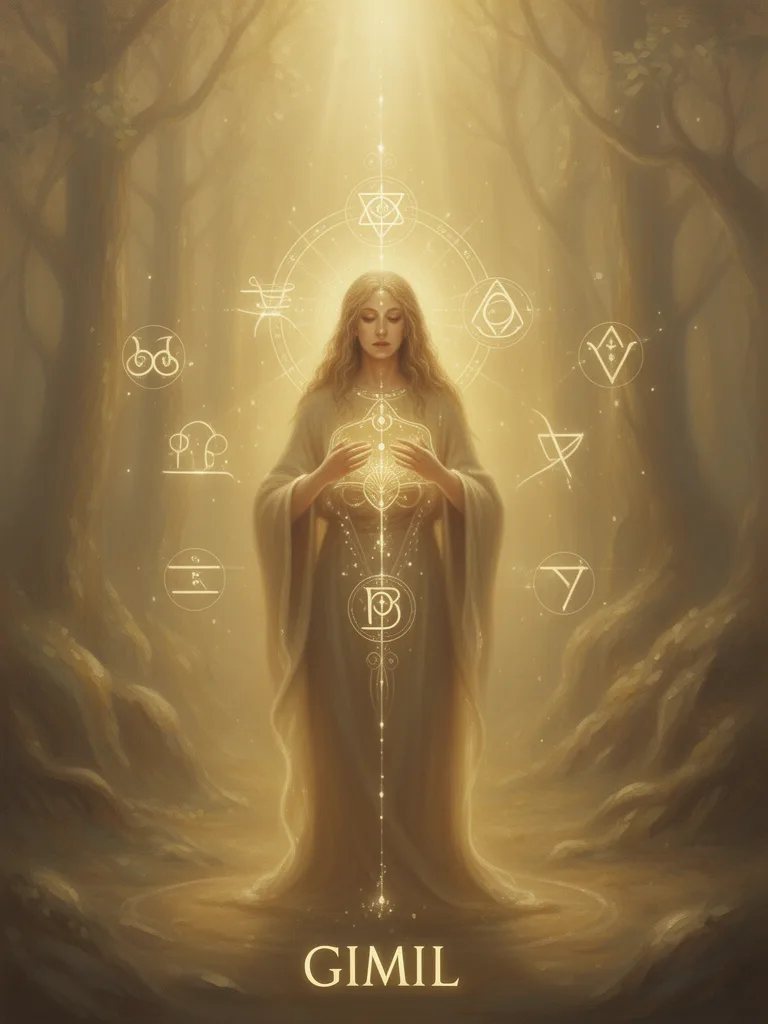
Gimil is a term from Norse mythology, often translated as a celestial dwelling or paradise. It is envisioned as a magnificent hall or realm, destined to house the righteous and the gods after the cataclysmic events of Ragnarök, the twilight of the gods.
Where the word comes from
The term "Gimil" originates from Old Norse, likely related to "gim" or "gull," meaning "gold" or "shining." It appears in Norse sagas and the Poetic Edda, often associated with a heavenly or divine abode, a golden hall of the gods.
In depth
"The Cave of Gimil" or Wingolf. A kind of Heaven or Paradise, or perhaps a New Jerusalem. Imilt l)y the "Strong 118 THE()«()IMir< Al. aiul Mijrhty God' who remains nainoless in the Edda, aljove the Field of" Ida. and aftiT the new earth rose out of the waters.
How different paths see it
What it means today
The concept of Gimil, often rendered as a golden hall or a celestial paradise in Norse cosmology, offers a profound glimpse into humanity's enduring quest for a realm of ultimate justice and peace. It is not simply a passive afterlife, but an active reconstitution of the divine order following cosmic upheaval. Mircea Eliade, in his seminal works on comparative religion, often explored the archetype of the sacred center, a point of origin and stability around which the world is organized. Gimil functions as such a center, a place of refuge and renewal after the cataclysm of Ragnarök.
This idea of a divinely wrought sanctuary, a "New Jerusalem" as Blavatsky notes, resonates across disparate spiritual traditions. In Sufism, for instance, the concept of the "City of the Pure" or the spiritual heart can be seen as an inner Gimil, a sanctified space within the individual where divine light resides. Similarly, the Buddhist notion of Nirvana, while fundamentally different in its emphasis on the cessation of suffering and the dissolution of self, also points towards an ultimate state of peace and liberation, a transcendent realm beyond the cycles of worldly turmoil.
The imagery of Gimil, a hall of gold or a shining abode, speaks to a primal human attraction to light, purity, and enduring substance. It is the antithesis of the shadowy realms of chaos and dissolution. This longing for a place of unblemished perfection is a recurring theme in myth and mysticism. Carl Jung, in his exploration of archetypes, would likely see Gimil as an embodiment of the Self, the totality of the psyche, and the aspiration towards wholeness and integration. The very act of envisioning such a place, of giving it form and name, is a testament to the human spirit's capacity to project its deepest hopes for order and meaning onto the canvas of existence. Gimil, in its essence, is the dream of a world remade, a testament to the enduring possibility of divine grace and cosmic harmony.
Related esoteric terms
No reflections yet. Be the first.
Share your interpretation, experience, or question.
