Gaea
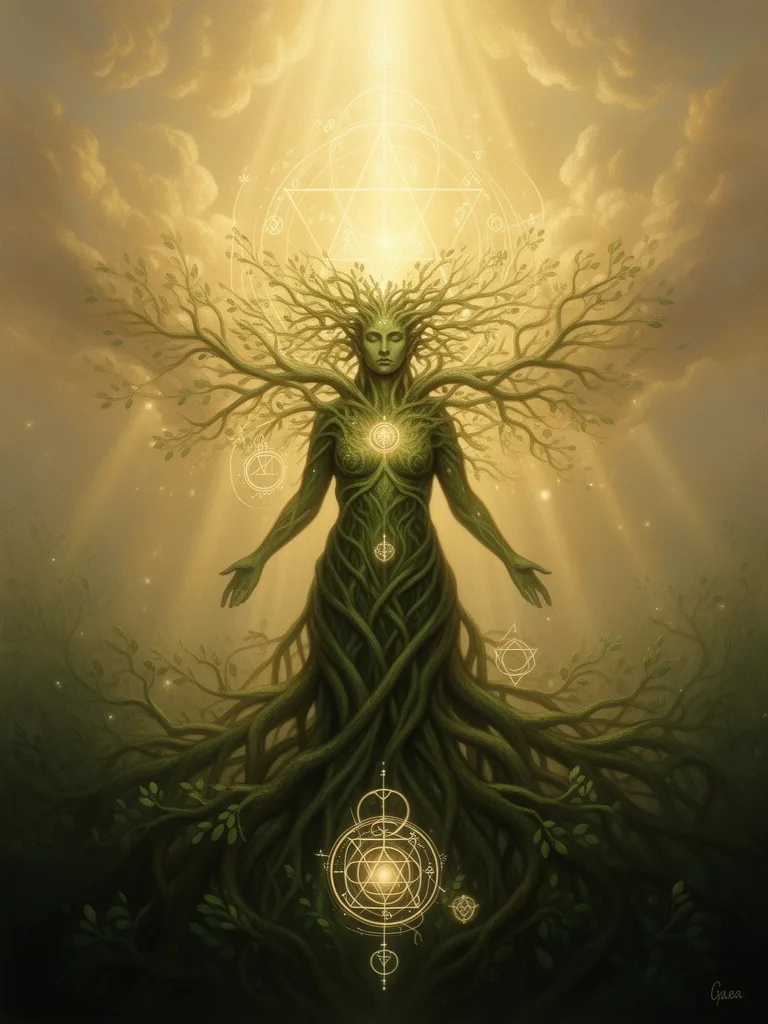
Gaea is the primordial goddess of the Earth in ancient Greek mythology, often personified as the mother of all life and the consort of Uranus (Sky). She represents the fundamental, fertile ground from which existence emerges.
Where the word comes from
The name "Gaea" (or Gaia) originates from ancient Greek, likely derived from a Proto-Indo-European root meaning "earth" or "to bend." It first appears in Hesiod's Theogony (c. 700 BCE) as the personification of the Earth itself, a foundational deity in early cosmogonies.
In depth
Primordial flatter in the Cosmogony of llesiod ; Earth, as some think ; the wife of Ourauos, the sky or heavens. The female j)ersona<>e of the primeval Trinity, composed of Ouranos, Gsea and Eros. Gaffarillus. An Aleliemist and plnlosoi)lier who lived in the middle of tiie seventeenth century. He is the first philosopher known to maintain that every natural object {e.g., plants, living creatures, etc.), when burned, retained its form in its ashes and that it could be raised again from them. This claim was justified by the eminent chemist Du Chesne, and after him Kireher, Digby and Vallemont have assured themselves of the fact, by demonstrating that the astral forms of burned plants could be raised from their ashes. A receipt for raising such astral phantoms of flowers is given in a work of Oetinger, Thoughts ou the Birth and the Generation of Things. Gaganeswara (SI:.). "Lord of the Sky", a name of Garuda.
How different paths see it
What it means today
The figure of Gaea, the Earth Mother of ancient Hellenic lore, offers a profound counterpoint to the often abstract or disembodied spiritual pursuits that characterize much esoteric inquiry. Hesiod, in his Theogony, presents her not merely as a geographical location but as a primordial deity, born from Chaos, the very first principle of existence. She is the fertile ground, the womb of the cosmos, from which arose mountains, seas, and the very race of gods and men.
This personification of the Earth as a living, sentient entity has deep roots, resonating with the animistic traditions described by Mircea Eliade, where the sacred is immanent in the natural world. Gaea's union with Uranus, the Sky, is a cosmic act of procreation, a primal duality that gives birth to the multiplicity of creation. Her story is a reminder that the material world, far from being separate from the divine, is its direct, tangible manifestation.
For the modern seeker, Gaea serves as an anchor, grounding the often ethereal flights of consciousness in the palpable reality of existence. She embodies the principle of immanence, the idea that the sacred is not solely transcendent but also deeply embedded within the fabric of the everyday world. The alchemical notion, alluded to in Blavatsky's reference to Gaffarillus, of raising forms from ashes, hints at a deeper understanding of Gaea's generative power, a cyclical process of death and rebirth inherent in the very substance of the Earth.
This perspective challenges a dualistic worldview that often separates spirit from matter, the divine from the mundane. Gaea invites us to see the Earth as a sacred entity, a living system imbued with a profound, generative intelligence. Her worship, or even contemplation, can foster a sense of reverence for the natural world, a recognition of our interconnectedness with all life, and an understanding of the cyclical rhythms that govern both cosmic and personal transformation. The Earth, in this light, is not merely a stage for human drama but a co-creator, a silent partner in the ongoing unfolding of existence.
Related esoteric terms
Books on this concept




No reflections yet. Be the first.
Share your interpretation, experience, or question.
