Ferho
Ferho is the supreme creative force in Nazarene Gnosticism, representing the ultimate divine potency responsible for all existence. It is the unmanifest source from which the aeons and the material world emanate, embodying the absolute, unknowable divine will.
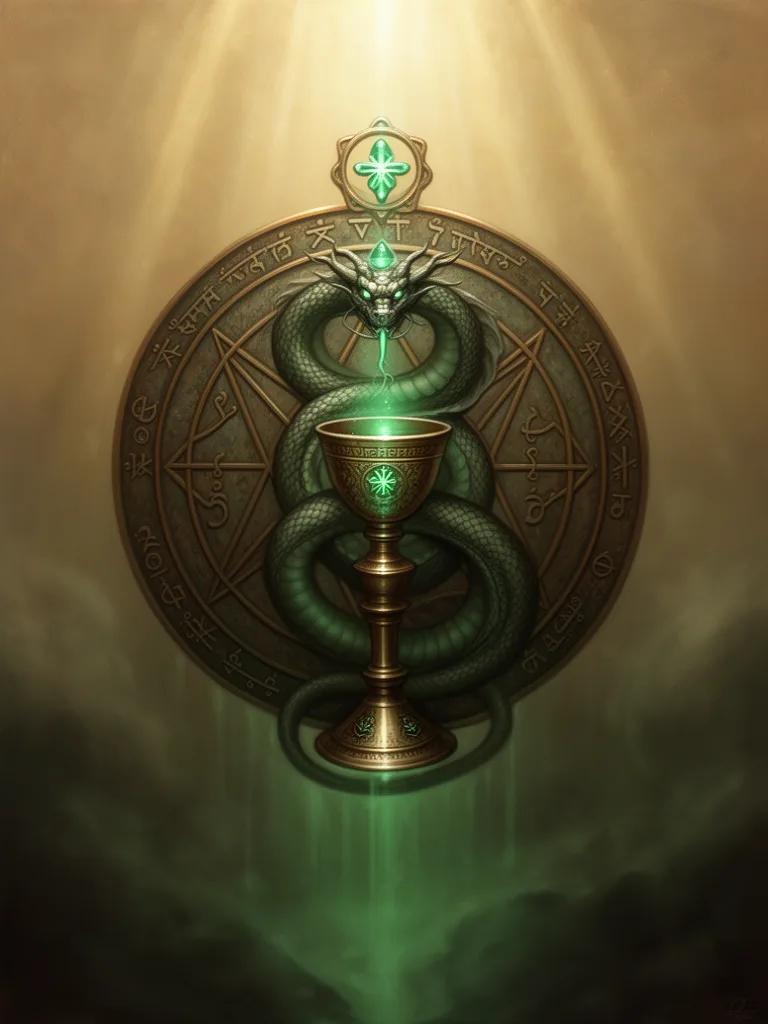
Where the word comes from
The term "Ferho" originates from the Mandaean language, a Semitic tongue closely related to Aramaic. It is derived from roots signifying "to create" or "to form." Its usage is specific to certain Gnostic sects, particularly the Nazarenes, as recorded in texts like the Codex Nasareus.
In depth
The highest and greatest creative power with the Nazarene Gnostics. {Codex Nazarceus).
What it means today
The concept of Ferho, as articulated within the esoteric cosmology of Nazarene Gnosticism, presents a profound departure from more anthropomorphic conceptions of the divine. It speaks to a primordial, almost elemental creative energy, a force that precedes distinction and form. This is not a god who wills creation in a human sense, but rather the inherent generative capacity of the absolute itself. Mircea Eliade, in his explorations of shamanism and archaic religions, often touched upon the idea of a primal, undifferentiated source from which the world emerges, a concept that resonates with Ferho's position as the ultimate creative power.
In the Gnostic framework, Ferho exists in a realm of pure potentiality, a state of being before the emergence of the aeons, the divine emanations that populate the Pleroma. The material world, often seen as a flawed imitation or even a prison, is a consequence of a lesser, ignorant creative act, distinct from the pure, unadulterated generative power of Ferho. This dualistic understanding, where a supreme, unknowable source stands apart from the imperfect manifest reality, is a hallmark of many Gnostic systems. For the modern seeker, Ferho invites contemplation on the nature of origin, on the idea that the ultimate source of existence might be a principle of pure potentiality rather than a conscious, volitional entity. It challenges the ingrained tendency to project human characteristics onto the divine, suggesting instead an impersonal, absolute generative force that is the very ground of being. This perspective offers a way to conceive of ultimate reality as something utterly transcendent, yet paradoxically, the very engine of all that is. The silence of Ferho, prior to the symphony of creation, is a testament to the vastness of the unmanifest.
Related esoteric terms
No reflections yet. Be the first.
Share your interpretation, experience, or question.
