Eden
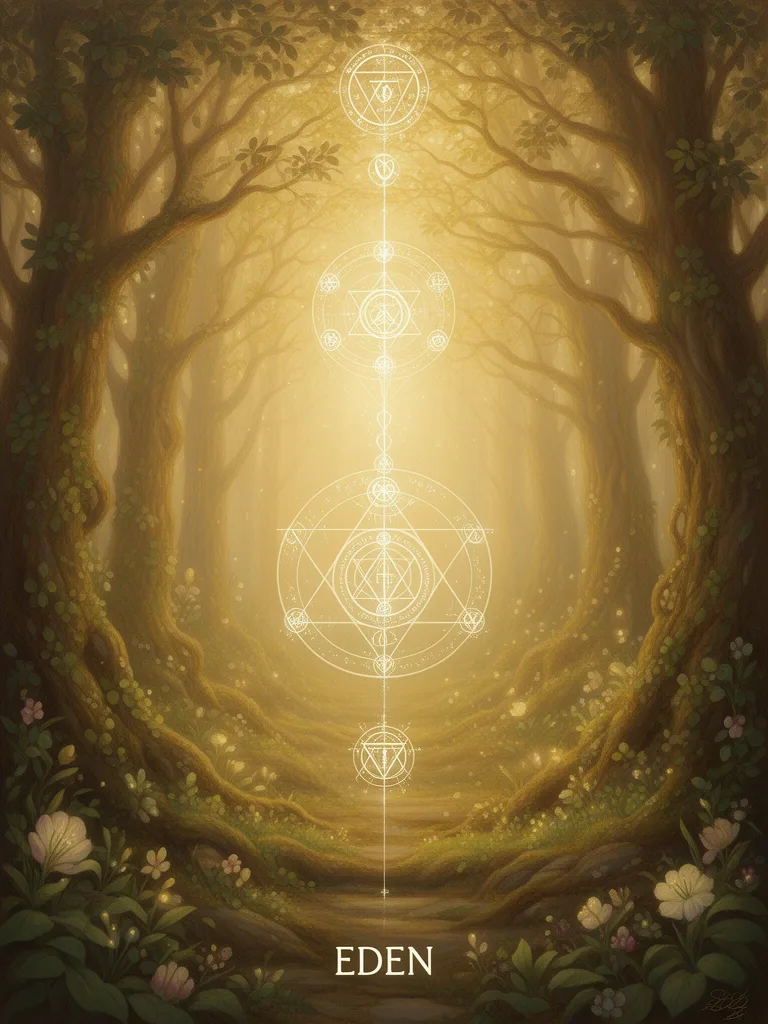
Eden, a biblical term derived from the Hebrew word for "delight" or "pleasure," refers to a primordial garden, a sacred space of divine presence and initiation. It symbolizes an original state of innocence and spiritual perfection, often depicted as a place of abundant life and unbroken connection with the divine before the advent of material consciousness.
Where the word comes from
The Hebrew word for Eden (עֵדֶן) is related to the Akkadian word edinu, meaning "plain" or "steppe." This term itself likely derives from Sumerian edin. In Genesis, Eden is described as a garden, a place of pleasure and divine presence, suggesting a profound spiritual rather than purely geographical location.
In depth
"Delight", pleasure. In Genesis the "Garden of Delight" built by God ; in the Kabbala the "Garden of Delight", a place of Initiation into the mysteries. Orientalists identify it with a place which was situated in Baljylonia in the district of Karduniyas. called also Gan-dunu, which is almost like the Gan-eden of the Jews. (See the works of Sir H. Rawlinson, and G. Smith.) That district has four rivers. Euphrates, Tigris, Surappi, Fkni. The two first have been adopted without any change by the Jews: the other two they have probably transformed into "Gihon and Pi.son", so as to have something original. The following are some of the reasons for the identification of Eden, given by Assyriologists. The cities of Babylon, Larancha and Sippara, were founded before the flood, according to the chronology of the Jews. "Surippak was the city of the ark, the mountain east of the Tigris was the resting place of the ark, Babylon was the site of the tower, and Ur of the Chaldees the birthplace of Abraham." And, as Abraham, "the first leader of the Hebrew race, migrated from Ur to Ilarran in Syria and from thence to Palestine", the best Assyriologists think that it is "so 102 THEIXSOI'IIICAL much evidonco in favor of tinhypothesis that Chahlca was the ori{?inal homo of these stories (in the liibh' ) and that the Jews receivi<l them originally from the Babylonians". Edom lllih.). Kdoinitc Kinjrs. A dctjiiy eonerah'd mystery is to be found in the allej^ory of the seven Kinjrs of Edom. who "reifi^ned in the land of p]dom before there rei<rned any King over the ehildreii of Israel''. (Gen. xx.wi, 31.) The Kabbala teaeiies that tiiis Kingdom was one of "unbalanced forces" and necessarily of unstable character. The world of Israel is a type of the condition of the worlds which came into existence subsequently to the later i)eriod when the equilil)rium had become established, fw.w.w.] On the other hand the Eastern Esoteric philosoi)hy teaclies that the seven Kings of Edom are not the type
How different paths see it
What it means today
The biblical narrative of Eden, often reduced to a historical account of a lost paradise, offers a far richer allegorical landscape for the modern seeker. Blavatsky's inclusion of its etymological roots in "delight" and its association with "Initiation into the mysteries" points toward its function as a symbol of profound spiritual realization. This is not simply a place that was, but a state that can be. As Mircea Eliade explored in his work on myth and reality, such primordial sites serve as a constant reminder of a sacred time and space, an archetypal blueprint for the human condition. The garden, with its four rivers, can be seen not just as a Mesopotamian geographical reference, but as a representation of the fourfold emanation of divine energy or the four cardinal directions of spiritual orientation.
The Kabbalistic interpretation, as hinted at by Blavatsky, elevates Eden to a realm of spiritual instruction. This aligns with the idea of initiation, where the initiate is guided through stages of understanding, much like one might traverse a sacred garden, encountering symbolic flora and fauna that represent stages of spiritual development and divine wisdom. It is a place where the veils between the material and the spiritual are thinned, allowing for direct apprehension of truths usually obscured by the mundane.
For the modern individual, wrestling with feelings of alienation and a sense of disconnection, the myth of Eden serves as a powerful metaphor for an original state of unity. It speaks to a deep-seated longing for wholeness, for a return to a state where the self is not fractured by doubt or fear, but is in harmonious resonance with the cosmos. This echoes the insights of Carl Jung, who saw such myths as expressions of the collective unconscious, containing profound psychological truths about the human journey toward individuation and integration. The garden, therefore, becomes a psychological as well as a spiritual territory, a space within the psyche where the seeds of divine potential lie dormant, awaiting the gardener's careful tending.
The challenge for the contemporary seeker is to move beyond a literal interpretation and to recognize Eden as an inner sanctuary, a state of being accessible through practices that cultivate mindfulness, contemplation, and a profound sense of presence. It is the rediscovery of the inherent delight in existence, the pleasure of being fully alive and aware, unburdened by the illusions of separation. The journey back to Eden is not a physical migration but a conscious turning inward, a cultivation of the soul's garden.
Related esoteric terms
Books on this concept








No reflections yet. Be the first.
Share your interpretation, experience, or question.
