Deist
A Deist is a philosophical belief system that posits a creator deity who established the universe and its natural laws but does not intervene in human affairs or offer divine revelation. Deism emphasizes reason and observation of the natural world as the primary means of understanding divinity.
Where the word comes from
The term "Deist" emerged in the 16th century, likely from the Latin "deus" meaning "god." It gained prominence during the Age of Enlightenment in the 17th and 18th centuries, particularly in France and England, as thinkers sought to reconcile faith with scientific reason.
In depth
One who admits the existenee of a fjod or pods but claims to know nothinpf of either and denies revelation. A Freethinker of olden times.
How different paths see it
What it means today
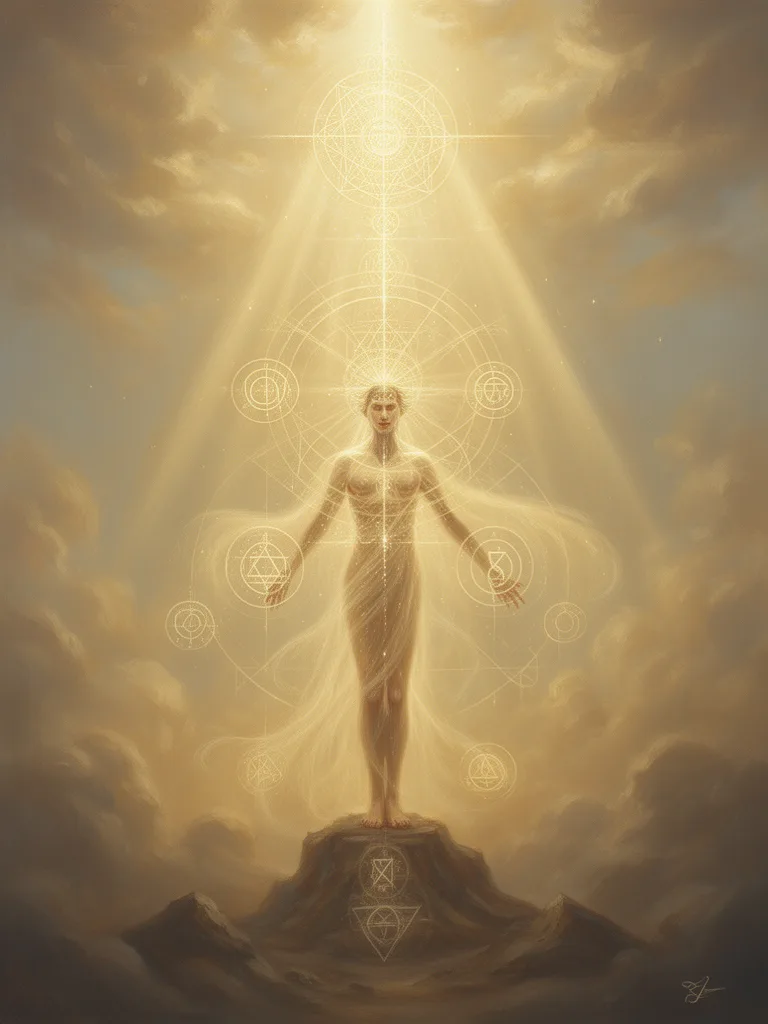
Blavatsky's definition, penned in an era when the implications of Enlightenment thought were still being vigorously debated, captures the core of Deism: a belief in God, yet one profoundly detached from the human drama of revelation and divine intervention. This is not the anthropomorphic deity of Abrahamic faiths, nor the pantheistic immanence that sees God in every leaf and stone. Rather, the Deist God is akin to the master architect, the cosmic engineer who, having designed the universe with exquisite precision, allows its natural laws to unfold autonomously.
This perspective finds echoes in the mechanistic worldview that characterized much of early modern science. Thinkers like Voltaire, while often critical of organized religion, embraced a form of Deism, seeing the order and complexity of nature as irrefutable evidence of a divine designer. It’s a faith built not on the whispers of prophets or the pronouncements of saints, but on the silent, undeniable testimony of the stars, the seasons, and the very fabric of existence. The universe, for the Deist, is its own scripture, its laws the divine text.
The challenge for the modern seeker in understanding Deism lies in its deliberate abstinence from the comforting, or perhaps constraining, narratives of divine presence and guidance. It demands a certain intellectual fortitude, an acceptance of a universe that operates by its own inherent logic, a logic that points to an origin but offers no ongoing dialogue. It is a belief system that respects the majesty of creation while respecting the autonomy of its processes, a profound acknowledgment of the divine in the sheer fact of existence, unadorned by myth or miracle. It invites contemplation of the ultimate cause, not as a participant in our lives, but as the foundational principle of all that is.
RELATED_TERMS: Theism, Pantheism, Agnosticism, Atheism, Natural Theology, Enlightenment Philosophy, Rationalism, Creator Deity
Related esoteric terms
Books on this concept








No reflections yet. Be the first.
Share your interpretation, experience, or question.
