Dead
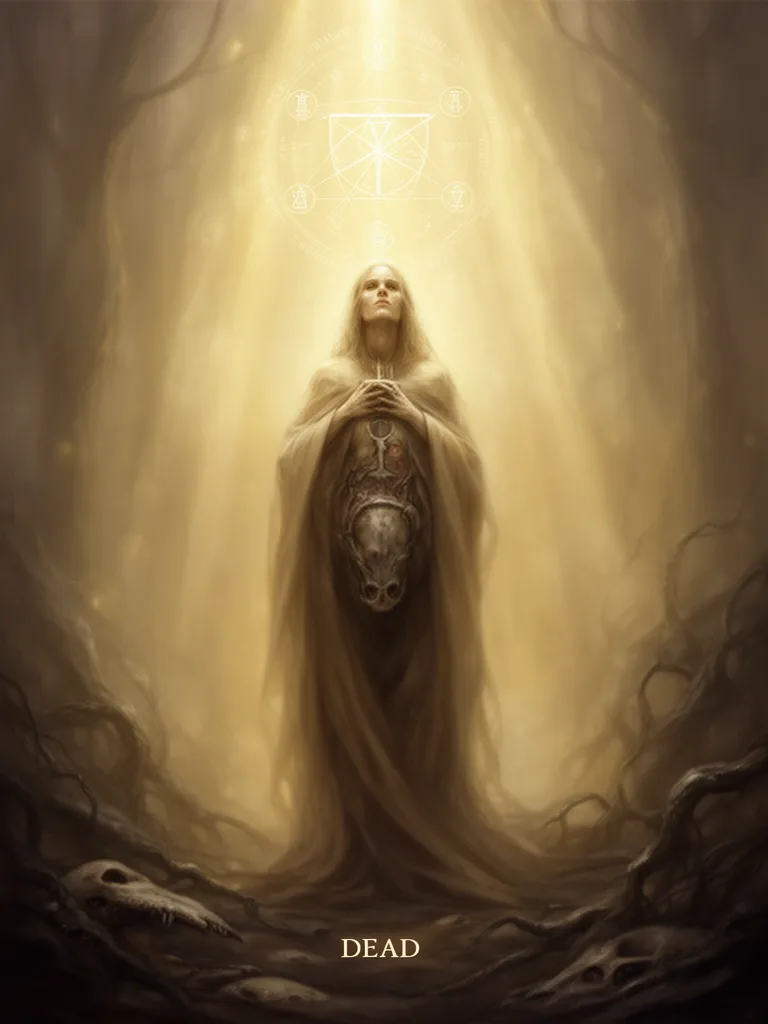
The cessation of biological function, often viewed in esoteric traditions not as an absolute end, but as a transition or transformation of consciousness, energy, or matter, frequently symbolizing the dissolution of the ego or the material form.
Where the word comes from
The term "dead" originates from the Proto-Germanic *dautaz, meaning "having died." It evolved into Old English "dēad" and is cognate with words in other Germanic languages. The concept, however, transcends its linguistic roots, appearing in various forms across ancient mythologies and philosophies to denote the absence of life or the state following it.
In depth
It is Typhon. who havinj; killed Osiris, incarnates in Apap, seeking to kill Ilorus. Like Taoer lor Ta-np-oir) the female aspect of Typhon, Apap is called "the devourer of the souls", and truly, since Apap symbolizi's the animal body, as matter left soulless and to itself. Osiris, beinj;, like all the other Solar gods, a type of the Higher Ego (Christos), Horns (his son) is the lower Manas or the p( rsonal Ego. On many a moiniment one can see Horns, heli)ed by a number of dog-headed gods artned with crosses and spears, killing Apap. Says an Orientalist: "The Cioil Ilorus standing as conqueror upon the Serpent of Evil, may be considered as the earliest form of our well-known group of St. George (who is Michael) and the Dragon, or holiness trampling down sin." Draconianism did not die with the ancient religions, but has passed bodily into the latest Christian form of the worship.
How different paths see it
What it means today
The word "dead" conjures an immediate, visceral finality, a stark punctuation mark at the end of a sentence. Yet, in the vast lexicon of esoteric thought, this punctuation is less an end and more a comma, a pause, a shift in grammatical structure. Blavatsky’s reference to Apap, the serpent of chaos, and Osiris, the resurrected god, frames death not as an absolute void but as a perennial struggle between dissolution and renewal, a cosmic drama playing out within the human psyche and the universe alike. This is echoed in the Hermetic principle of solve et coagula, the alchemical axiom of dissolving and then coagulating, suggesting that what appears to be an ending is merely a prelude to a new formation.
The Sufi concept of fana, or annihilation of the ego, offers a profound parallel. It is a voluntary spiritual death, a conscious letting go of the self-identity that binds us to the impermanent world, in order to realize a more permanent, divine reality. This is not a morbid fascination with demise but a courageous confrontation with the illusion of separateness. Similarly, Buddhist philosophy, in its insistence on impermanence (anicca), positions death as an inherent part of existence, a natural transition within the cycle of rebirth, until the ultimate cessation of suffering in Nirvana.
Mircea Eliade, in his seminal works on religion and myth, explored the universal human impulse to find meaning in death, often through rituals that mediate between the world of the living and the realm of the departed. He highlighted how cultures have consistently sought to understand death not as an absolute negation but as a passage, a transformation. This is evident in Hindu traditions where the soul transmigrates, and in Kabbalistic thought where the soul's journey continues post-mortem, undergoing purification.
For the modern seeker, the esoteric understanding of death offers a radical reorientation. It invites us to see the dissolution of form not as an enemy to be vanquished but as a necessary condition for transformation. It is the shedding of the old skin, the falling of the leaf, the retreat of the tide. This perspective can alleviate the existential dread that often accompanies our awareness of mortality, reframing it as an invitation to live more fully in the present, understanding that the "death" of the ego is a daily practice, a continuous process of letting go, and that the ultimate cessation of biological function is but one phase in an eternal unfolding. It is the ultimate letting go, the final surrender to the grand, mysterious rhythm of existence.
Related esoteric terms
Books on this concept




No reflections yet. Be the first.
Share your interpretation, experience, or question.
