Cosmic Gods
Cosmic Gods are personified creative forces or intelligences responsible for the formation and organization of the material universe. They represent the active, formative aspect of eternal thought impressed upon primordial substance at the dawn of each cosmic cycle.
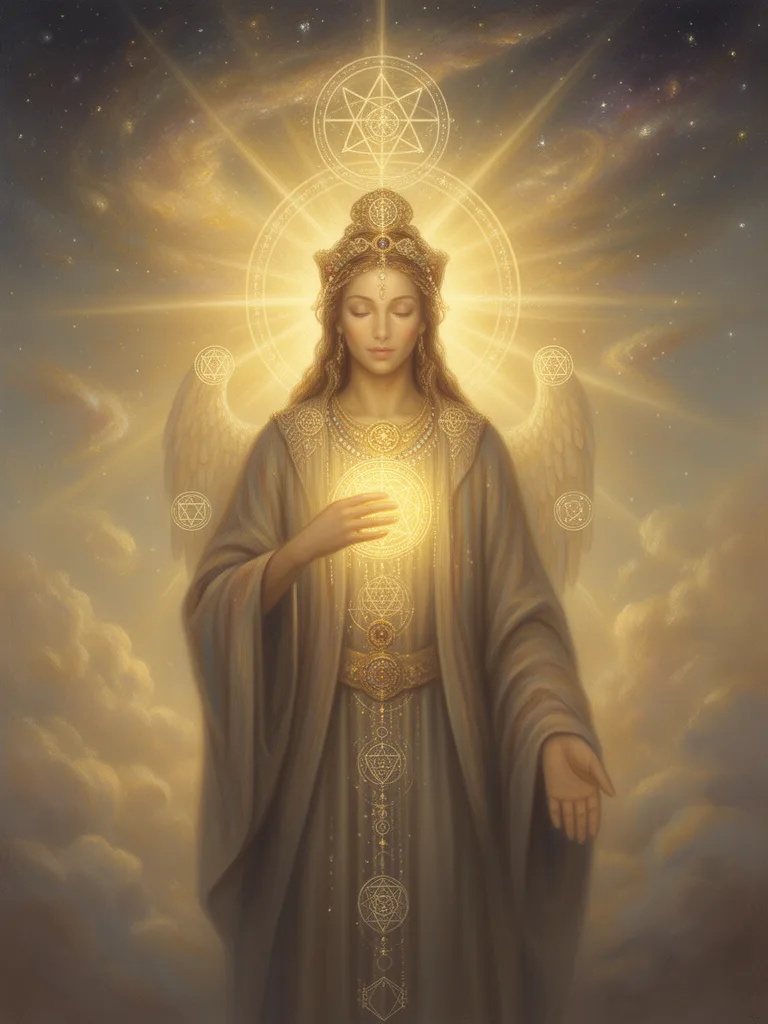
Where the word comes from
The term "Cosmic Gods" is a composite. "Cosmic" derives from the Greek kosmos, meaning order, arrangement, or universe. "Gods" comes from the Old English god, referring to a divine being or deity. The concept aligns with Blavatsky's Cosmocratores, from the Greek kosmokrator, meaning "world rulers" or "rulers of the universe."
In depth
Infi-rioi- ;,'0(is, those connreted with thr formation of matter. Cosmic Ideation lOicult.). Eternal thonj^ht, imi»re.ss«'d on substance or spirit matter, in the eternity; thouj^ht which l)ecome8 active at the l)ej::iniiinj!: of every n»'W life-cycle. Cosmocratores f(ir.). "Builders of tlie Tnivers.'". the "world architects'", or tiie Creative Forces personified.
How different paths see it
What it means today
Blavatsky's formulation of "Cosmic Gods" resonates with a profound, almost alchemical, vision of creation. It sidesteps the often-anthropomorphic deities of simpler faiths to point toward immense, impersonal forces that orchestrate the very fabric of reality. This isn't about beings to be appeased, but about fundamental principles of cosmic order and intelligent design at play. Mircea Eliade, in his studies of the sacred, explored how archaic cultures perceived the world as imbued with divine agency, a notion that finds a sophisticated echo here. The "Cosmic Gods" are akin to the "Builders of the Universe," as Blavatsky notes, echoing the Gnostic Demiurge or the Hindu Trimurti, not as individual personalities, but as personifications of creative impulses.
This concept invites a contemplation of cosmic intention. If the universe is not merely a random aggregation of matter and energy, but the product of "eternal thought," then there is an inherent intelligence, a cosmic ideation, guiding its formation. This resonates with Carl Jung's exploration of archetypes, which he saw as universal patterns of the collective unconscious that shape human experience and, by extension, could be seen as blueprints for cosmic phenomena. The "Cosmic Gods" are the active agents of this cosmic blueprint, the forces that translate abstract ideation into tangible form.
The cyclical nature implied by "at the beginning of every new life-cycle" suggests a cosmic rhythm, a grand inhalation and exhalation of existence. This is a universe that is not born once but is perpetually renewed, a concept explored in various traditions, from the Hindu Yugas to the Stoic conflagration and rebirth. The "Cosmic Gods" are the engineers of this grand, recurring process. For the modern seeker, grappling with a universe that can feel both vast and indifferent, this concept offers a sense of inherent order and purpose, a reminder that the intricate dance of stars and galaxies might be guided by a profound, albeit impersonal, intelligence. It encourages a shift from viewing the universe as a passive stage to an active, divinely animated theater of existence.
RELATED_TERMS: Demiurge, Logos, Divine Mind, Archetypes, Cosmic Cycles, Creative Forces, World Soul, Universal Consciousness
Related esoteric terms
No reflections yet. Be the first.
Share your interpretation, experience, or question.
