Chiim
Chiim, a Hebrew term meaning "lives" or "living beings," appears in ancient texts as a plural descriptor, often associated with divine pronouncements or the totality of existence. It signifies a vibrant, active state of being, distinct from mere inanimate matter.
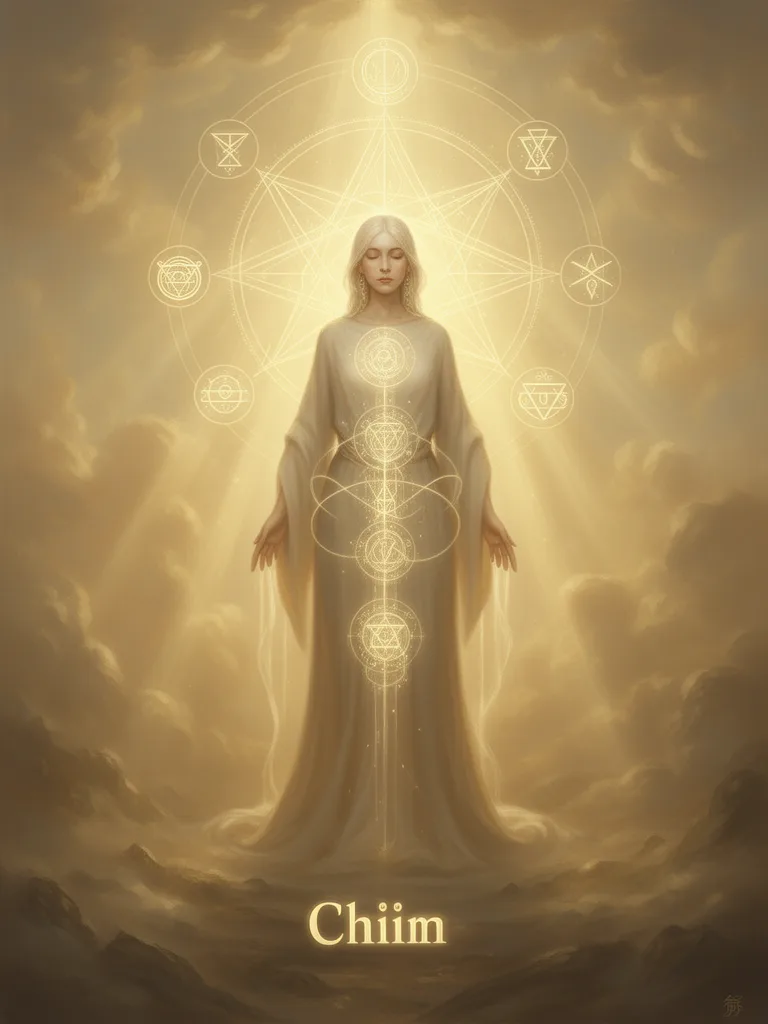
Where the word comes from
The term "Chiim" (חַיִּים) is Hebrew, derived from the root word "Chay" (חַי), meaning "alive" or "living." As a plural noun, it denotes "lives" or "living things." Its usage is ancient, appearing in biblical texts and later in Kabbalistic literature.
In depth
A plural noun — "lives"; found in compound names; Elohim Chiim, the gods of lives, Parkhurst translates "the living God"; and Ranch Chiim, Spirit of lives or of life, [w.w.w.] China, Tlie Kabbalah of. One of the oldest known Chinese books is the Yih King, or Book of Changes. It is reported to have been written 2850 B.C., in the dialect of the Accadian black races of Mesopotamia. It is a most abstruse system of Mental and Moral Philosophy, with a scheme of universal relation and divination. Abstract ideas are represented by lines, half lines, circle, and points. Tiius a circle represents YIH, the Great Supreme ; a line is referred to YIN, the Masculine Active Potency; two half lines are YANG, the Feminine Passive Potency. KWEI is the animal soul, SHAN intellect, KHIEN heaven or Father, 76 TIlHOSOl'JllCAl. KIIWAX tartli or Mother. KAN mQIIIX is Son; inalc iiumlKTs are odd, n-pivsi'iitt'd by li^'it eirc-lts, rtuialc miiiilnTs arc I'ven, by black circU'S. Tlu're arc two most mysterious dia<irams. one calU'd "HO or the River Map", and also associated with a Horse; and the other called "The Writin": of LO"; these are formed of {groups of white and black circles, arran{;ed in a Kabbalistic manner. Tile text is by a Kinjj; named Wan, and the coinincntai'Nby Kan, his son; the text is allowed to be older than the time of Confucius, jw.w.w.] Chit (>^k.). Abstract Consciousness. Chitanuth our (lid).). Chitons, a priestly j;arb ; the "coats of .skin'" yiven by Java Alcim to Adam and Eve after their fall.
How different paths see it
What it means today
Blavatsky's inclusion of "Chiim" within her sprawling lexicon, linking it to ancient Mesopotamian texts and Chinese philosophy, reveals a characteristic syncretic impulse. While the direct linguistic lineage to the Yih King's "Chi" (氣), often translated as vital energy or breath, is tenuous, the underlying resonance of a fundamental life force is undeniable. The Hebrew "Chiim" speaks to a plurality of living entities, a cosmic census of animate existence. It is not merely a biological classification but a theological one, as in "Elohim Chiim," the gods of lives. This phrasing suggests a divine stewardship or origin for the very fact of animation.
Mircea Eliade, in his seminal work "The Myth of the Eternal Return," explores how ancient cultures perceived time and existence not as a linear progression but as a cyclical unfolding of divine manifestations. "Chiim" can be seen as a linguistic marker of this perceived dynamism, the ever-present surge of life emanating from a divine source. In Kabbalistic thought, the concept of "Chayyim" (life) is deeply interwoven with the Sefirot, particularly Keter (Crown), the ultimate divine will, and Chokhmah (Wisdom), from which emanates the divine flow of existence. The plural form emphasizes the myriad ways this divine life expresses itself, from the grandest cosmic forces to the smallest, most ephemeral creature.
For the modern seeker, "Chiim" serves as a potent reminder that the universe is not a sterile, mechanical construct but a vibrant, pulsating entity. It encourages a shift in perspective from viewing life as a rare accident to understanding it as a fundamental, abundant outpouring of being. The term invites us to ponder the interconnectedness of all living things, not just as biological kin, but as participants in a shared, animating principle. This is not a call for sentimental anthropomorphism, but for a recognition of the profound mystery that animates both the stone and the star, the microbe and the mind. It challenges us to perceive the divine not as an abstract, distant deity, but as the very essence of vitality that courses through all that is.
RELATED_TERMS: Jiva, Prana, Ruach, Nephesh, Vital Force, Anima Mundi, Qi
Related esoteric terms
No reflections yet. Be the first.
Share your interpretation, experience, or question.
