Bel
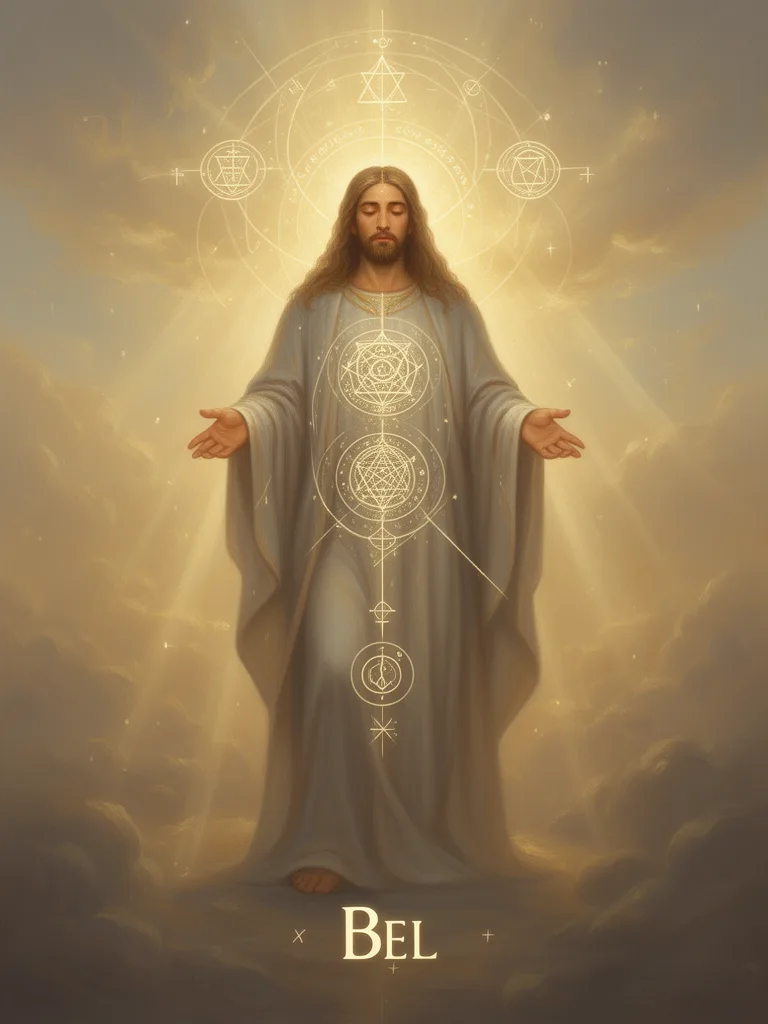
Bel, meaning "Lord" in Akkadian, was the supreme deity of the Babylonian pantheon, often identified with the god Marduk. He represented cosmic order, kingship, and was revered as the creator and sustainer of the universe, embodying divine authority and universal dominion.
Where the word comes from
The name "Bel" derives from the Akkadian word "bēlu," meaning "lord" or "master." It was a title rather than a personal name, applied to various deities, most prominently to Marduk, the patron god of Babylon, who rose to supreme status. The title's usage dates back to the Old Babylonian period.
In depth
The oldest and mightest god of Babylonia, one of the earliest trinities, — Anu iq.v.) ; Bel, "Lord of the World", father of the gods. Creator, and "Lord of the City of Nipur"; and Ilea, maker of fate, Lord of the Deep, God of Wisdom and esoteric Knowledge, and "Lord of the city of Eridu". The wife of Bel, or his female aspect (Sakti), was Belat, or Beltis, "the mother of the great gods", and the "Lady of tiie city of Nipur". The original Bel was also called Enu, Elu and Kaptu (see Chahhaii account uf (tciusis, by G. Smith). Ilis eldest son was the Moon God Sin (whose names were also Ur, Agu and Itu), who was the presiding deity of the city of Ur, called in his honour by one of his names. Now Ur was the place of nativity of Abrara (see "Astrology"). In the early Babylonian religion the Moon was. like Soma in India, a male, and the Sun a female deity. And this led almost every nation to great fratricidal wars between the lunar and the solar worshippers — e.g., the contests between the Lunar and the Solar Dynasties, the Chandra and Suryavansa in ancient Aryavarta. Thus we find the .same on a smaller scale between the Semitic tribes. Abram and his father Teraii are shown migrating from LTr and carrying their lunar god (or its scion) with them; for Jehovah Elohim or El — another form of Elu — has ever been connected with the moon. It is the Jewish lunar chronology which has led the European "civilizt-d" nations into the greatest blunders and mistakes. Merodach. the son of Ilea, became the later Bel and was worshipped at Babylon. Ilis other title, Belas, has a number of synil)()lic meanings.
How different paths see it
What it means today
The figure of Bel, particularly as identified with Marduk, offers a compelling lens through which to examine the ancient human impulse to personify cosmic governance. In the vast, often chaotic expanse of the early world, the establishment of a supreme deity like Bel provided a necessary anchor of order, a divine sovereign whose authority mirrored the aspirations for earthly kingship and societal structure. As Mircea Eliade illuminated in his studies of myth and religion, such supreme gods often emerge during periods of cultural consolidation, serving to legitimize the ruling powers and unify diverse populations under a shared celestial mandate.
Bel's title, "Lord of the World," is not merely a boast but an articulation of a fundamental human yearning: to find meaning and order in the universe, to believe that a benevolent, authoritative force guides its unfolding. This impulse is visible across cultures, from the Zeus of the Greeks to the higher gods in many indigenous traditions. The shift in Babylonian religion, elevating Marduk to the status of Bel, reflects a dynamic process of theological evolution, where local deities could ascend to cosmic prominence, embodying the aspirations of a rising urban center.
The association of Bel with creation and the establishment of cosmic laws speaks to a profound philosophical inquiry into origins and sustenance. He is not just a distant creator but an active participant, the sustainer of the very order he brought into being. This resonates with the psychological need for a secure, predictable cosmos, a world governed by divine wisdom and power, rather than arbitrary chance. The very concept of "lordship" implies a relationship of responsibility and care, a divine shepherd for the human flock and the cosmic order.
In contemporary thought, while the anthropomorphic deity may have receded for many, the underlying need for order, for a guiding principle, persists. Bel's legacy, therefore, is not just a historical artifact but a testament to the enduring human quest for meaning and structure, a quest that continues to shape our understanding of ourselves and the universe, prompting us to seek patterns and purpose in the grand, often inscrutable, narrative of existence.
Related esoteric terms
Books on this concept








No reflections yet. Be the first.
Share your interpretation, experience, or question.
