Attis
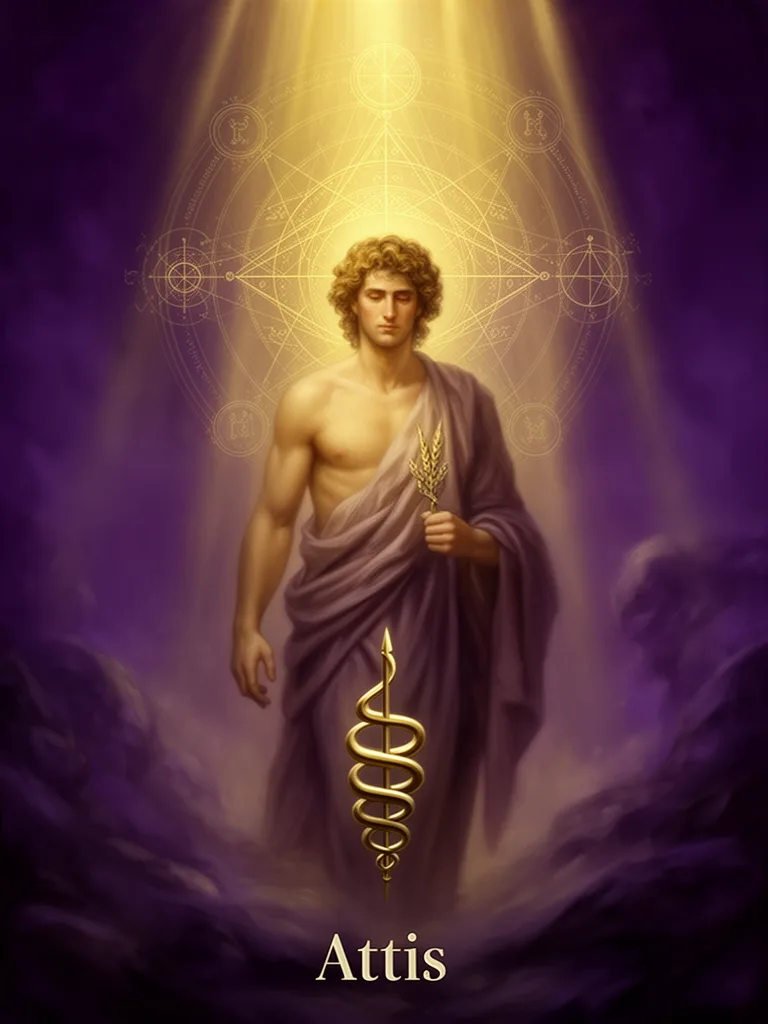
Attis is a Phrygian deity associated with vegetation, death, and rebirth, often depicted as the consort of the Great Mother Cybele. His myth, involving self-mutilation and resurrection, symbolizes the cyclical renewal of nature, particularly the dying and returning life of plants.
Where the word comes from
The name Attis likely derives from Phrygian or Lydian roots, possibly related to words for "father" or "child," reflecting his complex role as both a divine figure and a symbol of fertility. Its precise linguistic origin remains debated among scholars, with connections to Anatolian languages.
In depth
Attis (; Ancient Greek: Ἄττις, also Ἄτυς, Ἄττυς, Ἄττης) was the consort of Cybele, in Phrygian and Greek mythology. His priests were eunuchs, the Galli, as explained by origin myths pertaining to Attis castrating himself. Attis was also a Phrygian vegetation deity. His self-mutilation, death, and resurrection represents the fruits of the earth, which die in winter only to rise again in the spring. According to Ovid's Metamorphoses, Attis transformed himself into a pine tree.
How different paths see it
What it means today
The figure of Attis, a vibrant yet tragic deity from the ancient Phrygian pantheon, resonates with a profound, almost visceral, truth about existence. His story, intricately woven with the Great Mother Cybele, speaks to the primal forces of nature – its fertility, its inevitable decay, and its miraculous resurgence. Mircea Eliade, in his seminal works on religion, often explored such cyclical myths as fundamental expressions of the human psyche's engagement with the cosmos. Attis's self-mutilation, a ritualistic act performed by his priests, the Galli, while shocking to modern sensibilities, was understood in antiquity as a potent symbol of renunciation and ecstatic devotion. It was a sacrifice that mirrored the earth's own giving of its bounty, a process that involves the death of seeds to bring forth new life.
This act of self-abnegation, transforming the physical into the symbolic, points towards a deeper spiritual economy. It suggests that the vital energy, the very essence of life, can be transmuted. In the Western esoteric tradition, particularly as it intersects with Hermeticism, this resonates with the alchemical axiom solve et coagula – dissolve and coagulate. The dissolution of the old self, the shedding of attachments and limitations, is a necessary precursor to the coagulation of a new, more refined spiritual form. Attis's transformation into a pine tree, a symbol of eternal life and resilience, further underscores this theme of enduring transformation beyond physical death. It is a reminder that the fruits of the earth, like the fruits of the spirit, are born from a process of dying and becoming, a continuous cycle of renewal that animates both the natural world and the human soul. The myth of Attis, therefore, is not merely an ancient story but a profound meditation on the nature of sacrifice, transformation, and the enduring power of life.
RELATED_TERMS: Cybele, Adonis, Osiris, Persephone, Vegetation Deities, Mystery Religions, Resurrection, Sacrifice
Related esoteric terms
Books on this concept







No reflections yet. Be the first.
Share your interpretation, experience, or question.
