Anu
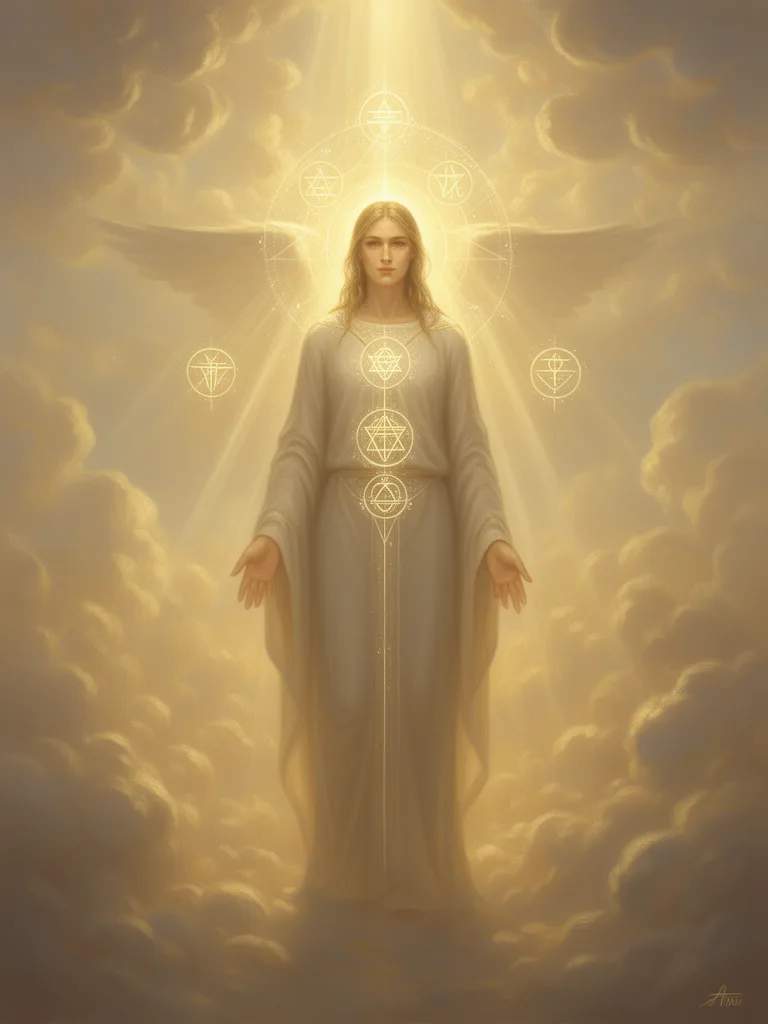
Anu is a primordial concept representing the smallest indivisible particle or essence, often associated with divinity or the fundamental building block of existence. It suggests a paradoxical unity of the infinitely small and the infinitely large, hinting at pantheistic or panentheistic views of the divine.
Where the word comes from
The term "Anu" is most prominently associated with ancient Mesopotamian mythology, where it referred to the sky god and a supreme deity. In Sanskrit, "anu" (अणु) signifies an atom or a minute particle. The latter meaning aligns with Blavatsky's interpretation, suggesting a conceptual bridge between the divine essence and the elemental constituents of the cosmos.
In depth
All "atom", a title of Braliiiia, who is said to be an atom just as is the infinite universe. A hint at the jiantheistie nature of the god.
How different paths see it
What it means today
Blavatsky's interpretation of "Anu" as both "atom" and a title for Brahma invites a contemplation that transcends mere etymological curiosity. It speaks to a profound cosmic philosophy, one that sees the divine not as a distant architect, but as the intrinsic essence woven into the very warp and weft of existence, down to its most elemental constituents. This idea, that the infinite can be found within the infinitesimal, echoes across spiritual traditions. Mircea Eliade, in his studies of archaic religions, frequently highlighted the sacredness of the microcosm, the belief that the patterns of the cosmos are replicated in the smallest forms. Carl Jung, in his exploration of the collective unconscious, recognized archetypal patterns that manifest in both grand narratives and the minutiae of individual experience. The concept of Anu challenges our modern tendency to compartmentalize, to separate the divine from the material, the spiritual from the scientific. It suggests that the "atom" of the physicist, the irreducible particle, might also be a locus of the sacred, a point where the universe folds in upon itself. This is not a pantheistic assertion that God is everything, but perhaps a panentheistic suggestion that everything is in God, and that God's presence is most intimately felt in the fundamental building blocks of reality. To consider Brahma as an atom is to understand that the creative principle is not distant but immanent, a force that permeates and animates the smallest speck of dust as much as the grandest celestial sphere. It is a call to find the infinite in the finite, a practice that requires a profound shift in perception, a willingness to see the divine not in the spectacle, but in the silent, indivisible core of all things. This perspective encourages a reverence for the fundamental, a recognition that the universe's grandeur is not solely in its vastness, but also in its exquisite, elemental precision. The contemplation of Anu, therefore, becomes a path to a more integrated understanding of existence, where the sacred is not a separate domain but the very ground of being, present in every atom, every breath, every moment. It is a reminder that the universe is not merely made of atoms, but that the atoms themselves are imbued with a cosmic significance, a divine breath that animates them.
Related esoteric terms
Books on this concept







No reflections yet. Be the first.
Share your interpretation, experience, or question.
