Monad
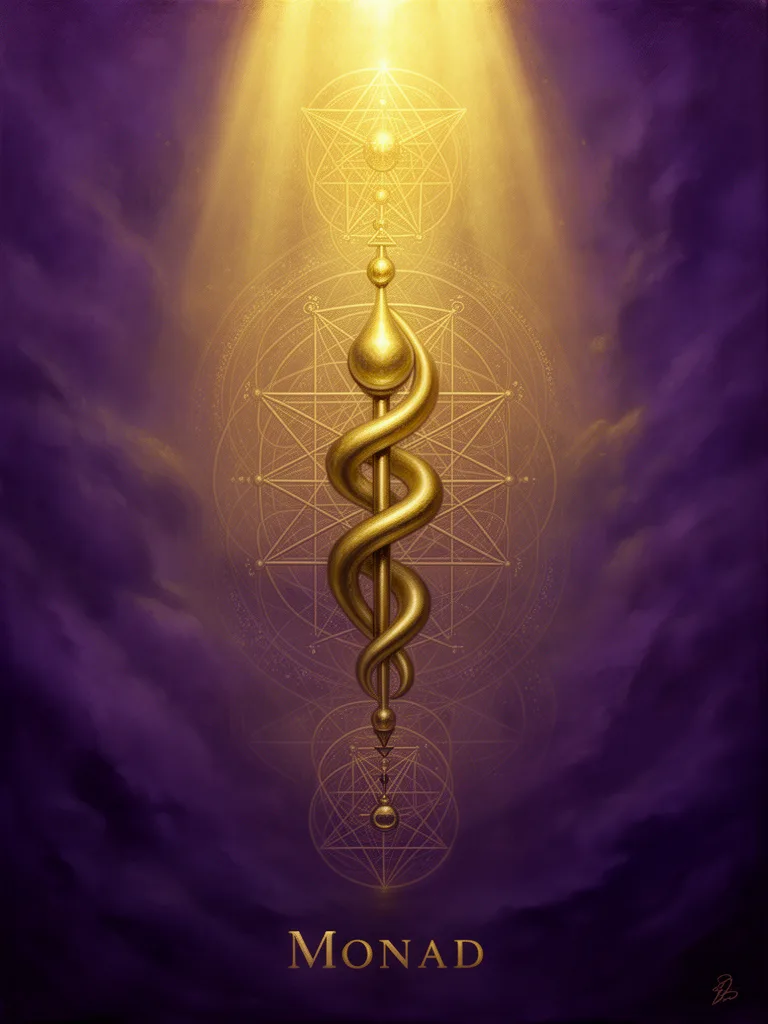
The Monad is the ultimate, indivisible unity, the primordial source from which all existence emanates. In Hermetic and Theosophical thought, it represents the divine spark within, often seen as the unified principle of spirit, consciousness, and intellect that transmigrates through various forms.
Where the word comes from
Derived from the Greek "monas" (μονάς), meaning "unit" or "single thing," itself from "monos" (μόνος), meaning "alone." The term gained prominence in philosophy through Pythagoras and later became central to Neoplatonism and Gnosticism, signifying the absolute One.
In depth
The Unity, the one; but in Occultism it oftt-n means the unifit'd triad, Atma-Buddhi-]Manas, or the duad, Atma-Buddhi, that immortal part of man which reincarnates in the lower kingdoms, and gradually progresses through them to Man and then to the final goal — Nirvana.
How different paths see it
What it means today
The concept of the Monad, as explored in Hermeticism and echoed in other esoteric traditions, offers a profound counterpoint to the fragmented experience of modern life. It speaks to an original, unbroken wholeness, a divine singularity from which all diversity springs. This is not a distant, aloof deity but an active, generative principle, a cosmic seed from which the garden of existence unfolds.
In the context of Blavatsky's definition, the Monad is not just the abstract "One" but also the dynamic, individualized spark of that One that journeys through the evolutionary cycles. This journey, from lower kingdoms to the human state and beyond, suggests a teleological impulse within the universe, a constant movement towards self-realization and reunion with the source. Mircea Eliade, in his studies of shamanism and archaic religions, noted the pervasive human intuition of a sacred origin, a primal unity that underlies the perceived chaos of the world. The Monad taps into this deep-seated longing for connection to a fundamental reality.
The philosophical underpinnings, traced from Pythagoras through Plotinus, emphasize the ineffability of the Monad. It is beyond description, beyond categorization, the ultimate simplicity that contains all complexity. This echoes the apophatic theology found in various mystical traditions, where the divine is best approached through negation, by stripping away all limiting attributes. For the modern seeker, the Monad serves as a reminder that beneath the surface of our manifold experiences—our thoughts, emotions, and sensory perceptions—lies an irreducible core of being, a spark of the divine that is eternally whole. It is an invitation to look inward, not for a constructed self, but for the recognition of this inherent unity, a silent, luminous presence that is the ground of all our becoming. The practice, then, becomes less about acquiring something new and more about remembering what has always been, a homecoming to the singular source.
RELATED_TERMS: The Absolute, Brahman, Godhead, Unity, The One, Atman, Logos
Related esoteric terms
Books on this concept






No reflections yet. Be the first.
Share your interpretation, experience, or question.
