Amun
Amun, originally a local deity of Thebes, evolved into a supreme creator god in ancient Egyptian religion, often syncretized with the sun god Ra as Amun-Ra. He represented the hidden, the unseen essence of existence, and the vital breath of life, accessible through initiation.
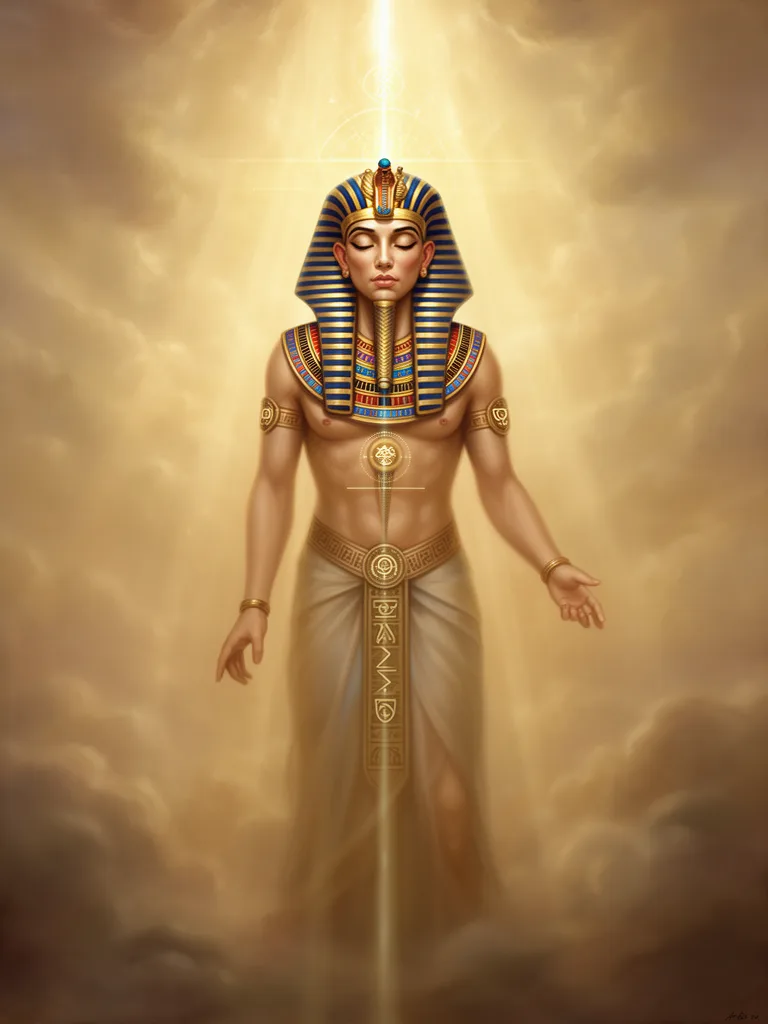
Where the word comes from
The name "Amun" likely derives from the Egyptian "Imn," meaning "hidden" or "the hidden one." This appellation underscores his elusive, transcendent nature. Its precise linguistic roots are debated, but the concept of the concealed deity is ancient within Egyptian cosmology.
In depth
The Egyptian god of wisdom, Avho had only Initiates or Hierophants to serve him as priests.
How different paths see it
What it means today
In the sprawling pantheon of ancient Egypt, Amun emerges not merely as a god but as a profound symbol of the ineffable, the divine veiled in mystery. His epithet, "the Hidden One," speaks to a fundamental human impulse: to apprehend that which lies beyond the immediate grasp of the senses, the ultimate source from which creation springs. This is not a god of thunderous pronouncements or overt displays of power, but one whose presence is felt in the subtle currents of existence, in the very breath that animates the world.
Mircea Eliade, in his seminal work "The Myth of the Eternal Return," illuminates how ancient cultures grappled with the sacred, often locating it in hidden, primordial spaces or potent, unseen forces. Amun embodies this. His priesthood, restricted to "Initiates or Hierophants," points to a tradition of esoteric knowledge, a path of ascent where understanding is earned through rigorous spiritual discipline and inner transformation. This resonates with the alchemical tradition, where the pursuit of the philosopher's stone is as much an internal purification as an external manipulation of matter.
The syncretism of Amun with Ra, becoming Amun-Ra, the supreme sun god, further complicates and enriches his nature. He becomes both the hidden, generative principle and the manifest, life-giving energy. This duality mirrors psychological archetypes, such as the shadow self and the luminous ego, suggesting that true wholeness involves integrating the concealed aspects of the divine and the self. Carl Jung’s exploration of the collective unconscious and archetypes offers a modern lens through which to understand how these ancient deities continue to speak to our inner lives, representing fundamental patterns of human experience and spiritual longing.
The concept of Amun, therefore, is not confined to the sands of ancient Egypt. It whispers across traditions, a persistent echo of the search for ultimate reality. It is the silent hum beneath the cacophony of the material world, the unseen architect whose blueprints are etched in the very fabric of being. To contemplate Amun is to turn inward, to acknowledge the profound wisdom that lies not in what is seen, but in what is deeply, often imperceptibly, felt.
RELATED_TERMS: Brahman, The Absolute, Gnosis, The Unmanifest, Prima Materia, Logos, Ain Soph, The Tao ---
Related esoteric terms
Books on this concept







No reflections yet. Be the first.
Share your interpretation, experience, or question.
