Amen
A word of affirmation and assent, "Amen" historically signifies truth, certainty, and the hidden divine. It functions as a seal on prayers and declarations, connecting the human to the ineffable, echoing ancient Egyptian concepts of a concealed yet manifest deity.
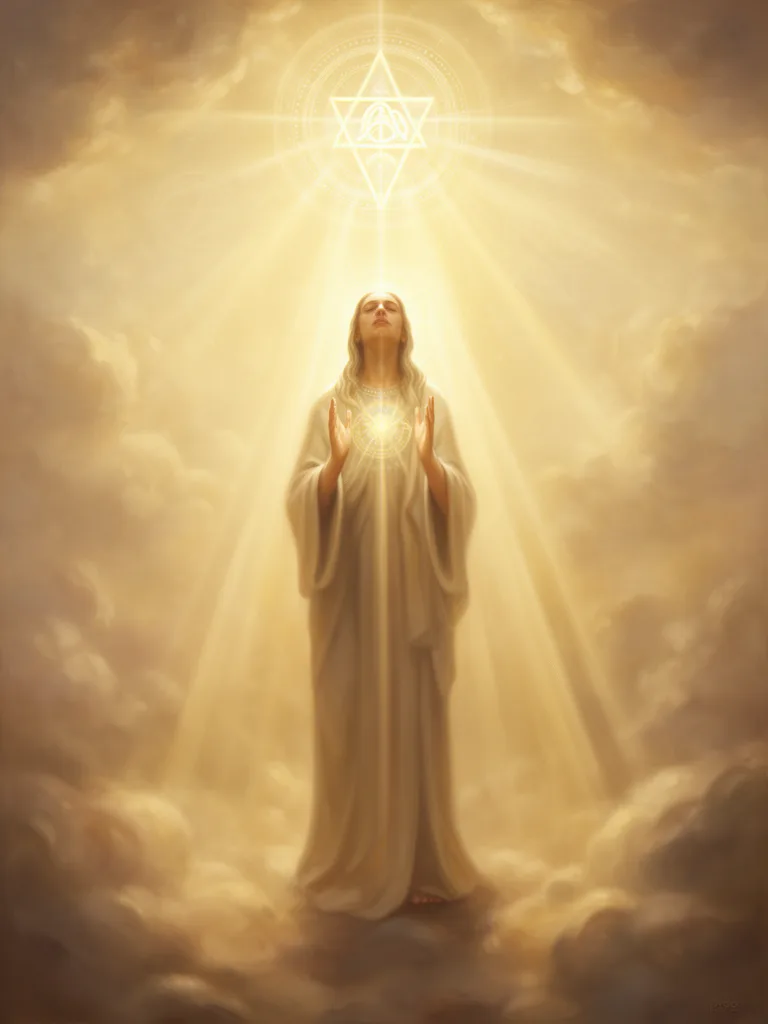
Where the word comes from
The word "Amen" derives from the Hebrew āmēn, meaning "truth" or "certainty." Its roots are also found in the Egyptian ymn, referring to the hidden god Amun. The numerical value in Hebrew gematria, 91, is significant, aligning with other sacred names, suggesting a deeper, numerical resonance of divine presence.
In depth
Jn Hebrew is formed of the letters A M N = 1, 40, 50 = 91, and is thus a simile of "Jehovah Adonai'' = 10, 5, 6, 5 and 1, 4, 50, 10 =91 together; it is one form of the Hebrew word for "truth". In common parlance Amen is said to mean "so be it", [w.w.w.] But, in esoteric parlance Amen means "the concealed". Manetho Sebennites says the word signifies that which is hi(l(h n and we know througii Hecata'us and others that the Egyptians used tiic word to call upon their great God of Mystery, Amraon (or "Ammas, the hidden god") to make iiimself conspicuous and manifest to them. Bonomi, the famous hieroglyphist, calls his worshipj)ers very pertinently the "Amenoph", and ]Mr. Bonwick (piotes a writer who says: "Amnion, the hidden god, will remain for ever hidden till anthropomorphically revealed; gods who are afar off are useless". Ami-n is styled "Lord of the new-moon festival". Jehovah-Adonai is a new form of the ram-headed god Amoun or Amnion {q.v.) who was invoked by the Egyptian priests under the name of Amen.
How different paths see it
What it means today
The simple utterance of "Amen," so familiar in religious discourse, conceals a profound depth, a resonance that stretches back to the dawn of civilization. Blavatsky, in her characteristic manner, points to its Egyptian antecedents, linking it to Amun, the "hidden god," a deity invoked to make himself conspicuous, to manifest. This duality—the concealed and the revealed—is the very heart of esoteric understanding. The Egyptian priests, in calling upon Amun-Amen, were not merely petitioning a distant power; they were, in essence, affirming the presence of the divine within the very fabric of their seeking. Mircea Eliade, in his exploration of the sacred, often highlighted how the manifestation of the divine, the hierophany, breaks through ordinary reality, making the invisible visible. "Amen" functions as a verbal hierophany, a word that seals a prayer, a declaration, an intention, thereby solidifying its connection to the divine source. It is not merely agreement, but an ontological affirmation, a statement of participation in a truth that transcends the speaker. Like the alchemist's final seal on a perfected elixir, or the mystic's silent contemplation of the Godhead, "Amen" bridges the gap between the phenomenal and the noumenal, the spoken word and the eternal silence from which it arises. It is the echo of the primordial creative act, a human voice finding its harmony with the cosmic hum. To truly understand "Amen" is to grasp the inherent paradox of existence: that the most profound truths are often the most deeply hidden, yet are made known through the very act of seeking and affirming.
RELATED_TERMS: Truth, Affirmation, Divine Name, Manifestation, Hiddenness, Gematria, Sacred Utterance, Hierophany
Related esoteric terms
Books on this concept




No reflections yet. Be the first.
Share your interpretation, experience, or question.
