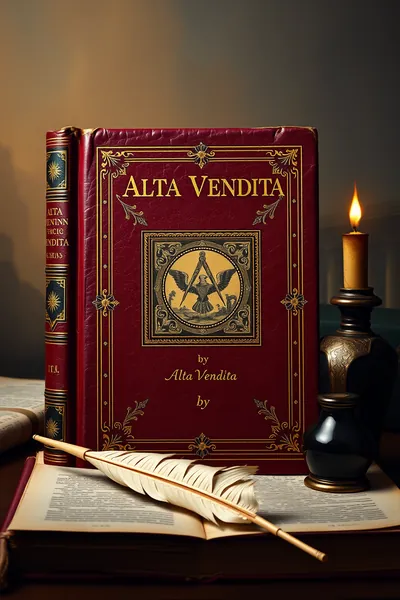
Alta Vendita
The Alta Vendita refers to a set of secret instructions attributed to the highest lodge of the Italian Carbonari, a revolutionary society. Published in 1859, these documents allegedly outlined a long-term strategy for infiltrating and subverting Catholic institutions, aiming to secularize society and promote liberal ideals. Its authenticity and origins remain debated.
Where the word comes from
The term "Alta Vendita" is Italian, literally translating to "High Sale" or "High Market." It likely refers metaphorically to a high-level, clandestine transaction or agreement. The documents themselves first appeared in print in 1859, though their purported origins trace back earlier within the secretive structure of the Carbonari.
In depth
The Permanent Instruction of the Alta Vendita (commonly called the Alta Vendita, "high marketplace") is a document originally published in Italian in 1859, claimed by some Catholics to have been produced by the highest lodge of the Italian Carbonari and written by "Piccolo Tigre" ("Little Tiger"). "Piccolo Tigre" is supposedly the pseudonym of a Jewish Freemason (according to George F. Dillon, a proponent of the theory of a Masonic war against Christian civilisation).
How different paths see it
What it means today
The spectral presence of the Alta Vendita in the annals of conspiracy theory offers a curious lens through which to examine anxieties about institutional power and hidden influence. Attributed to the Carbonari, a 19th-century Italian revolutionary movement, these alleged secret instructions painted a chillingly prescient picture of long-term strategy aimed at subverting established religious and political orders. The very idea of a "Permanent Instruction" suggests a temporal sweep far beyond immediate political gains, a patient, almost alchemical process of societal transformation.
While its authenticity remains a subject of fervent debate, the enduring power of the Alta Vendita narrative lies in its resonance with a deep-seated human tendency to perceive orchestrating hands behind the grand, often bewildering, movements of history. It taps into a primal fear of the unseen, the manipulation of the visible by the invisible, a theme that echoes throughout esoteric thought. Mircea Eliade, in his studies of shamanism and the sacred, often highlighted the importance of hidden knowledge and secret societies in maintaining cosmic order or initiating transformative change. The Alta Vendita, in its own dark way, plays with this notion of hidden knowledge, albeit with a decidedly secular and subversive intent.
The document's alleged focus on infiltrating and corrupting institutions mirrors, in a distorted fashion, the initiatory pathways found in many mystical traditions. However, where Hermeticism or Sufism might speak of inner purification and ascent, the Alta Vendita proposes an external, societal descent through strategic manipulation. It is a testament to the enduring human fascination with power, both overt and covert, and the belief that understanding the hidden mechanisms of control can offer a path to either mastery or liberation. The specter of the Alta Vendita serves as a potent reminder that narratives of influence, whether real or imagined, continue to shape our understanding of the world.
Related esoteric terms
Books on this concept



No reflections yet. Be the first.
Share your interpretation, experience, or question.
