Aheie
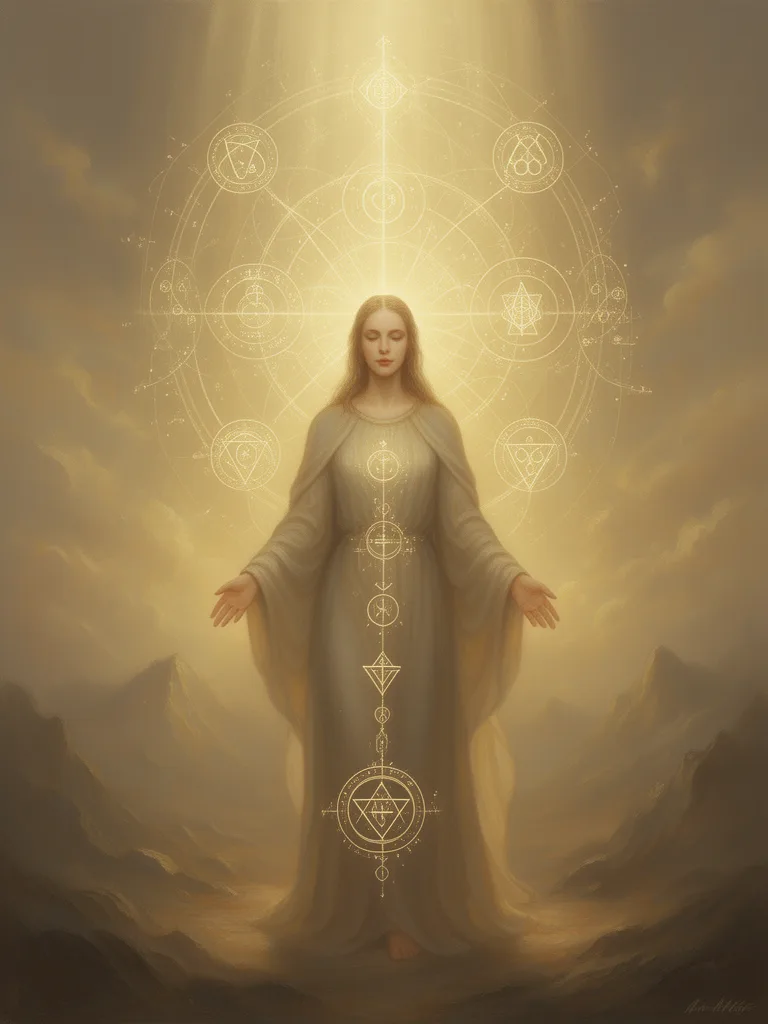
Aheie, often transliterated as Eheieh or Ehyeh, is a divine name in Kabbalistic tradition, signifying "I Am Who I Am" or "I Will Be Who I Will Be." It represents the ultimate, unmanifest divine essence, the primordial, self-existent being from which all existence flows.
Where the word comes from
The term derives from the Hebrew root היה (h-y-h), meaning "to be" or "to exist." It is the first-person singular imperfect form of this verb, appearing in Exodus 3:14 as God's self-declaration. Scholarly consensus points to its profound theological significance as a statement of eternal, unconditioned existence.
In depth
p]xistenee. lie wlio exists; corresponds to Kether and Macroprosopus. Ah-hi (Scnsar), Ahi (Sk.), or Serpent.s. Dliyan Chohans. "\Vi.se Serpents" or Dragons of Wisdom.
How different paths see it
What it means today
In the dense, luminous cosmology of Kabbalah, Aheie emerges not merely as a name but as a divine utterance, a primal exhalation of being. It is the whispered secret of existence itself, the echo of the uncaused cause. Blavatsky, in her characteristic synthesis, links it to the "Wise Serpents" or "Dragons of Wisdom," a potent image evoking ancient, primordial knowledge, a serpentine understanding that coils at the root of creation. This is not the serpent of temptation, but the serpent of gnosis, as seen in the Ophites or the alchemical uraeus. The name, tied to Kether, the Crown, signifies the ultimate, undifferentiated divine will, the point of pure potentiality before the unfolding of the Sefirot, the divine emanations. For the modern seeker, grappling with a universe often perceived as fragmented and chaotic, Aheie offers a profound anchor. It is the assurance of an underlying unity, a self-existent source that is not merely a distant creator but the very fabric of reality. Mircea Eliade, in his studies of the sacred, often pointed to the power of primordial names and utterances to connect the individual to the eternal. The contemplative practice, in this light, might involve meditating on this divine name, not as a petition, but as an affirmation of one's own participation in that ultimate, unconditioned "I Am." It is the recognition that the deepest self is not a fleeting ego but a spark of that eternal, self-subsisting divine essence. The challenge lies in moving beyond intellectual assent to a felt apprehension of this primordial reality, a realization that resonates with the stillness at the heart of all movement.
Related esoteric terms
No reflections yet. Be the first.
Share your interpretation, experience, or question.
