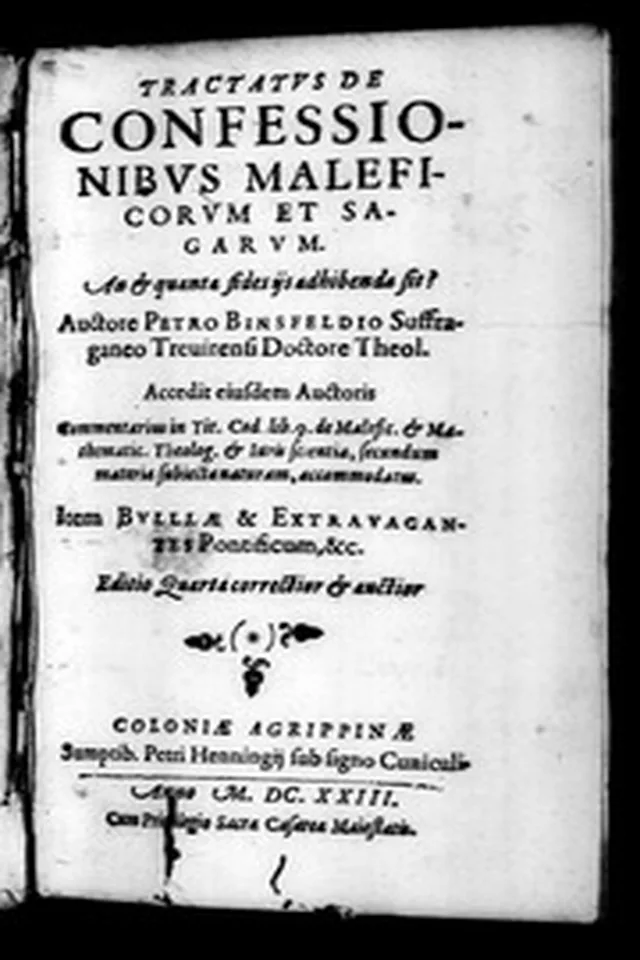
Tractatvs de confessionibvs maleficorvm et sagarum. An & quanta fides ijs adhibenda sit? Auctore Petro Binsfeldio ... 1623: Iss 113
 80
80

Tractatvs de confessionibvs maleficorvm et sagarum. An & quanta fides ijs adhibenda sit? Auctore Petro Binsfeldio ... 1623: Iss 113



Pierre Binsfeld's "Tractatus de Confessionibus Maleficorum et Sagarum" (1623) stands as a critical examination of the judicial and theological framework surrounding witchcraft confessions. As Associate Editor Sophia Crane, I find Binsfeld's rigorous approach to evaluating testimony illuminating. He dissects the reliability of accused witches' confessions, probing the psychological and social pressures that could lead to such admissions. This work is invaluable for scholars of early modern legal history, religious studies, and the sociology of belief. Its strength lies in its systematic analysis, offering insights into the legalistic parsing of diabolical pacts and spectral evidence. It is an essential text for those seeking to understand the mechanics behind historical accusations and the intellectual currents that shaped the persecution of alleged sorcerers.
📝 Description
80
Pierre Binsfeld's 1623 treatise examines the credibility of confessions from the accused in witchcraft trials.
Published in 1623, Pierre Binsfeld's "Tractatus de Confessionibus Maleficorum et Sagarum" analyzes how much weight should be given to the confessions of those accused of witchcraft. Binsfeld, a jurist involved in the legal and theological discussions of his era, scrutinizes the nature of evidence presented in such cases. He also looks into the psychology behind confessions and the societal fears that drove the witch hunts. This book is more than just a historical record; it is an examination of belief systems, delusions, and the fragile distinction between perceived supernatural actions and human error. It gives the reader insight into the hidden reasons for fear and how 'occult' realities were shaped within a strict social structure. The work prompts reflection on the basis of belief and how stories can influence what is accepted as truth, relevant for those interested in the darker aspects of human behavior and historical occultism.
This work sits within a tradition of juridical and theological texts that grappled with the supernatural during the early modern period. While not occult literature itself, it addresses beliefs about maleficium and the legal frameworks that attempted to understand and prosecute it. It reflects a period where the lines between criminal justice, religious doctrine, and popular belief regarding magic and demonic influence were intensely debated and codified.
💡 Why Read This Book?
Uncover the complex legal and theological arguments surrounding witch confessions in the early modern period. Understand how societal fears influenced justice and the construction of occult narratives. Essential for scholars of history, law, religion, and practitioners interested in the historical interpretation of witchcraft and its legal ramifications.
⭐ Reader Reviews
Honest opinions from readers who have explored this book.
❓ Frequently Asked Questions
What is the primary focus of Binsfeld's "Tractatus de Confessionibus Maleficorum et Sagarum"?
The book primarily analyzes the credibility and weight given to confessions made by individuals accused of witchcraft and sorcery, examining the legal and theological justifications for such testimonies.
Who was Pierre Binsfeld and what was his role?
Pierre Binsfeld was a jurist and legal scholar of the early 17th century, actively engaged in the judicial and theological discourse surrounding witchcraft trials.
What historical period does this text illuminate?
This text significantly illuminates the early 17th century, a period rife with intense witch-hunting and ongoing debates about the nature of sorcery and its prosecution.
Is this book for beginners in occult studies?
While foundational, its dense legal and theological arguments make it more suited for advanced students, scholars, or those with a specific interest in the historical legal aspects of witchcraft.
What kind of 'occult' knowledge does this book offer?
It offers insight into the historical 'occult' through the lens of legal and theological interpretation of alleged supernatural acts, rather than practical occult instruction.
🔮 Key Themes & Symbolism
The Nature of Confession and Testimony
Binsfeld meticulously dissects the concept of 'confession' within the context of witchcraft accusations. He interrogates the veracity of statements extracted under duress, from individuals potentially suffering from psychological distress or manipulation. The work explores the philosophical and theological arguments about whether confessions could be considered reliable evidence, especially when concerning alleged pacts with demonic entities. It examines the legal procedures and societal pressures that often coerced these admissions, highlighting the complex interplay between perceived guilt and the mechanisms of justice.
Societal Fear and the Construction of the 'Witch'
This treatise provides a stark glimpse into the pervasive societal fears that fueled the witch hunts. Binsfeld's analysis reveals how the collective anxieties about demonic influence, social disorder, and personal misfortune were projected onto accused individuals. The text explores how 'confessions' served to solidify these fears, providing a narrative framework for understanding perceived malevolent forces. It illustrates the process by which individuals were constructed as 'malefici' and 'sagarum' (sorcerers and witches) through legal pronouncements and public belief, often irrespective of actual wrongdoing.
Legal and Theological Interpretations of the Occult
Fundamentally, Binsfeld's work is a legal and theological document attempting to reconcile Christian doctrine with judicial practice concerning alleged occult activities. It examines how biblical passages, patristic writings, and contemporary theological debates were applied to the interpretation of witchcraft. The treatise grapples with questions of divine permission, demonic agency, and the boundaries of human knowledge in discerning supernatural phenomena. This provides crucial insight into the intellectual landscape that legitimized and guided the persecution of those accused of practicing forbidden arts.
💬 Memorable Quotes
Direct passages from the work, attributed to the author.
“An & quanta fides ijs adhibenda sit?”
— This Latin interrogative, meaning 'And how much faith should be given to them?', is the central question driving Binsfeld's rigorous examination of witch testimonies.
“Maleficorum confessiones, quibus daemonum opera attribuitur, non semper verae sunt.”
— The confessions of malefactors, to which the work of demons is attributed, are not always true. This highlights Binsfeld's critical stance on the automatic acceptance of such claims.
“Timor et tormenta mentem turbant.”
— Fear and torment disturb the mind. This poignant observation underscores the psychological impact of interrogation methods on the reliability of confessions.
“Sicut ignis, ita et maleficium, aliis nocet, aliis non.”
— Just as fire, so also malevolence, harms some, but not others. This analogy suggests a nuanced view on the perceived effects of witchcraft, hinting at its subjective interpretation.
“Veritas odium parit.”
— Truth begets hatred. This aphorism reflects the potential for uncovering difficult truths to provoke negative reactions, relevant to the controversial nature of witchcraft accusations.
🌙 Esoteric Significance
Tradition
While not a manual of occult practice, this work is deeply significant within the esoteric tradition of understanding belief systems and the societal construction of the 'other.' It falls within the lineage of demonological and legalistic texts that, paradoxically, illuminated the perceived mechanics of magic and devil-worship, even while condemning it. It offers insight into how esoteric concepts like pacts with demons and the misuse of natural forces were understood and adjudicated within a specific historical and intellectual framework.
Symbolism
The 'maleficorum' (sorcerers) and 'sagarum' (witches) themselves become potent symbols within Binsfeld's analysis. They represent the embodiment of societal anxieties, the perceived corruption of natural order, and the tangible manifestation of demonic temptation. The 'confession' acts as a symbolic ritual, a public acknowledgment of a hidden pact and a surrender to perceived external powers. The legal process surrounding these confessions symbolizes the societal attempt to exorcise perceived evil and restore a divine equilibrium.
Modern Relevance
In a modern context, Binsfeld's work speaks to contemporary discussions on misinformation, mass hysteria, and the psychology of belief. It offers a historical case study on how fear, prejudice, and flawed reasoning can lead to the persecution of individuals and groups. Understanding the historical methods of judicial inquiry into alleged occult practices provides valuable context for examining how belief systems, even secular ones, can be used to justify exclusion and condemnation, urging critical examination of evidence and narrative.
👥 Who Should Read This Book
This text is essential for academic scholars of early modern European history, legal history, and the history of religion and magic. It is also highly recommended for occult practitioners and spiritual seekers interested in the historical roots of witchcraft accusations and the legal frameworks that shaped perceptions of the supernatural. For beginners, it offers a challenging yet rewarding entry point into the complex historical discourse surrounding witchcraft, providing a foundation for understanding later esoteric developments. Advanced readers will appreciate its detailed analysis of legalistic arguments and theological interpretations.
📜 Historical Context
Published in 1623, Binsfeld's "Tractatus de Confessionibus Maleficorum et Sagarum" emerged during the zenith of the European witch hunts, a period characterized by widespread fear of diabolical influence and intense legal persecution. The early 17th century saw sophisticated legal treatises and theological discourses attempting to codify and justify the prosecution of alleged witches. This era was marked by a blend of burgeoning rationalism and deeply ingrained superstition, with jurists like Binsfeld working through the complex terrain of evidence, belief, and divine justice. The text reflects the intellectual climate of the Counter-Reformation, where theological purity and societal order were paramount, and any perceived deviation could be interpreted as a sign of demonic corruption. Its publication signifies a critical moment in the ongoing debate about the nature of evidence in capital cases involving alleged supernatural crimes.
📔 Journal Prompts
Consider the psychological pressures that might lead to a false confession in a modern context. How do these compare to the pressures faced by accused witches?
Analyze the role of 'fear' as a catalyst for societal action and belief. How has this manifested throughout history and in contemporary society?
Examine the concept of 'evidence' in historical and modern legal systems. What constitutes valid proof, and how has this definition evolved?
Reflect on how societal anxieties are projected onto marginalized groups. What are the parallels between historical witch hunts and modern forms of scapegoating?
Discuss the ethical implications of judicial interrogation techniques. Where is the line between seeking truth and coercing a confession?
🗂️ Glossary
Maleficorum
Latin for 'of malefactors' or 'of sorcerers,' referring to individuals accused of practicing harmful magic.
Sagarum
Latin for 'of witches,' specifically referring to female practitioners of witchcraft.
Confessio
Latin for 'confession,' an admission of guilt or wrongdoing, central to Binsfeld's analysis in this context.
Daemon
A supernatural being, often malevolent, believed to be allied with Satan; central to the theological framework of witchcraft.
Diabolus
Latin for 'devil,' the chief demon, often invoked in accusations of pacts and sorcery.
This book appears in 2 collections
🔮 Readers Also Liked
Browse all →






More by BINSFELD, Pierre.
All books →



From the “Witchcraft” Collection
View all →




More Free Witchcraft & Paganism Books
View all →