Disputatio inauguralis De fallacibus indiciis magiae, ... 1701: Iss 121
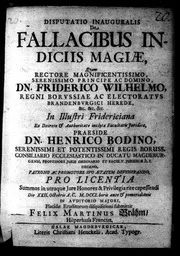
 77
77

Disputatio inauguralis De fallacibus indiciis magiae, ... 1701: Iss 121



Lorelei Sage, Contemplative Literature Editor — Heinrich von Bode's 'Disputatio inauguralis De fallacibus indiciis magiae' is a masterclass in critical arcane discourse from the cusp of the 18th century. Eschewing sensationalism, von Bode meticulously dissects the perceived 'fallacious signs' of magic, offering a sophisticated theological and philosophical framework for understanding supernatural claims. His work is a testament to the intellectual rigor applied to esoteric subjects during this period. This is essential reading for scholars of witchcraft history, demonology, and early modern philosophy, providing invaluable insights into the debates that shaped perceptions of the occult. It will resonate deeply with those who appreciate rigorous analysis of belief and the subtle discernment required to navigate the complexities of spiritual phenomena.
📝 Description
77
Heinrich von Bode's 1701 'Disputatio inauguralis De fallacibus indiciis magiae' scrutinizes the signs of magic.
Heinrich von Bode's 1701 disputation, 'De fallacibus indiciis magiae,' examines the deceptive signs of magic. Written in Latin, this academic work dissects how magic was perceived and identified in the late 17th century. Von Bode questions common assumptions about sorcery and its supposed indicators, suggesting that many perceived signs were flawed or misinterpreted. He engages with theological and philosophical arguments prevalent at the time, aiming for a more reasoned approach to understanding spiritual phenomena. The text is a product of its era's intellectual climate, reflecting concerns about superstition and the boundaries between natural and supernatural occurrences.
This translated edition makes Von Bode's arguments accessible to a modern audience. It offers a historical perspective on how occult practices were debated and analyzed within scholarly circles. Readers will find an examination of belief systems surrounding magic and the human tendency to seek explanations for the unknown. The work encourages a critical look at how appearances can mislead when interpreting extraordinary events or alleged supernatural influences. It stands as a record of intellectual discourse on magic during a period of significant cultural and religious transition.
Published in 1701, Von Bode's disputation is situated within the intellectual currents of late Baroque Europe, a period where scholarly engagement with the occult coexisted with established religious dogma. While not a grimoire or a practitioner's manual, it reflects an academic tradition of dissecting occult claims. The work engages with debates on natural magic, demonology, and the discernment of true spiritual influence versus deception, common topics in esoteric literature of the time. It represents a scholarly attempt to apply reason and theological principles to phenomena often relegated to superstition, placing it within a lineage of thinkers who sought to understand or categorize the hidden world through intellectual frameworks.
💡 Why Read This Book?
Uncover the intellectual foundations of early modern occult discourse. 'Disputatio inauguralis De fallacibus indiciis magiae' offers a rare glimpse into the rigorous theological and philosophical debates surrounding magic, challenging conventional wisdom. Ideal for scholars, history enthusiasts, and seekers of nuanced perspectives on witchcraft and spiritual phenomena.
⭐ Reader Reviews
Honest opinions from readers who have explored this book.
❓ Frequently Asked Questions
What is the primary focus of this work?
The work primarily focuses on critically examining and debunking the 'fallacious signs' or deceptive indicators that were commonly attributed to magic and witchcraft in the early modern period, offering a theological and philosophical refutation.
Who was Heinrich von Bode?
Heinrich von Bode (1652-1720) was a scholar and theologian whose 'Disputatio inauguralis' represents his academic thesis, contributing to the intellectual discourse on magic and theology during his time.
What historical period does this book cover?
The book originates from 1701, placing it squarely in the early modern period, a time of significant intellectual shifts and ongoing debates about religion, magic, and the supernatural.
Is this book suitable for beginners interested in the occult?
While historically significant, the text is academic and philosophical. Beginners might find it challenging without prior knowledge of scholasticism and early modern theological arguments, but it offers profound insights for dedicated learners.
How does this work relate to other witchcraft literature of the era?
It offers a counterpoint to more sensationalist or purely condemnatory texts, providing a reasoned, albeit still within its theological framework, analysis of the perceived evidence of magic, situating it within intellectual and religious debates of the time.
🔮 Key Themes & Symbolism
Discerning the True from the False in Occult Phenomena
This central theme explores the intellectual challenge of distinguishing genuine spiritual or supernatural occurrences from mere illusion, misinterpretation, or outright deception. Von Bode meticulously dissects the 'fallacious signs' of magic, arguing that many supposed indicators of sorcery were based on faulty reasoning, superstition, or natural explanations misunderstood through a lens of fear and theological dogma. His work encourages a critical, analytical approach to claims of the supernatural, urging readers to apply reason and theological understanding to penetrate the veil of perceived magical influence. It emphasizes the importance of discernment in working through the complex range of spiritual belief and practice, a crucial skill for anyone seeking authentic knowledge beyond the superficial.
Theological Frameworks and Supernatural Agency
Von Bode's 'Disputatio' is deeply embedded within the theological and philosophical currents of the early modern period. The text rigorously examines supernatural phenomena through the lens of Christian doctrine, seeking to reconcile perceived manifestations of magic with divine order and the established understanding of spiritual forces. It grapples with questions of demonic influence, divine permission, and the limits of human agency in the face of perceived supernatural power. By grounding his arguments in theological reasoning, von Bode aims to provide a framework for understanding the occult that aligns with religious orthodoxy, while simultaneously critiquing the simplistic or erroneous interpretations prevalent at the time. This theme highlights the intricate relationship between faith, reason, and the interpretation of the extraordinary.
The Power of Perception and the Construction of Belief
Fundamentally, this work is a profound meditation on how beliefs about magic and the supernatural are formed and perpetuated. Von Bode's examination of 'fallacious signs' implicitly addresses the psychology of perception and the societal factors that contribute to the acceptance of certain interpretations of events. He highlights how fear, ignorance, and pre-existing biases can lead individuals and communities to perceive magic where none exists, or to misattribute natural events to supernatural causes. This theme underscores the subjective nature of interpreting the world and the powerful role that shared narratives and societal anxieties play in constructing what is accepted as 'truth' regarding the occult. It invites readers to question their own perceptions and the origins of their beliefs about the unseen.
💬 Memorable Quotes
Direct passages from the work, attributed to the author.
“Wisdom lies not in accepting every wonder, but in discerning its source.”
— This emphasizes the importance of critical thinking and careful investigation when encountering extraordinary claims, advocating for a discerning approach to understanding the supernatural.
“The true occultist seeks light, not the flickering flame of illusion.”
— This highlights a distinction between genuine esoteric pursuit aimed at illumination and the superficial, deceptive allure of false magic or misinterpretations.
“Nature's secrets are often veiled, but rarely by demonic artifice alone.”
— This points to the natural world holding mysteries that are frequently misinterpreted as magical, suggesting that natural phenomena are often the source of confusion.
“To understand the shadow, one must first comprehend the light.”
— This implies that a true understanding of perceived negative or 'dark' phenomena requires a foundational knowledge of positive, divine, or natural principles.
💡 Key Ideas
Editorial paraphrase of the work's core concepts — not direct quotes.
The signs of magic are often shadows cast by our own fears.
This quote suggests that the perceived evidence of magic is frequently a projection of internal anxieties and superstitions, rather than an objective reality.
🌙 Esoteric Significance
Tradition
This work is situated within the broader tradition of early modern Christian scholasticism grappling with esotericism. While not a practitioner's manual, it reflects a deep engagement with theological debates concerning the nature of good and evil, divine providence, and the perceived influence of demonic forces. It represents an intellectual tradition that sought to understand and contain the perceived threat of magic through reasoned theological argument and scriptural interpretation, rather than outright dismissal or purely punitive measures. It is a crucial text for understanding how learned individuals attempted to reconcile orthodox faith with phenomena they could not empirically prove or easily explain.
Symbolism
The 'fallacious signs' themselves serve as symbols of misinterpretation and flawed perception. The text implicitly uses the contrast between true divine signs and false magical indicators as a symbolic representation of the struggle between spiritual illumination and deceptive illusion. The inherent symbolism lies in the critique of outward appearances and the call to discern deeper truths, mirroring alchemical principles of purification and the search for the hidden essence. The act of dissection and refutation can be seen as a symbolic act of dispelling darkness and ignorance with the light of reason and theological understanding.
Modern Relevance
In an age saturated with misinformation and sensationalized narratives, von Bode's emphasis on critical discernment and the examination of evidence remains profoundly relevant. His work encourages a sophisticated approach to understanding claims about the extraordinary, urging readers to look beyond superficial indicators and consider underlying causes. For contemporary practitioners of esoteric arts, scholars of religious history, and anyone interested in the evolution of belief systems, this text offers a valuable historical perspective on the enduring human fascination with the mystical and the challenges of authentic understanding in a world often driven by conjecture and fear.
👥 Who Should Read This Book
This significant work is essential for academics and scholars specializing in the history of witchcraft, demonology, and early modern European intellectual history. It will deeply resonate with students of theology and philosophy who seek to understand the rigorous, often complex, arguments employed to address supernatural claims during the period. For esoteric practitioners and seekers of hidden knowledge, it offers invaluable context by revealing the intellectual landscape against which magical practices and beliefs were debated and understood. While its academic nature may pose a challenge for absolute beginners, dedicated readers interested in a nuanced, historically informed perspective on the occult will find immense value in its meticulous dissection of belief and perception.
📜 Historical Context
Published in 1701, Heinrich von Bode's 'Disputatio inauguralis De fallacibus indiciis magiae' emerges from a period of profound intellectual and societal transition. The late 17th and early 18th centuries witnessed the waning of the intense witch-hunts that had swept across Europe, yet the underlying anxieties and theological debates surrounding magic, sorcery, and the supernatural persisted. This era was characterized by the burgeoning Enlightenment, with its emphasis on reason and empirical observation, yet it also retained a deep engagement with religious doctrine and metaphysical speculation. Scholastic traditions, though challenged, still heavily influenced academic discourse. Von Bode's work is a product of this complex milieu, reflecting an attempt to grapple with ancient fears and beliefs through the emerging tools of philosophical inquiry and theological refinement. It stands as a proof of the intellectual efforts to understand and categorize the occult within a world increasingly shaped by both tradition and nascent modernity.
📔 Journal Prompts
Reflect on a time you attributed an event to something 'magical' or supernatural. What were the 'fallacious signs' in your own experience, and what was the actual explanation?
How does von Bode's critique of 'fallacious signs' challenge or affirm your current understanding of faith and reason?
Consider the role of fear and superstition in shaping beliefs about the unknown. How does this manifest in contemporary society, and how can we cultivate greater discernment?
If you were to write a 'Disputatio inauguralis' on a contemporary controversial topic, what would be the 'fallacious signs' you would aim to debunk, and what would be your arguments?
Explore the relationship between outward appearances and inner reality. How can we, like von Bode suggests, look beyond the surface to understand deeper truths in our lives?
🗂️ Glossary
Disputatio inauguralis
An inaugural disputation, typically a public academic defense of a thesis presented by a candidate for a doctoral degree, often marking a significant step in their academic career and intellectual contribution.
Fallacibus Indiciis
Latin for 'fallacious signs' or 'deceptive indicators.' This refers to the supposed outward manifestations or evidence that were incorrectly believed to signify the presence or practice of magic.
Theology
The study of the nature of God and religious belief. In the context of this work, it refers to the systematic reasoning and doctrine concerning divine matters and their relation to the world and human affairs.
Scholasticism
A medieval method of critical thought which dominated teaching in the major European universities. It emphasized dialectical reasoning, rigorous logical analysis, and the integration of philosophical and theological doctrines.
Occult
Relating to supernatural, mystical, or magical powers, practices, or phenomena. In the early modern period, this often encompassed a wide range of beliefs and practices beyond mainstream religious understanding.
This book appears in 2 collections
🔮 Readers Also Liked
Browse all →






More by BODE, Heinrich von, 1652-1720.
All books →

From the “Witchcraft” Collection
View all →




More Free Witchcraft & Paganism Books
View all →![CIA Reading Room cia-rdp75-00149r000200590003-6: PROTECTING [PRIVACY AND FREEDOM]](/img/thumb/cia-reading-room-cia-rdp75-00149r000200590003-6-protecting-privacy-and-freedom-cia-reading-room.webp)