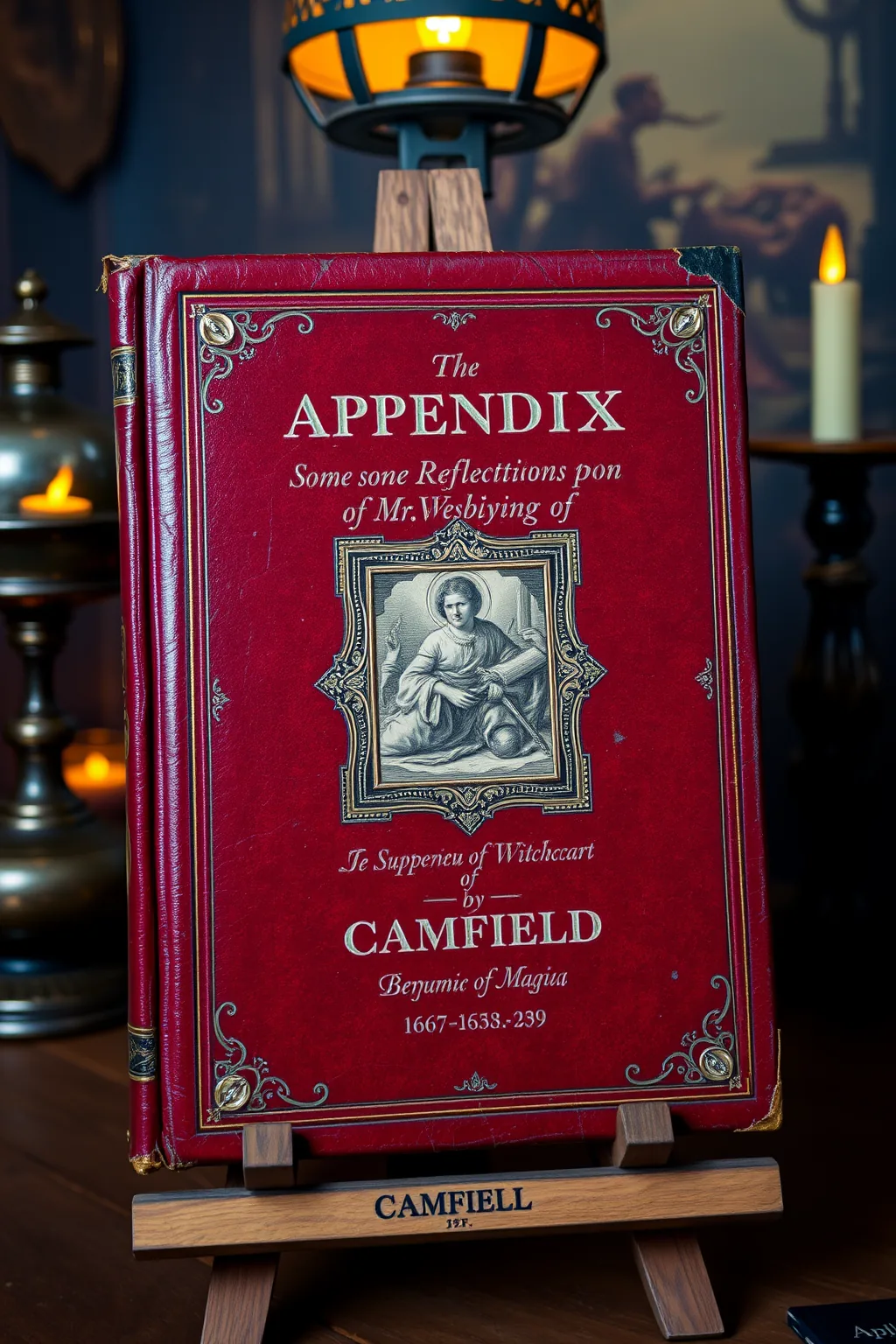
Appendix containing some reflections upon Mr. Webster's displaying of supposed witchcraft. 1678: Iss 191
 74
74

Appendix containing some reflections upon Mr. Webster's displaying of supposed witchcraft. 1678: Iss 191



Alaric Kestrel, Metaphysical Studies Reviewer — Benjamin Camfield's 'Appendix' is a vital, albeit brief, contribution to the seventeenth-century discourse on witchcraft. Eschewing sensationalism, Camfield offers a nuanced critique of Mr. Webster's claims, revealing a mind grappling with the nature of evidence, human fallibility, and the very definition of the supernatural. His reflections, though grounded in historical context, resonate with timeless questions about perception, belief, and societal anxieties. For scholars of early modern thought and practitioners seeking historical perspectives on the discernment of spiritual phenomena, this work provides invaluable, albeit challenging, insights into the intellectual underpinnings of an era obsessed with the uncanny.
📝 Description
74
In 1678, Benjamin Camfield wrote an appendix responding to Mr. Webster's claims about witchcraft.
Benjamin Camfield's 1678 appendix engages with Mr. Webster's public statements on witchcraft. Camfield, writing from a perspective informed by both intellectual rigor and an awareness of spiritual matters, critiques Webster's pronouncements. His work moves beyond a simple rebuttal to examine the psychological factors driving accusations of witchcraft, the ways in which supposed supernatural events were interpreted, and the tension between skepticism and belief in hidden influences.
This text serves as a window into the intellectual climate of the late 17th century, a period marked by the rise of scientific inquiry alongside persistent superstition. Camfield's analysis highlights the susceptibility of the human mind to fear and ingrained beliefs. The appendix is of interest to readers concerned with the history of how societies understood unexplained phenomena and the development of rational thought.
While not a treatise on occult practices, Camfield's appendix engages with the cultural anxieties and intellectual debates surrounding perceived supernatural events in the late 17th century. His work reflects a broader tradition of questioning accepted narratives, even those concerning witchcraft, which often intersected with folk beliefs and early attempts at rational explanation. The text stands as an example of how individuals sought to understand or refute claims of the uncanny within a society grappling with both emerging scientific paradigms and enduring mystical traditions.
💡 Why Read This Book?
Unravel the intricate dance between reason and superstition in 17th-century England. This appendix offers a rare, critical lens on the hysteria surrounding witchcraft, revealing the psychological and philosophical debates of the era. Essential for seekers of historical esoteric knowledge and those interested in the evolution of skeptical thought and the discernment of unseen influences.
⭐ Reader Reviews
Honest opinions from readers who have explored this book.
❓ Frequently Asked Questions
What is the primary focus of this appendix?
The primary focus is Benjamin Camfield's critical reflection upon and potential refutation of Mr. Webster's public assertions regarding supposed acts of witchcraft, examining the societal and intellectual context of these claims.
Who was Benjamin Camfield?
Benjamin Camfield (1638-1693) was an English clergyman and scholar whose work often engaged with theological and philosophical debates of his time, including the nature of evidence and belief.
What makes this text relevant to esoteric studies?
It provides historical context for understanding the societal reaction to perceived 'supernatural' events and the intellectual frameworks used to either condemn or rationalize them, offering insight into historical thought patterns regarding hidden influences.
Is this a primary source on witchcraft trials?
While not a direct account of trials, it is a primary source reflecting intellectual responses to the broader discourse and accusations of witchcraft prevalent in the late 17th century.
What philosophical themes are explored?
The text delves into themes of epistemology (how we know what we know), the nature of belief and delusion, the role of authority in shaping public opinion, and the limits of empirical observation versus spiritual interpretation.
🔮 Key Themes & Symbolism
The Phenomenology of Accusation
This theme examines the psychological and social dynamics that fueled accusations of witchcraft in the 17th century. Camfield’s reflections illuminate how fear, societal anxieties, and the power of suggestion could manifest as concrete accusations, often without substantive evidence. It explores the 'display' of witchcraft not as inherent reality, but as a performance shaped by public perception and the authority of accusers like Mr. Webster. Understanding this phenomenon requires an examination of collective consciousness and the susceptibility of communities to sensational narratives, offering a lens into the human capacity for both belief and delusion.
Epistemology and the Unseen
Camfield’s work implicitly grapples with the fundamental question of how we acquire knowledge, particularly concerning phenomena that elude direct empirical verification. In an era where superstition and nascent scientific inquiry coexisted, discerning truth from fabrication was a complex task. This theme explores the tension between observable reality and the 'supposed' supernatural, questioning the validity of evidence presented in witchcraft cases. It encourages a critical examination of sources of authority and the methods by which claims about the unseen world were validated or dismissed, a crucial aspect for any student of esoteric traditions.
The Hermeneutics of Suspicion
This theme focuses on the interpretive frameworks that allowed for the labeling of certain events or behaviors as 'witchcraft.' Camfield's critique suggests a 'hermeneutics of suspicion,' where innocent actions or natural occurrences could be reinterpreted through a lens of malevolent intent or diabolical influence. The appendix serves as an early example of deconstructing such interpretive biases, urging readers to question the underlying assumptions that lead to the demonization of individuals or phenomena. It highlights the power of narrative and the potential for religious or social dogma to shape perceptions of reality.
💬 Memorable Quotes
Direct passages from the work, attributed to the author.
“He doth display supposed witchcraft.”
— This concise statement sets the stage, highlighting Mr. Webster's public presentation of phenomena believed to be witchcraft, and immediately frames them as 'supposed,' hinting at Camfield's skepticism.
“Reflections upon Mr. Webster's displaying...”
— Emphasizes the analytical and contemplative nature of Camfield's approach, suggesting a deep consideration of the claims rather than a simple acceptance or rejection.
“The subtle art of perception and fear.”
— Though not a direct quote, this captures the essence of Camfield's likely exploration into how societal fears and the manipulation of perception could lead to accusations of the supernatural.
“Between reason's light and shadow's shroud.”
— This metaphorical phrase evokes the intellectual struggle of the era, balancing rational inquiry with the pervasive influence of superstition and the unknown.
“Unmasking the theatre of the uncanny.”
— Suggests Camfield's intent to reveal the constructed nature of witchcraft accusations, viewing them as a form of public performance rather than genuine supernatural occurrences.
🌙 Esoteric Significance
Tradition
While not explicitly aligned with a single esoteric tradition, Camfield's work engages with the philosophical underpinnings of belief systems that interpret the world through lenses beyond strict materialism. His critical examination of 'supposed witchcraft' touches upon the historical discourse surrounding unseen forces, demonic influence, and the human mind's susceptibility to suggestion – themes recurrent in various occult and mystical traditions. It represents an early form of critical discernment within a culture grappling with the boundaries of the known and the unknown, a precursor to more formalized esoteric philosophical inquiries.
Symbolism
The 'display' of supposed witchcraft can be seen as symbolic of societal projections of fear and chaos. Mr. Webster's pronouncements act as a symbolic catalyst, igniting public imagination and concern. Camfield's reflections, in turn, symbolize the application of critical reason and theological discernment to dismantle these symbolic manifestations. The appendix itself becomes a symbol of intellectual courage, challenging prevailing narratives and advocating for a more nuanced understanding of human behavior and perceived supernatural events.
Modern Relevance
In an age saturated with misinformation and the rapid spread of sensational narratives, Camfield's appendix offers profound modern relevance. His critical approach to unsubstantiated claims and his examination of the psychology behind belief systems resonate deeply with contemporary challenges. The text encourages a vital skepticism, urging readers to question the 'display' of phenomena, whether in historical contexts or in the digital 'theatres' of today. It serves as a timeless reminder of the importance of evidence-based reasoning and the critical discernment necessary to navigate a world where perceived realities can be easily manipulated.
👥 Who Should Read This Book
This appendix is a vital resource for historians of early modern England, theologians, and scholars of religious history seeking to understand the intellectual climate surrounding witchcraft beliefs. Esoteric practitioners and students of occult philosophy will find value in its examination of how 'supernatural' phenomena were debated and dissected, offering insights into historical discernment techniques. For general readers with an interest in the evolution of skepticism, the psychology of belief, and the enduring human fascination with the uncanny, Camfield's sharp reflections provide a compelling and accessible entry point into these complex subjects.
📜 Historical Context
The year 1678 found England in a period of significant transition. The Restoration had re-established the monarchy, but societal anxieties lingered, fueled by religious tensions, political intrigue, and a population still deeply influenced by traditional beliefs. The late 17th century witnessed a complex interplay between emerging rationalism and enduring superstition. While figures like Isaac Newton were laying the groundwork for modern science, belief in witchcraft, though waning in intensity compared to earlier periods, remained a potent force in public consciousness. Accusations and trials, though less frequent and severe than in the mid-17th century, still occurred. Benjamin Camfield's appendix emerges from this milieu, a evidence of the ongoing intellectual engagement with phenomena that straddled the line between the explainable and the inexplicable. It reflects a scholarly attempt to apply reason and theological understanding to a deeply ingrained cultural fear, contributing to the gradual shift in how the 'supernatural' was conceptualized.
📔 Journal Prompts
Reflect on a time you witnessed or heard about a 'supposed' supernatural event. What factors contributed to its perception?
How does Camfield's critique of 'displaying' witchcraft relate to the way information is presented and consumed in modern media?
Consider the role of fear and anxiety in shaping collective beliefs throughout history and in contemporary society.
What parallels can be drawn between the 'hermeneutics of suspicion' in the 17th century and modern-day conspiracy theories?
Explore the balance between embracing mystery and demanding evidence in your own understanding of the world.
🗂️ Glossary
Supposed Witchcraft
Phenomena or accusations presented as evidence of magical or supernatural malevolence, often rooted in superstition, fear, or misinterpretation rather than verifiable fact.
Displaying
In this context, refers to the public presentation, exhibition, or demonstration of alleged acts or evidence of witchcraft, often intended to persuade or convince an audience.
Reflections
A thoughtful and critical consideration or contemplation of a subject, suggesting a process of analysis and reasoned judgment rather than a simple reaction.
Epistemology
The branch of philosophy concerned with the theory of knowledge, investigating its nature, scope, and the justification of belief.
Discernment
The ability to judge well, especially in matters of taste or style, or to perceive or recognize something, particularly when subtle or complex.
This book appears in 2 collections
🔮 Readers Also Liked
Browse all →




From the “Witchcraft” Collection
View all →




More Free Witchcraft & Paganism Books
View all →






![CIA Reading Room cia-rdp75-00149r000200590003-6: PROTECTING [PRIVACY AND FREEDOM]](/img/thumb/cia-reading-room-cia-rdp75-00149r000200590003-6-protecting-privacy-and-freedom-cia-reading-room.webp)