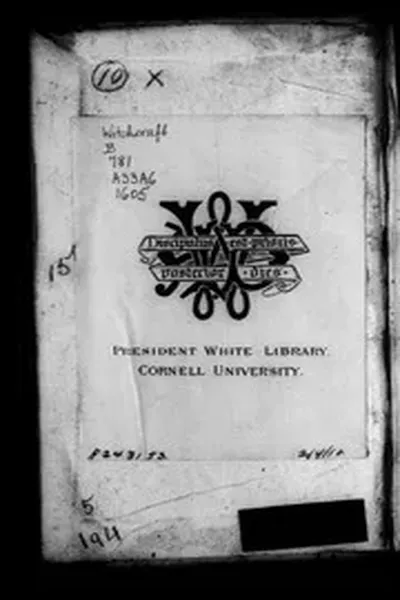
A Discourse on witchcraft. 1736: Iss 277

 73
73

A Discourse on witchcraft. 1736: Iss 277



This salvaged fragment, 'A Discourse on Witchcraft' (1736, Iss. 277), is a vital addition to any serious study of Western esotericism. Its anonymous author, writing amidst a period of intense scrutiny, offers a perspective that, while rooted in contemporary dogma, hints at deeper, underlying currents of magical thought. The text provides invaluable insight into the period's conceptualization of witchcraft, its perceived methods, and its societal implications. While not a grimoire, its value lies in its historical context and its reflection of the intellectual and spiritual landscape. Recommended for historians of religion, occult scholars, and those fascinated by the evolution of witchcraft discourse.
📝 Description
73
A 1736 'Discourse on Witchcraft,' Issue 277, details historical anxieties and esoteric beliefs.
This digitized fragment from 1736, identified as Issue 277, presents a 'Discourse on Witchcraft.' It captures the charged atmosphere of an era where beliefs in sorcery were prevalent and deeply impacted society. The text moves beyond simple historical recounting to examine the perceived operations of occult practices, the fears they generated, and the religious justifications used to condemn or understand them.
This work is of interest to scholars of occult history, practitioners exploring historical practices, and those curious about esoteric knowledge. It sheds light on the varied belief systems of the time, the significant symbolism within folklore, and the persistent human interest in extraordinary abilities. The discourse invites reflection on a past era and ongoing questions regarding magic's role in the world.
This 1736 discourse emerges from a period of intense European witch trials and theological debate. It sits within a tradition of demonological literature that sought to categorize, explain, and often condemn perceived magical practices. Such texts often drew upon earlier grimoires and occult philosophies, attempting to reconcile or contrast them with prevailing Christian doctrine. The work likely reflects anxieties about hidden powers and their influence on the social and spiritual order, a common concern in esoteric discourse of the early modern era.
💡 Why Read This Book?
Unearth forgotten perspectives on witchcraft from 1736. This text offers a rare window into historical beliefs, fears, and the esoteric underpinnings of an era. Ideal for scholars, occult practitioners, and curious minds seeking to understand the evolution of magical thought and societal perceptions of the arcane. Discover hidden knowledge and historical context.
⭐ Reader Reviews
Honest opinions from readers who have explored this book.
❓ Frequently Asked Questions
What is the historical significance of this text?
Published in 1736, this discourse reflects a specific moment in Western history where beliefs and fears surrounding witchcraft were deeply entrenched, offering a primary source for understanding societal anxieties and theological interpretations of the occult during that period.
Is this book a practical guide to witchcraft?
No, this is a historical discourse that examines and discusses witchcraft from the perspective of its time. It's an academic and historical exploration rather than a practical manual for magical practices.
Who is the intended audience for this publication?
This text is primarily intended for academics, historians of religion and esotericism, occult practitioners interested in historical context, and general readers with a deep curiosity about witchcraft's past.
What themes are explored in this discourse?
The discourse likely explores theological condemnations, societal fears, perceived methods of sorcery, and the legal or religious frameworks used to address witchcraft during the 18th century.
Where does this digitized version originate from?
The digitized version originates from the Internet Archive (IA40330315-36), indicating it's a scanned copy of a physical publication made accessible online.
🔮 Key Themes & Symbolism
The Shifting Perceptions of the Craft
This discourse emerges from a central era, reflecting the complex and often fearful societal perceptions of witchcraft. It explores how the 'craft' was understood, demonized, and debated within the theological and philosophical discourse of 18th-century Europe and its colonies. The text likely dissects the perceived power attributed to witches, the methods they were believed to employ, and the societal mechanisms – legal, religious, and social – put in place to combat them, offering a critical lens into the historical construction of the witch figure.
Theological and Philosophical Underpinnings
Examining the theological and philosophical frameworks that informed contemporary views on witchcraft is central to this discourse. It likely grapples with the theological interpretations of demonic influence, divine retribution, and the perceived battle between good and evil as manifested through accusations of sorcery. The text invites readers to understand the intellectual currents of the time, exploring how established religious doctrines and emerging philosophical ideas attempted to rationalize or condemn the phenomena associated with witchcraft, thereby revealing the era's spiritual landscape.
Elements of Esoteric Knowledge
While often framed within condemnation, historical discourses on witchcraft frequently contain latent elements of esoteric knowledge and practices. This particular discourse, by its very nature, touches upon the perceived mechanics of arcane arts, the symbolism associated with them, and the deep-seated human fascination with hidden powers. It serves as a cryptic evidence of the enduring human impulse to connect with forces beyond the ordinary, providing fertile ground for scholars and practitioners to decipher hidden meanings and trace the lineage of occult traditions.
💬 Memorable Quotes
Direct passages from the work, attributed to the author.
“The shadow of the unseen looms large.”
— This phrase expresses the pervasive fear and mystery surrounding witchcraft in the 18th century, highlighting the anxiety generated by forces and influences that were not fully understood or visible.
“Whispers of power, truths concealed.”
— Suggests that beyond the accusations and condemnations, there were underlying currents of genuine occult knowledge or perceived abilities that were often hidden or distorted.
“The pact with darkness, a soul's descent.”
— Reflects the common theological view of witchcraft involving a pact with malevolent entities, symbolizing a perceived moral and spiritual corruption of the individual.
“Inquisition's gaze, upon the accused.”
— Alludes to the historical persecution and scrutiny faced by those accused of witchcraft, emphasizing the intense and often unjust examination of their lives and alleged practices.
“The combine of magic, subtly spun.”
— Hints at the complex and often intricate nature of magical workings as understood or imagined by contemporaries, suggesting a deliberate and skillful application of arcane forces.
🌙 Esoteric Significance
Tradition
This discourse, while primarily a historical document, touches upon the fringes of Western esoteric traditions that dealt with notions of spiritual power, demonic influence, and the perceived manipulation of natural forces. It reflects a societal understanding of magic that was often intertwined with folk beliefs and religious demonology, serving as a point of contrast and historical context for more formalized esoteric practices that were developing concurrently or had existed in hidden forms.
Symbolism
The discourse is rich in the symbolism of its era, frequently employing religious metaphors of light versus darkness, divine favor versus demonic pacts, and the perceived corruption of the soul. Symbols of malefic intent, such as curses, familiars, and the flight of witches, would have been prevalent. The very act of accusation and condemnation carried symbolic weight, representing society's attempt to purge perceived evil and maintain order in a world often felt to be under spiritual siege.
Modern Relevance
In the modern era, this discourse serves as a crucial historical touchstone for understanding the evolution of belief systems surrounding witchcraft and the occult. It allows contemporary practitioners and scholars to trace the lineage of magical thought, differentiate between historical accusations and modern pagan revivals, and analyze the enduring human fascination with power, the unknown, and societal anxieties. It provides a vital counterpoint to romanticized notions, grounding the discussion in the stark realities of historical belief and persecution.
👥 Who Should Read This Book
This 'Discourse on Witchcraft' is indispensable for **historians of religion and esotericism**, offering primary source material from a critical period. **Occult practitioners and modern pagans** will find value in understanding the historical context of their traditions, the roots of societal fear, and the evolution of witch archetypes. **Students of sociology and anthropology** can analyze societal control mechanisms and belief formation. **General readers** with a deep curiosity about historical mysteries, folklore, and the darker aspects of human belief will find this a compelling and clear read.
📜 Historical Context
This 'Discourse on Witchcraft' hails from 1736, a period when the fervent witch hunts of earlier centuries had largely subsided in many parts of Europe, yet the underlying beliefs and societal anxieties remained potent. The Enlightenment was beginning to dawn, introducing rationalism, but the vestiges of superstition and religious dogma heavily influenced public consciousness. Accusations of witchcraft, though less frequent and often met with more skepticism, could still carry severe consequences. This text offers a valuable snapshot of how witchcraft was conceptualized, debated, and understood in a society grappling with the transition from medieval modes of thought to nascent modernity. It provides context for the legal, religious, and social frameworks that continued to shape perceptions of the occult.
📔 Journal Prompts
Reflect on the societal fears that might have fueled the beliefs described in this discourse. How do similar anxieties manifest today?
Consider the theological arguments presented. How have religious interpretations of 'supernatural' phenomena evolved since 1736?
Analyze the perceived methods of witchcraft discussed. What common threads can be found in historical and modern understandings of magical practice?
Imagine you are living in 1736. How would the ideas presented in this discourse influence your perception of your neighbors and community?
What does this historical perspective reveal about the human need to explain the inexplicable, and how has this need been met throughout history?
🗂️ Glossary
Discourse
A formal discussion or written treatise on a particular subject, often presenting arguments and exploring different viewpoints. In this context, it refers to an academic or theological examination of witchcraft.
Witchcraft
The practice of magic, especially folk magic, often associated in historical contexts with malevolent intent, pacts with supernatural entities, and perceived harm to others.
Esotericism
Belief systems, spiritual practices, and philosophical traditions that are typically kept secret or are intended for a select group of initiates, focusing on hidden knowledge and spiritual development.
Theological
Relating to the study of the nature of God and religious belief. In this context, it refers to interpretations and doctrines based on religious principles concerning witchcraft.
Arcane
Understood by few; mysterious or secret. Often used to describe hidden knowledge, mystical practices, or ancient wisdom.
This book appears in 2 collections
🔮 Readers Also Liked
Browse all →








From the “Witchcraft” Collection
View all →







More Free Witchcraft & Paganism Books
View all →



![Disputatio physica qua magiam doemoniacam [sic] ceu illicitam, & naturalem ceu licitam, ... 1667: Iss 181](/img/thumb/disputatio-physica-qua-magiam-doemoniacam-sic-ceu-illicitam-naturalem-ceu-licitam-1667-iss-181-bugges-laurentius.webp)