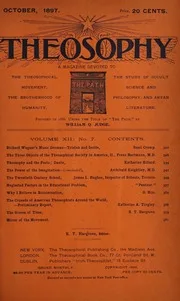
Theosophy 1897-10: Vol 12 Iss 7
 84
84

Theosophy 1897-10: Vol 12 Iss 7


By Evander Ashcroft (Alchemy & Hermeticism Editor) — This issue of 'Theosophy' from 1897 is a remarkable window into the heart of late Victorian esoteric thought. It masterfully weaves together philosophical discourse, spiritual insights, and practical occultism, offering a rich tapestry of hidden knowledge. The contributions, though unattributed, possess a striking depth, illuminating complex concepts with clarity and evocative language. It’s a treasure for serious students of Theosophy, Anthroposophy, and Hermetic philosophy, providing foundational understanding and inspiring further inquiry into the perennial wisdom traditions. This volume is particularly valuable for its unvarnished presentation of core Theosophical tenets.
📝 Description
84
Published in October 1897, this issue of 'Theosophy' presents writings from a crucial period of the movement.
This volume from October 1897 collects articles on esoteric subjects from the late 19th century. It reassembles lost fragments of ancient knowledge, detailing symbolic languages and metaphysical frameworks. The intent is to guide seekers toward self-understanding and cosmic awareness. The text invites engagement with philosophical debates and subtle energies. It is suited for individuals interested in consciousness, karma, reincarnation, and the structure of the universe. The issue aims to stimulate spiritual awakening and intellectual examination.
Its significance arises from its contribution to the early Theosophical movement. This period saw a spiritual renaissance amidst growing materialism. The collected writings reflect the spiritual inquiries characteristic of the era. Readers will find discussions that illuminate the connection between the seen and unseen worlds. The material encourages a thoughtful approach to spiritual and philosophical questions.
This issue belongs to the Theosophical tradition, which emerged in the late 19th century. Theosophy sought to synthesize Eastern and Western esoteric philosophies, drawing on ancient wisdom to address modern spiritual needs. Helena Blavatsky's writings were central to this movement, which aimed to uncover hidden spiritual laws and promote universal brotherhood. This 1897 publication reflects the ongoing effort to interpret and disseminate these ideas, connecting with a readership interested in occultism, comparative religion, and philosophical inquiry.
💡 Why Read This Book?
Unlock ancient wisdom and explore the foundations of Theosophy. This issue is essential for seekers of spiritual truth, scholars of esoteric history, and practitioners seeking to deepen their understanding of consciousness, karma, and the hidden laws of the cosmos. It offers a unique glimpse into a pivotal moment in mystical thought.
⭐ Reader Reviews
Honest opinions from readers who have explored this book.
❓ Frequently Asked Questions
Who is the intended audience for this volume?
This volume is primarily for earnest seekers of spiritual truth, scholars of comparative religion and mysticism, and individuals interested in the foundational principles of Theosophy and its related movements.
What is the significance of the publication date (1897)?
The late 19th century was a period of intense spiritual and intellectual ferment, with a resurgence of interest in ancient wisdom. This date places the content at a crucial juncture in the development of modern esoteric thought.
Are the authors identified in this issue?
The authors for this particular issue are listed as 'Unknown,' which is common for early Theosophical publications where the focus is on the collective wisdom being presented rather than individual authorship.
What are the main themes explored within this volume?
Key themes include the nature of consciousness, the cycle of reincarnation, the laws of karma, the existence of hidden spiritual hierarchies, and the path to human spiritual evolution.
Can this volume be read by beginners in esoteric studies?
While challenging, the language and concepts, though profound, are presented in a manner that can still be illuminating for dedicated beginners willing to engage deeply with the material.
🔮 Key Themes & Symbolism
The Nature of the Divine and the Cosmos
This theme explores the intricate relationship between the individual soul and the Universal Mind, exploring concepts of divine emanation, cosmic cycles, and the underlying spiritual architecture of existence. It posits a universe not as a random occurrence, but as a divinely ordered manifestation, governed by immutable laws that can be understood through diligent study and inner contemplation. The essays often touch upon the monadic essence present in all things, hinting at a profound unity that underlies the apparent diversity of the material world.
Karma, Reincarnation, and Spiritual Evolution
Central to the Theosophical worldview presented here is the doctrine of Karma and Reincarnation, viewed not as fatalistic punishment but as a dynamic process of spiritual growth. This section elucidates how actions in one life create ripples that shape future existences, providing the soul with opportunities for learning, purification, and advancement. It offers a framework for understanding life's challenges as lessons designed to foster ethical development and ultimately lead to the higher stages of human evolution, transcending the limitations of a single physical lifespan.
The Hidden Realms and Spiritual Hierarchies
This compelling theme unveils the existence of subtle planes of reality and the unseen beings that inhabit them, often referred to as spiritual hierarchies or 'Masters.' The texts explore how these higher intelligences interact with and influence the human realm, guiding evolution and offering wisdom to those who are receptive. It speaks of clairvoyance, astral travel, and the potential for humanity to connect with these realms, revealing a universe far more populated and intricately interconnected than commonly perceived by materialistic science.
💬 Memorable Quotes
Direct passages from the work, attributed to the author.
“The greatest treasures are hidden within the soul.”
— This aphorism highlights the internal nature of true spiritual wealth and enlightenment, suggesting that self-discovery is the ultimate pursuit.
“Every action is a seed planted in the garden of eternity.”
— Emphasizes the law of cause and effect (Karma) and its far-reaching, timeless consequences across multiple lifetimes.
“Seek not outward for the divine, but inward for its reflection.”
— A call to introspection and meditation, pointing towards the immanence of the divine within the human consciousness.
“The universe breathes in cycles of creation and dissolution.”
— Refers to the cosmic rhythms and grand cycles (Yugas or Manvantaras) that govern existence, a core concept in many ancient philosophies.
“Wisdom is the light that dispels the shadows of ignorance.”
— Defines wisdom as the essential tool for spiritual liberation, capable of overcoming the illusions and limitations imposed by lack of knowledge.
🌙 Esoteric Significance
Tradition
This volume is firmly rooted in the Theosophical tradition, which sought to revive and reinterpret ancient esoteric doctrines from various global sources, including Hinduism, Buddhism, Gnosticism, and Hermeticism. It champions the idea of a 'Wisdom Religion' underlying all faiths, emphasizing universal brotherhood, comparative study, and the investigation of unexplained laws of nature and the powers latent in humanity.
Symbolism
The texts within this issue likely engage with a wide range of esoteric symbolism, drawing from astrological, alchemical, and yogic traditions. Expect discussions on the symbolism of light and darkness, the meaning of geometric forms, the spiritual significance of colors, and the allegorical representations of cosmic principles and human chakras, all serving as keys to unlock deeper metaphysical truths.
Modern Relevance
Despite its historical origins, the themes of consciousness, interconnectedness, ethical living, and spiritual self-development remain profoundly relevant today. In an era grappling with existential questions and a yearning for meaning, the insights offered in this volume provide a framework for understanding personal challenges, fostering compassion, and exploring the potential for human spiritual growth beyond material limitations.
👥 Who Should Read This Book
This volume is a vital resource for seasoned students of esotericism, particularly those focused on the Theosophical and Anthroposophical movements. Scholars of comparative religion and intellectual history will find it useful for understanding the spiritual currents of the late 19th century. Aspiring practitioners seeking a deeper philosophical grounding for their spiritual path will benefit from its foundational teachings. Even curious beginners with a serious interest in the perennial wisdom traditions will discover clear insights into the nature of reality and the human soul.
📜 Historical Context
Published in 1897, this issue of 'Theosophy' emerges from a period of profound societal change and burgeoning interest in spiritualism, occultism, and Eastern philosophies. The late Victorian era was characterized by a growing disillusionment with purely materialistic worldviews and a search for deeper meaning. The Theosophical Society, founded by Helena Blavatsky, was a significant force in this intellectual and spiritual landscape, aiming to synthesize ancient wisdom traditions and present them to the modern world. This volume reflects that effort, offering esoteric interpretations of religion, science, and philosophy, and contributing to a wider dissemination of concepts like karma, reincarnation, and spiritual evolution.
📔 Journal Prompts
Reflect on a recent challenge: how might the concept of Karma offer a new perspective on its purpose?
Consider the idea of 'spiritual evolution.' What steps can you take today to foster your own spiritual growth?
How does the concept of 'hidden realms' influence your understanding of the universe and your place within it?
Explore the idea of 'universal brotherhood.' What practical actions can you embody this principle in your daily life?
What does 'inner reflection' mean to you, and how can you integrate it more deeply into your spiritual practice?
🗂️ Glossary
Theosophy
A philosophical and religious system that seeks to understand the divine nature of reality and the spiritual development of humanity, often drawing from ancient esoteric traditions and presenting a unified 'Wisdom Religion'.
Karma
The spiritual principle of cause and effect, where an individual's actions (karma) influence their future experiences and circumstances, often across multiple lifetimes, as a mechanism for learning and evolution.
Reincarnation
The belief that the soul or spirit, after biological death, can begin a new life in a new body, serving as a fundamental process for spiritual growth and the working out of karma.
Monad
In Theosophical terms, the divine spark or ultimate spiritual essence within each being, considered an eternal, immortal principle that undergoes cycles of manifestation and evolution.
Esoteric
Relating to or intended for a select group who possess special knowledge or understanding; often pertaining to inner or hidden spiritual teachings.
This book appears in 2 collections
🔮 Readers Also Liked
Browse all →






From the “Theosophy” Collection
View all →




More Free Theosophy & Anthroposophy Books
View all →