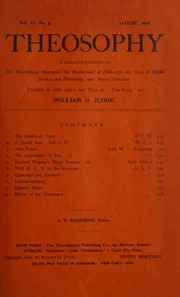
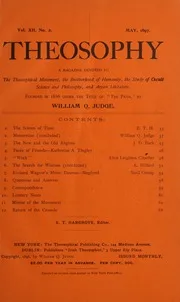
Theosophy 1897-05: Vol 12 Iss 2
 72
72

Theosophy 1897-05: Vol 12 Iss 2

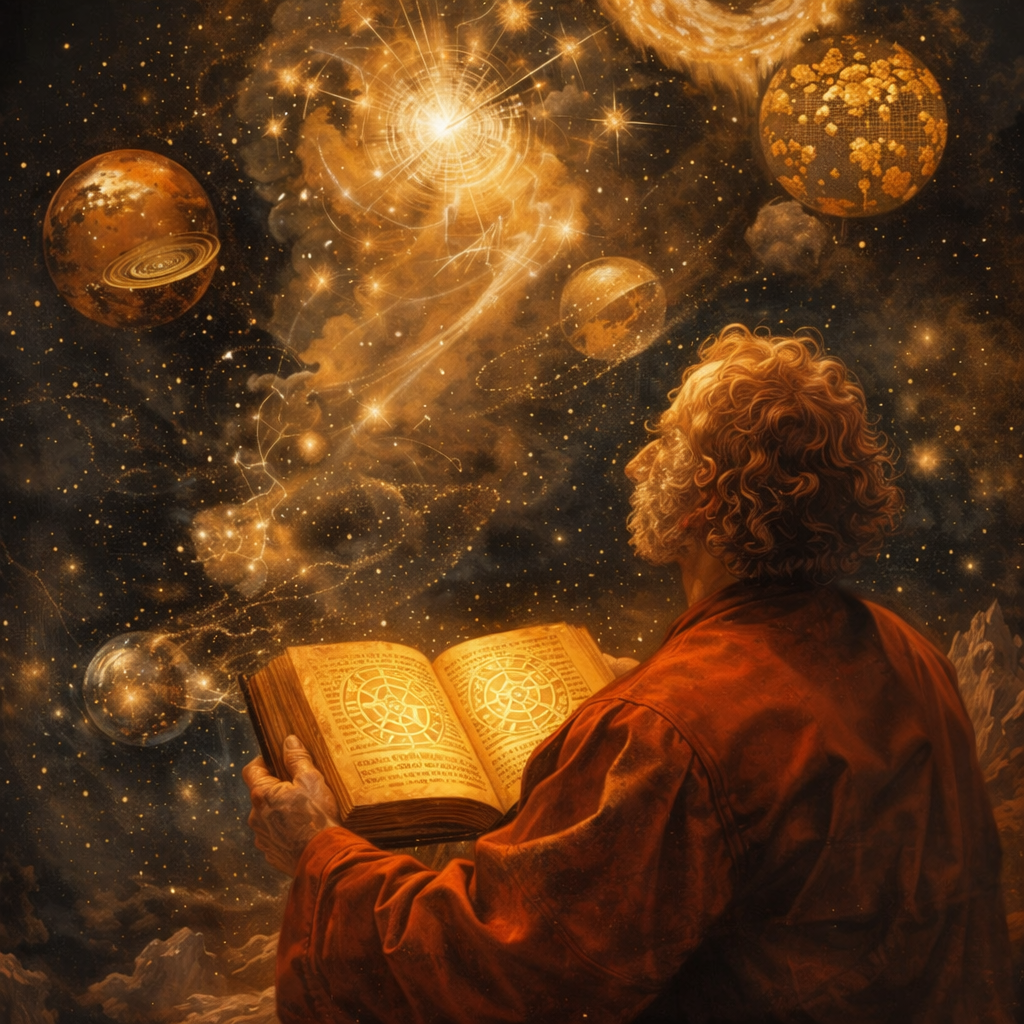

Balthazar Finch (Senior Critic, Occult Philosophy) — This issue of Theosophy is a rare gem, offering a concentrated dose of late Victorian esoteric thought. The anonymous contributors delve into subjects ranging from the nature of consciousness to the subtle bodies with a clarity and conviction that is deeply compelling. Its strength lies in its unwavering commitment to presenting complex metaphysical concepts in an accessible, albeit profound, manner. This is essential reading for serious students of the Theosophical movement and those seeking to understand the roots of modern spiritual inquiry, providing a foundational understanding of perennial wisdom.
📝 Description
72
This issue of Theosophy, Volume 12, Issue 2 from May 1897, discusses the spiritual evolution of humanity.
Published in May 1897, this issue of Theosophy delves into concepts of cosmic structure and human spiritual development. It examines ancient philosophies and the interconnectedness of all things. The content is aimed at individuals interested in the occult and those seeking a deeper understanding of reality beyond the material. This volume highlights principles that govern both the physical and spiritual planes. It presents an alternative to purely materialist viewpoints, addressing complex spiritual questions.
This 1897 publication is part of the Theosophical movement, founded by Helena Blavatsky. Theosophy sought to synthesize Eastern and Western esoteric traditions, presenting a universal spiritual philosophy. It often discussed concepts like karma, reincarnation, and the evolution of consciousness, aiming to uncover hidden truths within ancient religions and philosophies. This specific issue likely reflects the ongoing discourse within the movement regarding the nature of the universe and humanity's place within it, challenging the prevailing scientific and religious orthodoxies of the late 19th century.
💡 Why Read This Book?
Uncover the foundational tenets of Theosophy from a pivotal era. This volume offers a rare glimpse into the nascent stages of a global spiritual movement, providing esoteric knowledge that challenges conventional paradigms. Ideal for seekers of deeper truth, students of comparative religion, and practitioners of occult sciences looking to enrich their understanding of spiritual evolution and cosmic law.
⭐ Reader Reviews
Honest opinions from readers who have explored this book.
❓ Frequently Asked Questions
What is Theosophy?
Theosophy, derived from Greek words meaning 'divine wisdom,' is a spiritual philosophy that seeks to understand the underlying unity of all religions, philosophies, and sciences, positing a cosmic evolutionary process and the potential for human spiritual development.
Who were the primary authors in this issue?
While the author is listed as 'Unknown,' the content reflects the collective discourse and teachings prevalent within the Theosophical Society during that period, often drawing from foundational figures.
What are 'subtle bodies'?
In Theosophical thought, subtle bodies are non-physical vehicles or planes of consciousness that interpenetrate the physical body, such as the astral, mental, and causal bodies, each with distinct functions in spiritual evolution.
Is this text suitable for beginners?
While the language can be dense, the foundational concepts presented are invaluable for beginners seeking an introduction to Theosophical principles and esoteric philosophy. Prior openness to metaphysical ideas is beneficial.
How does this issue relate to Anthroposophy?
Theosophy laid much of the groundwork for Anthroposophy, founded later by Rudolf Steiner. This issue provides essential context for understanding the roots and philosophical lineage from which Anthroposophy emerged.
🔮 Key Themes & Symbolism
The Nature of the Sevenfold Man
This volume looks at the esoteric understanding of human constitution, positing the existence of multiple 'bodies' or planes of consciousness beyond the physical. It explores the interconnectedness of these subtle vehicles, their functions in spiritual evolution, and the process of awakening dormant spiritual potentials within the individual. The discourse emphasizes the journey of the soul through these various sheaths, offering a framework for understanding reincarnation and karmic law.
Cosmic Evolution and Reincarnation
Central to the teachings presented is the concept of a grand cosmic evolutionary cycle, of which human existence is but a part. The issue elucidates the principles of reincarnation, not merely as a belief, but as a fundamental law of spiritual progress. It explores how souls traverse myriad existences, learning and evolving through a series of experiences designed to foster wisdom and spiritual awareness across vast epochs of time.
The Quest for Universal Brotherhood
Beyond the metaphysical explorations, this issue champions the ideal of Universal Brotherhood as a practical application of esoteric understanding. It argues that recognizing the divine spark within all beings, irrespective of race, creed, or gender, is the a core part of true spiritual and social progress. This theme underscores the ethical dimension of Theosophy, urging readers to cultivate compassion, tolerance, and a sense of shared destiny with all humanity.
💬 Memorable Quotes
Direct passages from the work, attributed to the author.
“The outer shell is but a shadow of the inner Sun.”
— This aphorism suggests that our physical form is a mere manifestation, a transient reflection of our true, radiant spiritual essence, which is eternal and luminous.
“Wisdom is not found in books alone, but in the silent chambers of the soul.”
— This highlights the internal nature of true knowledge, emphasizing introspection and direct spiritual experience over purely intellectual pursuit.
“Each breath is a step on the ladder of ascent.”
— This poetic line illustrates the continuous spiritual progress possible in everyday life, suggesting that even mundane actions can contribute to our soul's journey.
“The universe whispers its secrets to the attentive heart.”
— This points to the subtle communication between the divine and the human, suggesting that spiritual truths are revealed not through force, but through quiet receptivity and intuition.
“To know thyself is to glimpse the face of the Infinite.”
— This profound statement links self-knowledge to the ultimate spiritual realization, implying that understanding our deepest self is a path to connecting with the divine.
🌙 Esoteric Significance
Tradition
This volume is deeply rooted in the Theosophical tradition, a modern esoteric movement that synthesizes elements from Eastern religions (Hinduism, Buddhism), Neoplatonism, Gnosticism, and Hermeticism. It focuses on the perennial philosophy, the idea that there is one underlying truth accessible through various paths, and emphasizes the universal laws governing existence, such as karma and reincarnation.
Symbolism
Key symbols explored often include the Tree of Life, the Serpent, the Eye, and geometric forms, each imbued with layered meanings representing cosmic principles, spiritual evolution, and the interconnectedness of all things. The text likely utilizes these symbols to convey complex metaphysical concepts that transcend literal interpretation, serving as keys to unlock deeper understanding.
Modern Relevance
The themes of spiritual evolution, the interconnectedness of life, and the importance of inner development continue to resonate deeply today. In an era grappling with existential questions and seeking meaning beyond the material, the wisdom offered in this journal provides a timeless perspective on consciousness, purpose, and the inherent divinity within all beings, offering a counterpoint to secularism.
👥 Who Should Read This Book
This issue is a rich source for dedicated students of the esoteric and the spiritually curious. Beginners will find it an useful introduction to Theosophical thought, laying a foundational understanding of its core principles. Scholars of comparative religion and philosophy will appreciate its historical context and contribution to the development of Western esotericism. Practitioners of meditation, yoga, or occult arts will discover useful insights that can deepen their personal spiritual journey and understanding of subtle energies. Anyone seeking to explore the mysteries of consciousness, reincarnation, and the universe's hidden architecture will find ample inspiration and knowledge within these pages.
📜 Historical Context
Published in May 1897, this issue of 'Theosophy' emerges from a period of intense spiritual and intellectual ferment in the West. The late Victorian era was marked by a burgeoning interest in Eastern philosophies, the occult, and alternative spiritualities, often as a reaction against prevailing materialism and rigid religious dogma. The Theosophical Society, founded by Helena Blavatsky, Henry Steel Olcott, and William Quan Judge, was at the forefront of this movement, seeking to revive ancient wisdom traditions and promote the idea of a universal brotherhood of humanity. This journal served as a vital platform for disseminating Theosophical teachings, engaging in debates on metaphysics, and fostering a community of like-minded seekers. Its content reflects the era's fascination with spiritualism, ancient mysteries, and the potential for human psychic and spiritual development, contributing significantly to the field of esoteric thought.
📔 Journal Prompts
Reflect on the concept of the 'Sevenfold Man.' How might understanding these subtle bodies inform your daily life and spiritual practice?
Consider a past experience and analyze it through the lens of karma and reincarnation. What lessons might your soul be learning?
How can the ideal of Universal Brotherhood be practically applied in your immediate community or personal interactions?
Identify a symbol that holds personal significance for you. What deeper meanings or spiritual truths does it represent?
In what ways do you feel the 'universe whispers its secrets' to you? Describe these moments of intuitive insight or spiritual connection.
🗂️ Glossary
Theosophy
A spiritual philosophy that seeks to understand the divine wisdom underlying all religions, philosophies, and sciences, often emphasizing reincarnation and spiritual evolution.
Esoteric
Intended for or likely to be understood by only a small number of people with a specialized knowledge or interest; relating to hidden meanings or mysteries.
Subtle Body
In esoteric traditions, a non-physical vehicle or layer of consciousness that interpenetrates the physical body, such as the astral, mental, or causal bodies.
Karma
The spiritual principle of cause and effect where intent and actions of an individual influence their future existence. It is often seen as the law of moral causation.
Perennial Philosophy
The concept that there is one fundamental, unchanging spiritual truth or wisdom underlying all the world's diverse religions and esoteric traditions.
This book appears in 2 collections
🔮 Readers Also Liked
Browse all →






From the “Theosophy” Collection
View all →





More Free Theosophy & Anthroposophy Books
View all →