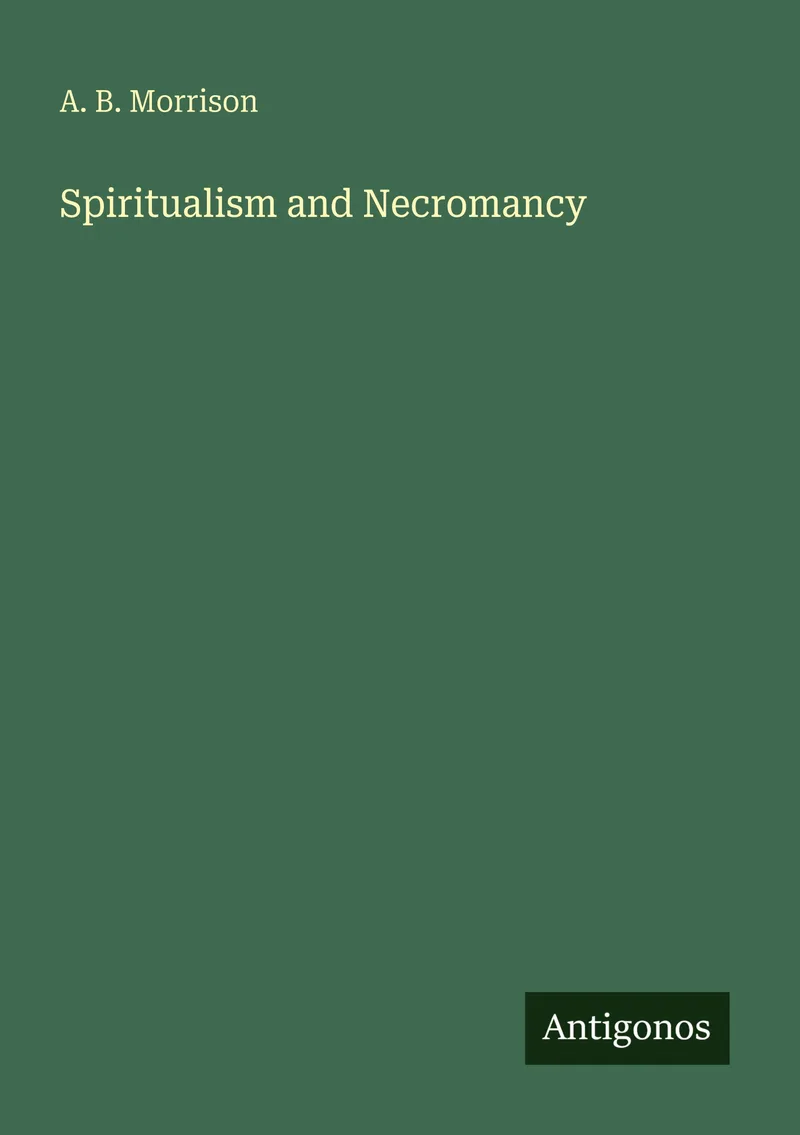
Spiritualism and Necromancy
 78
78

Spiritualism and Necromancy
Morrison's "Spiritualism and Necromancy" offers a fascinating, if sometimes uncritical, glimpse into the occult preoccupations of the late 19th century. The reprint itself is commendable for its fidelity to the original 1873 publication, preserving the text's original flavor. Morrison's strength lies in his detailed cataloging of various spiritualist phenomena and necromantic rites as understood at the time, providing a valuable primary source for historical researchers. However, the author's evident bias towards a particular interpretation of spiritualism, often bordering on credulity regarding the authenticity of mediums, limits its objective value. A particularly striking section details the alleged methods of invoking shades, which, while historically significant, lacks the critical distance one might expect from a modern analysis. The work provides a raw, unfiltered account of beliefs that shaped popular occultism, but readers seeking rigorous debunking or advanced magical theory will need to look elsewhere. It serves best as a historical document of belief.
📝 Description
78
A. B. Morrison's "Spiritualism and Necromancy" was first published in 1873.
This is a reprint of A. B. Morrison's 1873 study, "Spiritualism and Necromancy." The book examines the spiritualist movements and occult practices popular in the mid-19th century. It addresses the period's fascination with phenomena that both intrigued and unsettled Victorian society.
Morrison's work is for students of esoteric history, parapsychology, and Victorian occultism. Researchers interested in spiritualism, mediumship, and darker magical traditions will find its historical perspective useful. It also illuminates the origins of modern spiritualism and its controversial counterparts, showing the beliefs and anxieties of that time.
The book was published when spiritualism saw intense interest, spurred by figures like the Fox sisters and Allan Kardec. This era also featured a fascination with darker magic, often mixed with spiritualist ideas. Morrison reflects on a society debating séances, table-turning, and spirit communication, from scientific interest to outright skepticism.
Published in 1873, Morrison's work sits within the historical context of 19th-century spiritualism and occult revival. It contrasts the popular mediumistic practices aimed at contacting the departed with older traditions of necromancy, which involved invocation and perceived control over spirits. The book grapples with the societal reception of these phenomena, questioning the nature of mediumship and the perceived risks associated with attempts to communicate with the spirit world.
💡 Why Read This Book?
• Gain direct insight into 19th-century beliefs regarding spirit communication, as detailed in the book's examination of séances and mediumship in 1873. • Understand the historical conflation of spiritualism with necromantic practices, a key theme Morrison explores concerning the perceived dangers of invoking spirits. • Appreciate the specific societal anxieties surrounding the occult during the Victorian era, a period marked by intense interest in phenomena like those described by Morrison.
⭐ Reader Reviews
Honest opinions from readers who have explored this book.
❓ Frequently Asked Questions
What is the original publication date of A. B. Morrison's "Spiritualism and Necromancy"?
The original publication date for "Spiritualism and Necromancy" by A. B. Morrison was November 27, 1873. This reprint aims to preserve the historical integrity of that first edition.
What distinguishes this reprint from other editions?
This reprint by Antigonos publishing house focuses on preserving the cultural heritage of the original 1873 text, ensuring it is made available to the public in good condition.
Does the book provide practical instructions for necromancy?
While the book discusses necromantic practices as understood in 1873, its primary focus is on historical analysis and commentary rather than providing actionable instructions for modern practitioners.
Who was A. B. Morrison?
Information on A. B. Morrison is limited in the original publication. The focus is on the content and its historical context rather than extensive biographical details of the author.
Is "Spiritualism and Necromancy" suitable for beginners in occult studies?
It is best suited for those with an interest in the history of spiritualism and occultism, particularly the Victorian era. Beginners might find the historical language and concepts challenging without prior context.
What historical period does the book primarily cover?
The book primarily reflects the spiritualist and occult interests prevalent in the mid-to-late 19th century, specifically around the time of its original publication in 1873.
🔮 Key Themes & Symbolism
Victorian Spiritualist Phenomena
The text extensively details the manifestations of spiritualism as reported and believed in the 19th century. This includes phenomena such as table-turning, automatic writing, and direct spirit communication through mediums. Morrison attempts to categorize these events, often from a perspective that accepts their reality while questioning their ultimate source or nature. The book serves as a historical archive of these beliefs, illustrating the widespread fascination and debate surrounding the spirit world in the era of its publication.
Necromantic Rites and Beliefs
Morrison contrasts the popular spiritualist movement with the more clandestine practices associated with necromancy. The work explores the historical and folkloric underpinnings of summoning spirits of the deceased, often highlighting the perceived dangers and malevolent potential attributed to such arts. It examines the societal fears surrounding these practices, which were frequently depicted in sensationalist literature and moralistic tracts of the period, offering a critical examination of their place within the broader occult field of 1873.
The Nature of Mediumship
A central concern of "Spiritualism and Necromancy" is the role and authenticity of mediums. Morrison scrutinizes the claims made by individuals who purported to channel spirits, examining the psychological, social, and potentially supernatural factors involved. The book questions whether these abilities stem from genuine spiritual contact, psychological phenomena, or even deliberate deception. This critical inquiry into the conduit between the living and the dead is a significant aspect of the text's historical value.
Boundary Between Worlds
The book grapples with the perceived permeability of the veil between the material world and the spirit realm. It investigates the conditions under which spirits are believed to manifest and interact with the physical plane, and conversely, the risks associated with attempting to breach this separation. Morrison's analysis reflects the 19th-century tension between scientific materialism and a persistent yearning for transcendental experience, exploring the implications of crossing these defined boundaries.
💬 Memorable Quotes
Direct passages from the work, attributed to the author.
“The spectral form, when summoned, may prove a treacherous guide.”
— This statement captures the inherent risk associated with necromantic practices. It suggests that even if successful in calling forth a spirit, there is no guarantee of its benevolence or truthfulness, highlighting a potential for manipulation or harm.
“Séances often reveal more of human frailty than of celestial communication.”
— This interpretation points to a critical perspective on spiritualist gatherings. It suggests that the phenomena observed may be rooted in the psychological states, desires, or deceptions of the participants rather than genuine contact with disembodied entities.
“To traffic with the dead is to invite an imbalance into one's own life.”
— This highlights the perceived danger of necromancy. It implies that engaging in practices intended to commune with the deceased disrupts the natural order and can lead to negative consequences for the practitioner's spiritual or mental well-being.
“The ethereal plane is not always a area of peace; shadows linger.”
— This suggests that the spiritual world, as envisioned by some at the time, is not uniformly benign. It acknowledges the existence of darker or less desirable spiritual entities and influences that might be encountered during occult practices.
“Discernment is the primary shield against deceptive spiritual influences.”
— This emphasizes the importance of critical judgment when encountering spiritual phenomena. It suggests that individuals must actively employ reason and skepticism to differentiate genuine spiritual communication from misleading or harmful manifestations.
🌙 Esoteric Significance
Tradition
This work primarily engages with the popular occultism and spiritualist movements of the 19th century, rather than adhering strictly to established esoteric lineages like Hermeticism or Kabbalah. It reflects a societal grappling with spiritualism that sometimes intersected with, but often diverged from, more structured magical systems. Morrison's approach is less about initiatory transmission and more about cataloging and commenting on contemporary beliefs and practices surrounding spirit contact.
Symbolism
While not overtly symbolic in a Hermetic sense, the work touches upon the symbolism inherent in spirit manifestation. The 'spectral form' represents the ambiguous nature of encountered entities—potentially benign guides or deceptive phantoms. The 'ethereal plane' itself functions as a symbolic representation of the afterlife or non-physical realms, whose 'shadows' imply a darker, less understood aspect of existence beyond the physical.
Modern Relevance
Contemporary discussions on mediumship, paranormal investigation, and the psychology of belief echo the concerns raised in Morrison's text. While the specific practices of Victorian spiritualism may seem archaic, the underlying questions about consciousness, the nature of the afterlife, and the potential for entities beyond our immediate perception continue to be explored in modern parapsychology and certain fringe spiritual circles.
👥 Who Should Read This Book
• Students of Victorian history and culture seeking primary source material on occult beliefs and societal anxieties of the 1870s. • Researchers of Spiritualism interested in contemporary analyses of mediumship and spirit communication as presented in 1873. • Occult historians examining the historical relationship and perceived distinctions between popular spiritualism and necromantic traditions.
📜 Historical Context
Published in 1873, A. B. Morrison's "Spiritualism and Necromancy" emerged during a period of intense spiritual and occult fervor in Victorian England. The mid-19th century witnessed the rise of Spiritualism, popularized by figures like the Fox sisters and later studied by researchers such as Alfred Russel Wallace, who explored alleged spirit communications. Simultaneously, there was a fascination with darker magical traditions, often sensationalized in popular literature. Morrison's work situated itself within this milieu, attempting to analyze both the perceived benign spirit communications and the more feared necromantic arts. The book engaged with a public increasingly curious about the unseen, existing alongside scientific materialism and emerging psychological theories. Unlike more systematic approaches to magic emerging from figures like Eliphas Lévi in France, Morrison's text offers a more contemporary, almost journalistic, survey of beliefs circulating in England, grappling with phenomena that challenged established religious and scientific paradigms of the era.
📔 Journal Prompts
The perceived dangers of trafficking with the dead, as discussed by Morrison.
Your interpretation of 'human frailty' observed in spiritualist séances.
The concept of the ethereal plane and its potential 'shadows'.
How the spectral form might be a 'treacherous guide'.
The role of discernment when encountering phenomena described in the book.
🗂️ Glossary
Spiritualism
A religious movement originating in the mid-19th century, based on the belief that the spirits of the dead can communicate with the living through a medium.
Necromancy
A form of magic involving communication with the spirits of the dead, either by summoning their ghosts or by raising them bodily; also known as evocatio or goetia.
Medium
An individual believed to be able to mediate communication between spirits of the dead in the afterlife and human beings.
Séance
A meeting at which spiritualists attempt to make contact with the dead.
Spectral Form
The apparition or ghost of a deceased person, as perceived during alleged spiritual manifestations.
Ethereal Plane
In some esoteric traditions, a non-physical realm or dimension believed to exist beyond the material world, often associated with spirits or subtle energies.
Discernment
The ability to judge well, particularly in distinguishing between truth and falsehood, or between genuine and deceptive spiritual influences.