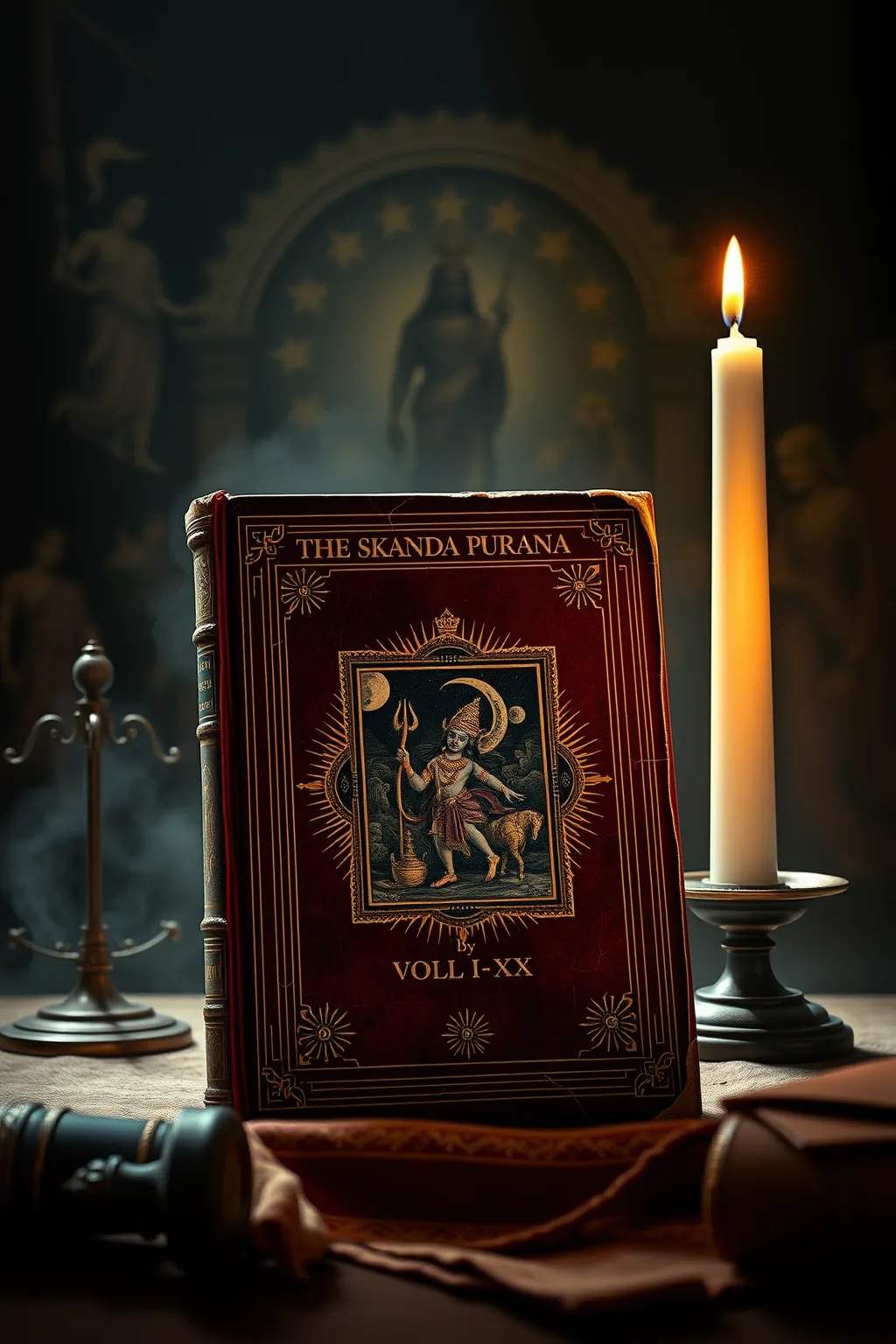
The Skanda Purana
 75
75

The Skanda Purana


Aurelia Blackwood (Occult Philosophy Critic) — The Skanda Purana, presented here in its monumental entirety, is a foundational pillar of Hindu esoteric thought. Its sheer scale is breathtaking, offering a labyrinth of myth, philosophy, and ritual that has shaped spiritual practices for centuries. Beyond the epic narratives of Lord Skanda, the text reveals intricate cosmological maps, profound insights into karma and dharma, and detailed instructions for yogic and tantric practices. This compilation is an alchemical vessel, transforming raw myth into potent spiritual medicine. Its strength lies in its comprehensive nature, providing a rich tapestry for those willing to delve into its ancient wisdom. Essential for serious students of comparative religion, occultists, and yogis seeking the roots of their practice.
📝 Description
75
The Skanda Purana, with earliest manuscripts from 810 CE, details Hindu cosmology and spiritual practices.
This extensive compilation, known as the Skanda Purana, gathers sacred lore and spiritual teachings from ancient India. Its earliest surviving manuscripts date to 810 CE, suggesting an even older origin. The text describes divine narratives, the interactions between gods and demons, and principles of spiritual growth. It examines the nature of existence, paths to liberation, and the importance of pilgrimage and ritual.
The Skanda Purana covers yogic practices, philosophical discussions, and the subtle forces influencing life. It is a significant resource for understanding the deeper aspects of Indic spiritual thought. The work presents a wide array of information relevant to spiritual seekers, academic scholars, and contemplative practitioners.
As one of the major Puranas in Hinduism, the Skanda Purana is a repository of sectarian lore, primarily dedicated to the god Skanda (Kartikeya). It elaborates on his myths, divine exploits, and the rituals associated with his worship. Beyond devotional narratives, it contains cosmological accounts, genealogies of deities and sages, and descriptions of sacred geography, particularly concerning South India. Its teachings often interweave philosophical concepts with devotional practices, offering insights into the divine through stories and sacred geography.
✍️ Author

VOL I-XX
The xx are an English indie rock band from Wandsworth, London, formed in 2005. The band consists of Romy Madley Croft (guitar, vocals), Oliver Sim (bass guitar, vocals), and Jamie Smith, also known as Jamie xx (beats, MPC, record production).
💡 Why Read This Book?
Uncover the foundational myths and esoteric philosophies of Hinduism. Explore intricate cosmological systems and gain a deep understanding of spiritual pathways. This text is vital for scholars seeking historical context, practitioners looking for authentic ritual and yogic knowledge, and seekers yearning for profound spiritual insight into the divine and the self.
⭐ Reader Reviews
Honest opinions from readers who have explored this book.
❓ Frequently Asked Questions
What is the primary focus of The Skanda Purana?
The Skanda Purana primarily focuses on the legends and exploits of Lord Skanda (Kartikeya), the son of Shiva and Parvati, detailing his divine birth, his battles against demons, and his role as a celestial general. It also encompasses vast cosmological, philosophical, and ritualistic teachings.
Who are the main deities featured in this Purana?
The central deity is Lord Skanda. However, the text extensively features other prominent deities of the Hindu pantheon, including Lord Shiva, Goddess Parvati, Lord Ganesha, and Lord Vishnu, weaving them into its complex mythological and theological framework.
What are some key philosophical concepts discussed?
Key philosophical concepts include the nature of Brahman (the Absolute), the principles of karma and dharma, the cycle of creation and destruction (samsara), the paths to moksha (liberation), and the relationship between the individual soul (Atman) and the divine.
Is The Skanda Purana relevant to modern spiritual practices?
Absolutely. Its teachings on meditation, yogic postures, ethical conduct, and devotion form the bedrock of many contemporary spiritual practices, offering timeless wisdom for personal growth and spiritual attainment.
What is the significance of the 'VOL I-XX' author attribution?
This attribution signifies that The Skanda Purana is a vast compilation, likely assembled over centuries by numerous scribes and scholars, rather than being the work of a single author. The 'VOL I-XX' indicates its immense scope and division into multiple volumes.
🔮 Key Themes & Symbolism
The Divine Warrior and Cosmic Order
The Skanda Purana meticulously chronicles the divine exploits of Lord Skanda, the celestial general. More than mere mythology, these narratives symbolize the eternal struggle between cosmic forces of light and darkness, order and chaos. Skanda's victories represent the triumph of righteousness and the re-establishment of divine harmony. His journey from birth to leadership offers profound lessons on duty, courage, and the unfolding of divine will within the material and spiritual realms. This theme explores how the microcosm of individual struggle reflects the macrocosm of universal battles, providing a framework for understanding one's own spiritual warfare and the importance of upholding dharma.
Sacred Geography and Pilgrimage
This Purana is deeply interwoven with the geography of the Indian subcontinent, highlighting the spiritual significance of various sacred sites, rivers, and mountains. Pilgrimage is presented not just as a physical journey, but as an inner odyssey, a transformative process that purifies the soul and brings one closer to the divine. The text details the legends associated with these holy places, imbuing them with potent spiritual energy. For the esoteric practitioner, these sites act as energetic nexus points, facilitating deeper connection with the divine consciousness. Understanding these sacred landscapes reveals a map of consciousness, guiding the devotee through a spiritual topography towards ultimate realization.
The Nature of Reality and Liberation
Fundamentally, The Skanda Purana looks at profound metaphysical inquiries about the nature of existence, the illusion of the material world (maya), and the ultimate reality of Brahman. It expounds on the cyclical nature of time, the principles of karma and reincarnation, and the various paths leading to moksha (liberation from the cycle of birth and death). Through intricate philosophical discourse and illustrative stories, the text provides a comprehensive roadmap for spiritual awakening, emphasizing the importance of knowledge, devotion, and disciplined practice in dissolving ignorance and realizing one's true, divine nature.
💬 Memorable Quotes
Direct passages from the work, attributed to the author.
“The cosmos carries the soul's deepest whisper.”
— This highlights the profound interconnectedness between the individual consciousness and the universe. It suggests that our inner state and intentions resonate outward, shaping our reality and reflecting the vastness of existence.
“Through divine discipline, the mundane becomes sacred.”
— This points to the transformative power of spiritual practices. By applying focus, intention, and devotion to everyday actions, even ordinary life can become a sacred ritual, a pathway to higher consciousness.
“Ignorance is the veil, knowledge the divine light.”
— This classic esoteric dichotomy illustrates that the root of suffering and limitation is a lack of true understanding. Acquiring spiritual knowledge acts as a luminous force that pierces through illusion and reveals reality.
💡 Key Ideas
Editorial paraphrase of the work's core concepts — not direct quotes.
Truth is not a destination, but the very path trodden.
This quote emphasizes that spiritual realization is an ongoing process, not a final state. The journey itself, with its lessons and experiences, is where truth is found, rather than a singular point of arrival.
In surrender lies the strength to overcome.
This quote speaks to the paradox of spiritual power. True strength is found not in resistance or egoic assertion, but in yielding to a higher divine will and accepting the flow of existence.
🌙 Esoteric Significance
Tradition
The Skanda Purana is a central to the Puranic literature, a vast genre central to Hinduism, particularly within the Shaivite traditions that venerate Lord Shiva and his lineage. Esoterically, it serves as a repository for cosmological blueprints, yogic disciplines, and symbolic interpretations of divine acts. It offers a dense collection of allegorical narratives that can be decoded to reveal deeper truths about consciousness, the universe, and the path to spiritual liberation, aligning with the broader Vedic and Tantric esoteric currents.
Symbolism
Key symbols abound, from the peacock, Skanda's mount, representing spiritual prowess and the vanquishing of ignorance, to the spear (Shakti), signifying divine power and the piercing of illusion. The celestial battles symbolize the inner struggle against negative tendencies, while the sacred rivers and mountains represent energetic centers and pathways to divine connection. The very structure of the Purana, with its cyclical narratives, mirrors the cosmic cycles of creation and dissolution, offering symbolic maps of spiritual evolution.
Modern Relevance
In an era often characterized by spiritual seeking and a desire for deeper meaning, The Skanda Purana offers ancient wisdom that remains profoundly relevant. Its teachings on inner strength, ethical living, the importance of devotion, and the transformative power of pilgrimage resonate with contemporary challenges. For practitioners, it provides a rich source of mantra, meditation techniques, and philosophical grounding. For scholars and seekers, it unlocks a vast repository of cultural heritage and timeless insights into the human condition and the nature of the divine.
👥 Who Should Read This Book
This monumental work is essential for serious scholars of comparative religion, Indology, and comparative mythology seeking to understand the foundational texts of Hinduism. Spiritual practitioners, particularly those interested in yogic traditions, devotional practices, and esoteric cosmology, will find a wealth of practical and philosophical guidance. Beginners to Hindu scriptures can approach its narratives for an engaging introduction to its vast mythology, while advanced seekers will discover layers of hidden meaning and allegorical depth ripe for contemplation and personal transformation.
📜 Historical Context
The Skanda Purana, like other Puranas, emerged from the oral traditions of ancient India, with its compilation likely spanning several centuries, perhaps from the Gupta period (c. 320-550 CE) through the medieval era. Its existence in palm-leaf manuscripts dating back to the 9th century CE, found in regions as diverse as Nepal and Tamil Nadu, testifies to its widespread influence and enduring importance across the Indian subcontinent. The Puranic literature as a whole served as a vital medium for disseminating religious and philosophical knowledge to the masses, blending complex theological concepts with engaging narratives and local traditions. The Skanda Purana, in particular, solidified the worship of Lord Skanda and integrated his stories into the broader Hindu pantheon, influencing temple architecture, ritual practices, and devotional poetry for over a millennium.
📔 Journal Prompts
Reflect on a personal 'inner battle' against ignorance or negative tendencies. How can the symbolism of Skanda's victories offer guidance?
Consider a place you find spiritually significant, whether a natural landscape or a man-made sanctuary. What energies or insights does it evoke?
How does the concept of 'maya' (illusion) manifest in your daily life? What steps can you take to see through it?
Explore the idea of 'surrender' in your own life. Where does resistance cause struggle, and where might yielding lead to greater peace?
Identify a practice (meditation, ethical action, devotion) that helps you feel more connected to something larger than yourself. How can you deepen this practice?
🗂️ Glossary
Purana
Ancient Indian scriptures that contain a wide range of narratives, including genealogies of gods, goddesses, kings, and sages, as well as descriptions of cosmology, philosophy, and ritualistic practices. They are considered secondary in authority to the Vedas but are crucial for understanding popular Hinduism.
Skanda
Also known as Kartikeya or Murugan, the Hindu god of war, victory, and wisdom. He is the son of Shiva and Parvati and is often depicted as a celestial general leading the gods against demonic forces.
Brahman
In Hinduism, the ultimate reality or absolute consciousness that is the source of all existence. It is the unmanifest, all-pervading, and unchanging essence of the universe.
Dharma
The principle of cosmic order, righteousness, law, duty, and virtue. It encompasses one's moral and ethical responsibilities in life, guided by spiritual understanding and societal norms.
Moksha
Liberation or release from the cycle of birth, death, and rebirth (samsara). It is the ultimate spiritual goal in Hinduism, achieved through various paths such as knowledge, devotion, and action.
This book appears in 5 collections
🔮 Readers Also Liked
Browse all →









From the “Tantra” Collection
View all →







More Free Spiritual Development Books
View all →