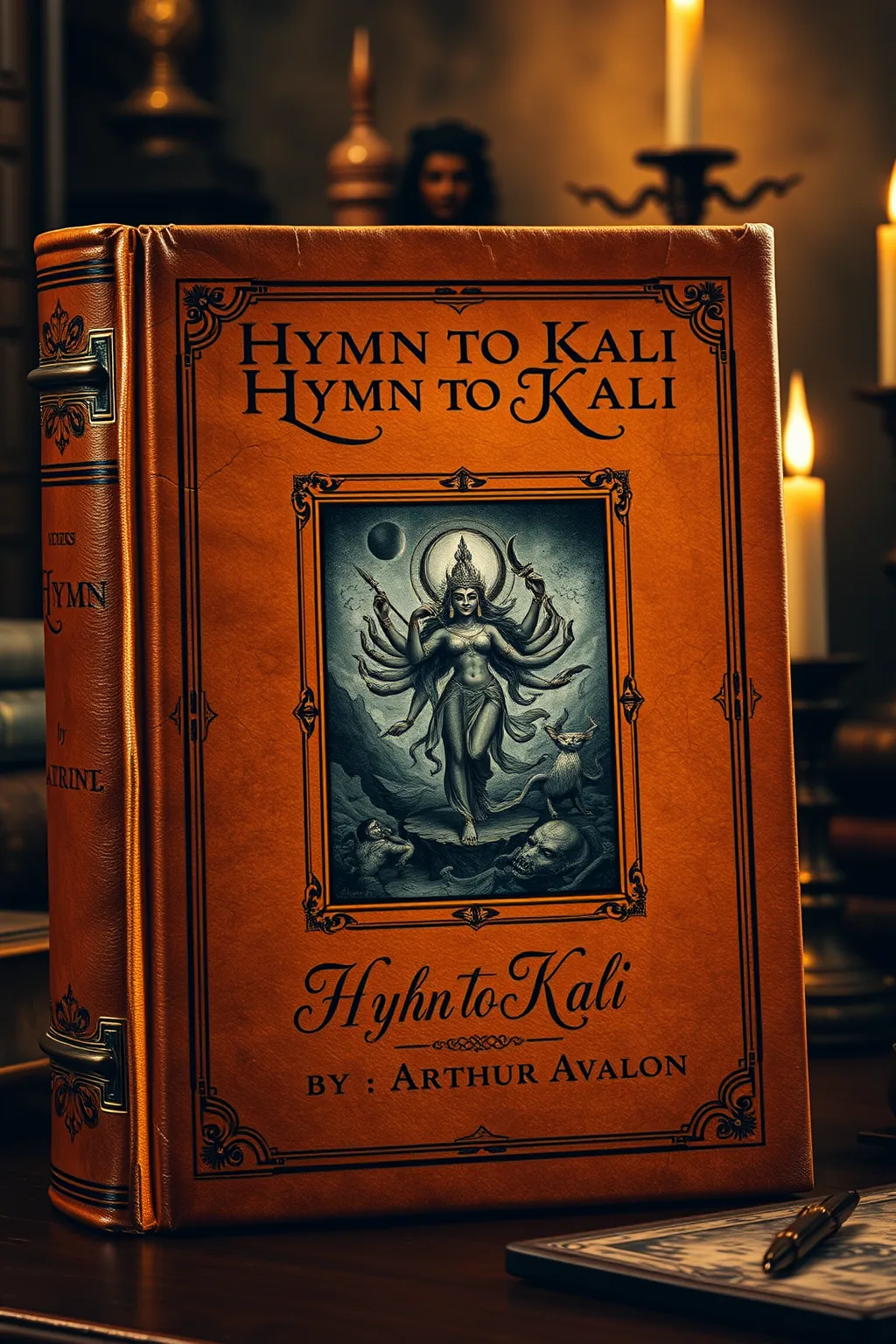
Hymn to Kali
 73
73

Hymn to Kali


Arthur Avalon's 'Hymn to Kali' is an essential cornerstone for any serious exploration of Tantric Hinduism. Avalon's scholarly dedication shines through his precise translation and deeply insightful annotations, offering unparalleled clarity on the complex philosophical and practical implications of Kali worship. He navigates the esoteric currents with an authority that demystifies, yet preserves the potent potency of the Mother Goddess. This work is invaluable for academics and spiritual practitioners alike, providing a robust foundation for understanding the profound symbolism and transformative potential inherent in this powerful deity. It is a testament to the enduring power of ancient wisdom.
📝 Description
73
Arthur Avalon published his translation and commentary on the Hymn to Kali in 1918.
Arthur Avalon's 1918 rendering of the Hymn to Kali introduces readers to the complex figure of the Goddess Kali. Avalon presents her as a force that embodies both destruction and creation, a necessary aspect of cosmic transformation and eventual liberation. His translation is accompanied by detailed notes that clarify the Tantric philosophy and practices embedded within the hymn.
The work aims to unlock esoteric Hindu knowledge, illustrating a worldview where the universe's apparent disorder is understood as divine activity. It is suited for those seeking direct spiritual experience, those interested in the philosophical foundations of Eastern mysticism, and practitioners looking to engage with the transformative power of feminine divine energy. The Hymn to Kali, as presented here, is more than just a text; it is a means to grasp the universe's cyclical patterns and the liberation found beyond illusion.
This work is situated within the tradition of Tantra, a spiritual path originating in India that often involves practices considered unorthodox by mainstream Hinduism. Tantra frequently focuses on the worship of goddesses like Kali, viewing the divine feminine as a powerful force for spiritual awakening. Avalon's translation and commentary aim to demystify these practices and their philosophical underpinnings for a Western audience, connecting them to broader concepts of Hindu cosmology and liberation.
💡 Why Read This Book?
Uncover the profound esoteric truths behind one of Hinduism's most potent deities. 'Hymn to Kali' offers a vital bridge between ancient Tantric practices and modern spiritual seeking. Ideal for those drawn to the Divine Feminine, seeking to understand cosmic cycles of destruction and creation, or exploring advanced Hindu philosophy. This work is a crucial resource for scholars and initiates alike.
⭐ Reader Reviews
Honest opinions from readers who have explored this book.
❓ Frequently Asked Questions
Who is Kali in Hindu tradition?
Kali is a principal deity in Hinduism, often depicted as the fierce aspect of the Divine Mother. She symbolizes time, change, power, creation, preservation, and destruction, embodying the ultimate reality that transcends duality.
What is Tantra and how does it relate to this hymn?
Tantra is a complex esoteric tradition in Hinduism and Buddhism focused on spiritual transformation through ritual, mantra, and yogic practices. This hymn is deeply embedded in Tantric cosmology and philosophy, offering insights into its core tenets.
Is this book suitable for beginners in Hinduism?
While the annotations are extensive and scholarly, beginners can approach the hymn itself for its devotional and poetic qualities. The notes provide deeper context for those ready to explore the esoteric layers.
What is the significance of Arthur Avalon's translation?
Arthur Avalon (Sir John Woodroffe) was a pioneering Western scholar of Indian traditions. His translations and commentaries are renowned for their scholarly rigor and ability to elucidate complex Tantric concepts for a Western audience.
What kind of spiritual development can one expect from studying this hymn?
Studying this hymn can lead to a deeper understanding of cosmic cycles, the nature of reality, and the transformative power of divine feminine energy. It can foster spiritual courage and encourage facing life's challenges with equanimity.
🔮 Key Themes & Symbolism
The Divine Mother's Dual Nature
This hymn looks at the paradoxical nature of the Divine Mother, Kali, as both the terrifying destroyer of illusion and ignorance and the loving nurturer of her devotees. It explores how her fierce aspect is essential for liberation, clearing the path for spiritual growth by dismantling ego and attachment. The text illuminates the profound truth that destruction is intrinsically linked to creation, and that true bliss arises from confronting and integrating the shadow aspects of existence. This duality is not a contradiction but a holistic representation of the cosmic dance of life and death, a fundamental concept in many esoteric traditions.
Tantric Paths to Liberation
The work serves as a profound exposition of Tantric principles, revealing the 'left-hand path' not as licentious, but as a rigorous spiritual discipline aimed at transcending conventional morality and duality. Avalon's notes meticulously unpack the symbolism of ritual, mantra, and meditation as tools for spiritual evolution. The hymn illustrates how Tantra seeks to harness the primal energies of the universe, including the potent feminine force (Shakti), to achieve self-realization and union with the divine. It emphasizes direct experience and the transformation of the practitioner from within.
The Nature of Reality and Cosmic Cycles
Through the lens of Kali, the hymn explores the cyclical nature of existence – the eternal rhythm of creation, preservation, and dissolution. It challenges the illusion of permanence, asserting that all phenomena are transient manifestations of a singular, ultimate reality. The text offers a metaphysical perspective on time, often personified by Kali, as a relentless force that governs all existence. Understanding these cosmic cycles, as depicted in the hymn, is presented as a crucial step towards detachment and the attainment of spiritual freedom, recognizing the impermanence that underlies all forms.
💬 Memorable Quotes
Direct passages from the work, attributed to the author.
“Her darkness is the absence of light, and hence, the source of all light.”
— This speaks to the paradoxical nature of Kali's darkness, suggesting it's not an emptiness but a primal state from which all manifest phenomena emerge, a womb of creation.
“She is the destroyer of ignorance.”
— This highlights Kali's role as a liberator, her fierce power directed towards dismantling the veils of illusion and delusion that obscure spiritual truth and hinder enlightenment.
“The universe is her playground.”
— This evocative phrase illustrates the cosmic scale of Kali's influence and the divine play (Lila) of existence, suggesting that all events and forms are part of her grand, dynamic manifestation.
“Through her, one attains liberation.”
— This points to the ultimate promise of devotion to Kali and the study of her hymns: the attainment of Moksha, freedom from the cycle of birth and death, and union with the divine.
💡 Key Ideas
Editorial paraphrase of the work's core concepts — not direct quotes.
The Goddess is the Supreme Consciousness.
This quote underscores the divine essence of Kali, positioning her not merely as a deity, but as the fundamental reality underlying all existence, the ultimate source of awareness.
🌙 Esoteric Significance
Tradition
This work is deeply rooted in the Shaktism tradition of Hinduism, specifically its Tantric branch. Shaktism venerates the Goddess (Shakti) as the supreme cosmic power. Within Tantra, Kali is a principal deity, representing the ultimate reality in her dynamic, transformative aspect. The hymn and its commentary explore concepts like Kundalini, chakras, and the yogic path to divine union, central tenets of Tantric practice aimed at spiritual liberation.
Symbolism
Kali's iconography is rich with esoteric symbolism: her dark complexion represents the formless, all-pervading nature of the Absolute; her disheveled hair, the untamed primal energy; her garland of skulls, the transcendence of mortality; her four arms, the control over the four dimensions of existence (past, present, future, and space); and her tongue tasting blood, the destruction of ego and ignorance. These symbols are keys to understanding her role as the devourer of illusion and the bestower of liberation.
Modern Relevance
In contemporary times, 'Hymn to Kali' offers useful insights into confronting personal and societal 'demons' – fear, ignorance, and ego. It provides a framework for understanding destructive forces not as inherently evil, but as necessary agents of change and purification. For spiritual seekers, Kali represents the powerful feminine archetype of transformation, offering strength and courage to navigate life's challenges and embrace personal growth, making her relevance enduring for those on a path of self-discovery.
👥 Who Should Read This Book
This profound text is useful for a diverse audience. **Spiritual Seekers** drawn to the Divine Feminine, Kali worship, or the transformative power of destruction and rebirth will find deep resonance. **Scholars of Hinduism and Comparative Religion** will benefit immensely from Avalon's meticulous translation and comprehensive annotations, offering critical insights into Tantric philosophy. **Practitioners of Yoga and Meditation** seeking to understand the deeper metaphysical underpinnings of their practices, particularly those related to Shakti and consciousness, will find essential knowledge here. **Anyone interested in esoteric traditions** and the complex, often paradoxical, nature of ultimate reality will discover a rich and rewarding study.
📜 Historical Context
Arthur Avalon's 'Hymn to Kali,' as part of his broader work on Indian Tantra, emerged during a period of intense Western scholarly interest in Eastern esoteric traditions. Published in the early 20th century, it coincided with a burgeoning Orientalist movement and a growing fascination with mysticism and occultism in Europe and America. Sir John Woodroffe (Avalon) was a key figure, acting as a crucial bridge between Indian philosophical and spiritual practices and a Western audience often encountering these concepts for the first time. His meticulous scholarship and deep respect for the traditions he studied helped to legitimize and disseminate Tantric knowledge, moving it beyond sensationalism and towards scholarly and spiritual appreciation, influencing generations of researchers and practitioners.
📔 Journal Prompts
Reflect on a time when a destructive force in your life ultimately led to growth or positive change. How does this relate to Kali's symbolism?
Consider the concept of 'illusion' in your own life. What aspects of reality do you perceive as illusory, and how might confronting them lead to greater freedom?
Explore the symbolism of darkness in your personal spiritual journey. How have you experienced or perceived 'darkness' as a source of illumination or transformation?
Meditate on the qualities of fierce love and protection. How might you embody these qualities in your interactions with yourself and others?
Write about a personal transformation you have undergone. What aspects of your 'old self' had to be 'destroyed' for the new to emerge?
🗂️ Glossary
Shakti
In Hinduism, Shakti refers to the dynamic, creative energy or power of the Divine Feminine, often personified as the Goddess. It is the force that animates the universe and is central to Tantric worship.
Tantra
A complex esoteric tradition within Hinduism and Buddhism that emphasizes spiritual liberation through ritual, meditation, mantra, and the harnessing of cosmic energies, particularly the divine feminine (Shakti).
Moksha
The ultimate goal in Hinduism, referring to liberation from the cycle of birth, death, and rebirth (samsara). It signifies spiritual freedom and union with the divine.
Lila
A Sanskrit term meaning 'play' or 'divine sport.' It refers to the concept that the universe and its creation is a divine play enacted by the gods, suggesting that cosmic events are not driven by necessity but by divine will and joy.
Kundalini
A primordial cosmic energy believed to reside in the dormant state at the base of the spine. Through yogic practices, it is awakened and guided upwards through the chakras to achieve spiritual enlightenment.
This book appears in 5 collections
🔮 Readers Also Liked
Browse all →







From the “Transcendental Meditation” Collection
View all →






More Free Spiritual Development Books
View all →