Dakshinamurti Stotra
 79
79

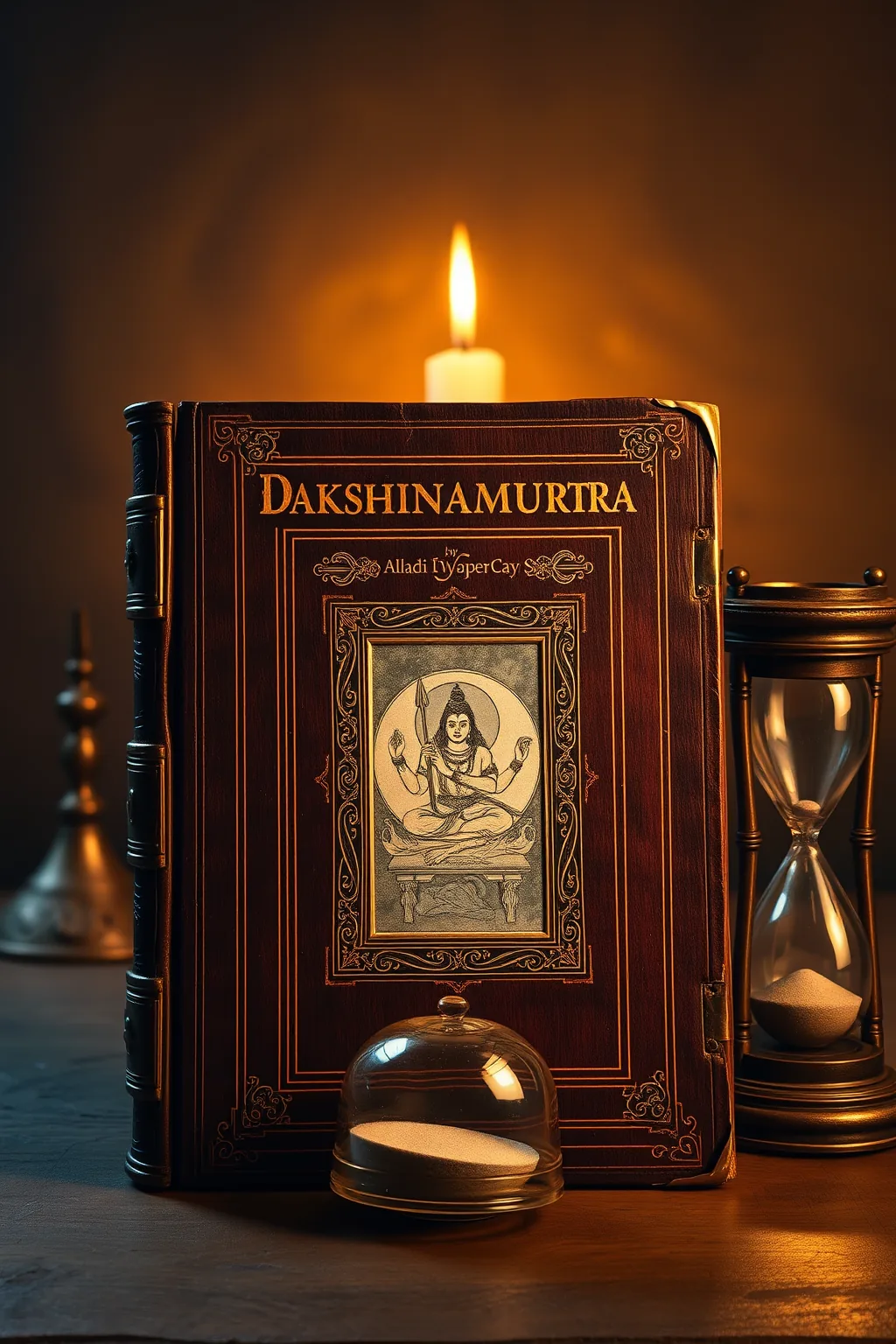
Dakshinamurti Stotra


Silas Hawthorne (Hermetic Studies Editor) — This rendition of the Dakshinamurti Stotra is a triumph of scholarly dedication and esoteric sensibility. Alladi Mahadeva Sastri masterfully navigates the profound philosophical depths of Shankaracharya's hymn, illuminating its intricate Advaita Vedanta principles with remarkable clarity. The text transcends mere translation; it is an invitation to direct experience, revealing the silent guru within and the illusory nature of the phenomenal world. For serious students of Eastern mysticism and those seeking liberation through self-knowledge, this work is indispensable. Its strength lies in its ability to retain the original’s potent spiritual charge while making its complex teachings accessible. A true gem for the discerning practitioner.
📝 Description
79
Adi Shankaracharya's Dakshinamurti Stotra unlocks Advaita Vedanta's core tenets.
This text presents Adi Shankaracharya's Dakshinamurti Stotra, a Sanskrit hymn. It uses the image of Dakshinamurti, Shiva as the silent teacher, to explain Advaita Vedanta. The verses examine how the universe appears illusory, obscuring true reality through Maya. The stotra guides readers toward understanding non-duality not through external rules, but through self-reflection and inner knowledge.
It provides a structure for spiritual seekers. The aim is to move beyond dualistic thinking toward the unified nature of consciousness. This is a text for contemplation, intended to diminish ego-based illusions and awaken awareness of the Self. It functions as a practice of consciousness, drawing the reader into the divine's quiet presence.
The Dakshinamurti Stotra is a key text within the Advaita Vedanta tradition of Hinduism. This school of thought emphasizes the oneness of the individual soul (Atman) and the ultimate reality (Brahman). The stotra's focus on introspection and the illusory nature of the phenomenal world aligns with Advaita's goal of liberation through knowledge. Dakshinamurti, as Shiva in his aspect as the silent teacher, embodies the direct, non-verbal transmission of this ultimate truth, bypassing intellectual constructs.
✍️ Author

Alladi Mahadeva Sastri
Tamil Brahmins are an ethnoreligious community of Tamil-speaking Brahmins, predominantly living in Tamil Nadu, though they number significantly in Andhra Pradesh, Karnataka, Kerala and Telangana in addition to other regions of India. They can be broadly di…
💡 Why Read This Book?
Embark on a transformative journey into the heart of Advaita Vedanta. This Stotra offers a direct path to understanding the Self, dismantling illusion, and realizing non-duality. It is essential for spiritual seekers, philosophers, and practitioners of meditation who wish to deepen their understanding of consciousness and attain liberation. Discover ancient wisdom for modern enlightenment.
⭐ Reader Reviews
Honest opinions from readers who have explored this book.
❓ Frequently Asked Questions
What is the primary teaching of the Dakshinamurti Stotra?
The primary teaching is Advaita Vedanta, emphasizing the non-dual nature of reality and the ultimate oneness of the individual self with Brahman, the supreme consciousness.
Who is Dakshinamurti?
Dakshinamurti is a form of Lord Shiva depicted as the silent guru, embodying knowledge and the dissolution of ignorance. He represents the ultimate teacher who reveals the truth through stillness and inner realization.
What role does Maya play in the Stotra?
Maya is presented as the cosmic illusion that veils the true nature of reality, creating the perception of a diverse and separate world. The Stotra guides the reader to see through this illusion.
Is this text suitable for beginners?
While profound, the Stotra, especially with insightful commentary like Sastri's, can be approached by dedicated beginners. It encourages introspection, which is a foundational practice.
What is the significance of 'silent teaching'?
The silent teaching signifies that ultimate truth cannot be conveyed through words alone, but is realized through direct experience, intuition, and the awakening of inner consciousness.
🔮 Key Themes & Symbolism
The Nature of Ultimate Reality (Brahman)
The Stotra posits that Brahman is the sole, unchanging reality, the substratum of all existence. It is beyond attributes, form, and temporal limitations. This theme explores the concept of a singular, all-pervading consciousness that is the source and essence of everything, challenging the conventional understanding of a world of multiplicity and duality. It invites contemplation on what truly exists beyond the transient phenomena we perceive.
The Illusion of the World (Maya)
Central to the Stotra is the concept of Maya, the illusory power that makes the unreal appear real. This theme examines how our senses and minds construct a perceived reality that obscures the underlying unity. It highlights that the universe of names and forms is a temporary manifestation, akin to a dream, and understanding its illusory nature is crucial for spiritual liberation.
Self-Inquiry and the Realization of Non-Duality (Advaita)
The hymn provides a framework for self-inquiry, urging the seeker to investigate the 'Who am I?' question. This theme focuses on the process of negating the false identifications with the body, mind, and ego, leading to the direct realization of the eternal, non-dual Self (Atman) that is identical with Brahman. It's a practical guide to dismantling ignorance and awakening to one's true nature.
💬 Memorable Quotes
Direct passages from the work, attributed to the author.
“The world is but a phantom, a dream.”
— This evokes the illusory nature of Maya, suggesting that our perceived reality is impermanent and ultimately not the true essence of existence.
“Know thyself, the silent teacher guides.”
— This points to the internal nature of spiritual knowledge, emphasizing self-awareness as the path to enlightenment, facilitated by the inner guru.
“In stillness, truth is revealed.”
— Highlights the importance of meditation and contemplation in transcending the noise of the mind to access useful insights.
“Beyond birth and death, the eternal Self.”
— Asserts the timeless and unchanging nature of the soul, distinct from the cycle of physical existence and dissolution.
“All is One, the great oneness.”
— Expresses the core Advaita principle of non-duality, affirming the ultimate unity of all existence.
🌙 Esoteric Significance
Tradition
This hymn is a core part of the Advaita Vedanta tradition, a profound school of Hindu philosophy emphasizing non-duality. It's deeply rooted in the Upanishads and represents the pinnacle of Vedantic inquiry into the nature of reality, consciousness, and the Self. Its esoteric dimension lies in its direct path to gnosis, bypassing ritualistic complexities for inner realization.
Symbolism
Dakshinamurti himself is a potent symbol: Shiva as the silent, introspective guru, facing south (Dakshina), symbolizing the dissolution of ignorance. The imagery of the youth (representing the universe in its manifest form) learning from the silent sage underscores the idea that true knowledge comes from within, not from external instruction. The yogic posture and the symbolic objects often associated with him further enhance its mystical resonance.
Modern Relevance
In an age of information overload and external distractions, the Dakshinamurti Stotra offers a vital antidote. Its emphasis on self-inquiry and inner stillness is profoundly relevant for modern seekers grappling with existential questions and the illusion of material pursuits. The Stotra provides a timeless framework for understanding consciousness, managing the mind, and cultivating a sense of inner peace and profound connection.
👥 Who Should Read This Book
This is essential reading for serious students of Advaita Vedanta, philosophy scholars, and spiritual practitioners seeking to deepen their understanding of non-duality. Beginners with a strong inclination towards self-inquiry will find it an informative, albeit challenging, guide. Mystics and yogis will appreciate its useful insights into consciousness and liberation. Anyone yearning to move beyond superficial existence towards a direct experience of truth will find immense value within these sacred verses.
📜 Historical Context
The Dakshinamurti Stotra emerged from the rich philosophical milieu of 8th-century India, a period marked by the ascendance of Adi Shankaracharya and the consolidation of Advaita Vedanta. This era saw a vibrant intellectual landscape where diverse schools of Indian philosophy debated and refined their metaphysical doctrines. Shankaracharya, a prodigious scholar and mystic, synthesized existing Vedic thought, presenting a clear, systematic philosophy of non-dualism. The Stotra, attributed to him, reflects this intellectual rigor and spiritual fervor, serving as a potent articulation of Advaita's core tenets. Its influence has been profound, shaping spiritual practices and philosophical discourse across India and beyond for over a millennium, offering a timeless guide to self-realization.
📔 Journal Prompts
Reflect on a time you felt a profound sense of stillness. What insights arose from that state?
When you contemplate the 'illusion of the world,' what specific aspects of your daily experience seem most unreal?
If you were to ask yourself 'Who am I?' sincerely, what initial answers arise, and how do they feel?
Consider the concept of the 'silent teacher.' Where in your life have you experienced guidance that transcended words?
How does the idea of your true Self being beyond birth and death resonate with your current understanding of existence?
🗂️ Glossary
Advaita Vedanta
A school of Hindu philosophy that asserts the non-dual nature of reality, teaching that the individual soul (Atman) is identical with the supreme consciousness (Brahman).
Brahman
The ultimate reality, the supreme consciousness, the unchanging substratum of all existence, often described as the impersonal, all-pervading Divine.
Maya
Cosmic illusion, the power that veils the true nature of reality and creates the perception of a diverse, separate world. It is the principle of phenomenal existence.
Atman
The individual soul or Self, which in Advaita Vedanta is ultimately identical with Brahman, the supreme consciousness.
Gnosis
Spiritual knowledge or insight, a direct intuitive apprehension of spiritual truths, often attained through mystical experience or profound contemplation.
This book appears in 2 collections
🔮 Readers Also Liked
Browse all →








From the “Transcendental Meditation” Collection
View all →






More Free Spiritual Development Books
View all →