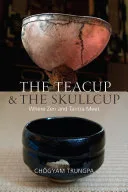
The Teacup and the Skullcup
 71
71

The Teacup and the Skullcup
Chögyam Trungpa's "The Teacup and the Skullcup" offers a glimpse into his early North American teachings, specifically his thoughts on Zen and Tantra from 1974. His ability to articulate complex Buddhist concepts with an accessible, almost conversational tone is a significant strength. The book highlights Trungpa's respect for Zen's disciplined approach, seeing it as a foundation that could support the more intricate practices of Vajrayana. A notable limitation is the inherent nature of edited transcripts; at times, the flow feels less cohesive than a fully composed text. The discussion around the "warrior" as someone who confronts suffering without self-deception provides a concrete example of his direct style. Ultimately, the work serves as an illuminating, if occasionally raw, document of a pivotal moment in Trungpa's transmission of Buddhist philosophy.
📝 Description
71
### What It Is
The Teacup and the Skullcup presents edited transcripts from two 1974 seminars by Chögyam Trungpa, titled "Zen and Tantra." These talks, delivered in Barnet, Vermont, and Boston, mark an early phase of his North American teaching career. Trungpa, a Tibetan Buddhist master, offers a nuanced perspective on the relationship between Zen Buddhism and Vajrayana Tantra. He acknowledges the rigor and discipline inherent in Zen while explaining how it informed his own presentation of tantric teachings.
### Who It's For
This work is intended for practitioners and scholars interested in the intersection of Eastern and Western spirituality. Students of Buddhism, particularly those exploring Tibetan traditions or comparative religious studies, will find value here. It also appeals to individuals curious about the transmission of Eastern philosophies into a Western context and the adaptation of spiritual practices for new cultural landscapes.
### Historical Context
Delivered in 1974, "Zen and Tantra" occurred during a period of significant Western engagement with Eastern religions. Trungpa Rinpoche's work emerged amidst a burgeoning interest in meditation and Eastern thought, often influenced by figures like Alan Watts and D.T. Suzuki. This era saw many Eastern teachers establishing centers in North America, adapting their teachings for Western audiences. Trungpa's approach, bridging Zen discipline with Tibetan Tantric philosophy, offered a distinct path compared to other contemporary Buddhist movements.
### Key Concepts
The book explores the concept of "form" in spiritual practice, distinguishing between the superficial appearance of rituals and their underlying energetic or meditative purpose. Trungpa discusses the "warrior" archetype not as a literal combatant, but as one who faces life's challenges with courage and clarity. The "teacup" and "skullcup" themselves symbolize the ordinary and the extraordinary, the mundane and the profound, suggesting their integration within a balanced spiritual life.
💡 Why Read This Book?
• Gain direct insight into Chögyam Trungpa's early articulation of "Zen and Tantra" in 1974, understanding how he integrated two distinct Buddhist traditions for Western students. • Explore the concept of the "warrior" not as a literal fighter but as an attitude towards life, as presented in the 1974 seminars, offering a practical approach to facing challenges. • Understand the symbolic meaning of the "teacup" and "skullcup" within Trungpa's framework, illustrating the integration of the mundane and the profound in spiritual practice.
⭐ Reader Reviews
Honest opinions from readers who have explored this book.
❓ Frequently Asked Questions
When was Chögyam Trungpa's "The Teacup and the Skullcup" first published?
The book "The Teacup and the Skullcup" was first published on December 22, 2015, compiling teachings from 1974.
What were the original seminar titles that "The Teacup and the Skullcup" is based on?
The book is derived from edited transcripts of two seminars given by Chögyam Trungpa in 1974, both titled "Zen and Tantra."
Where did Chögyam Trungpa deliver the "Zen and Tantra" seminars in 1974?
The seminars that form the basis of "The Teacup and the Skullcup" were held in Barnet, Vermont, and Boston in 1974.
What is the relationship between Zen and Tantra discussed in the book?
Trungpa explores how the discipline and strength gained from Zen practice can serve as a foundation for understanding and engaging with Vajrayana Tantra.
Who is Chögyam Trungpa?
Chögyam Trungpa (1939-1987) was a Tibetan Buddhist scholar and meditation master who played a key role in establishing Buddhist teachings in the West, particularly in North America.
What does the title "The Teacup and the Skullcup" symbolize?
The title represents the integration of the ordinary (teacup) and the extraordinary or profound (skullcup), suggesting a balanced approach to spiritual life.
🔮 Key Themes & Symbolism
Zen and Tantra Integration
Trungpa Rinpoche addresses the perceived dichotomy between Zen and Tantra, not as opposing forces, but as complementary paths. He highlights how the discipline, mindfulness, and directness of Zen practice can prepare the practitioner for the more intricate and profound methodologies of Vajrayana Tantra. The work examines how forms and practices from each tradition can inform the other, creating a richer, more comprehensive approach to spiritual development. This integration is crucial for understanding the evolution of Buddhist teachings in a Western context.
The Warrior's Attitude
Central to Trungpa's teachings in this volume is the concept of the "warrior." This is not a warrior of aggression, but one who faces the challenges and realities of life with courage, honesty, and precision. The warrior confronts suffering, confusion, and death without flinching or resorting to spiritual or psychological avoidance. This attitude is presented as fundamental to both Zen discipline and Tantric realization, enabling practitioners to engage with their world fully and authentically.
Form and Substance
The book delves into the nature of spiritual "form" – the rituals, practices, and teachings themselves. Trungpa distinguishes between adhering rigidly to the outward appearance of these forms and understanding their underlying purpose and energetic significance. He suggests that while forms provide necessary structure, true spiritual work involves penetrating beyond superficiality to the substance, integrating the mundane "teacup" with the profound "skullcup" of awakening.
Transmission to the West
As talks given early in Trungpa Rinpoche's North American teaching career (1974), these seminars represent a crucial moment in the adaptation of Tibetan Buddhism for Western students. The work illustrates the challenges and methods involved in translating complex philosophical and meditative traditions across cultural and linguistic divides. Trungpa's willingness to engage with existing Western spiritual frameworks, such as Zen, demonstrates a pragmatic approach to making these teachings accessible and relevant.
💬 Memorable Quotes
“The point is not to make the world into a Buddhist world, but to make the world into the world.”
— This statement underscores Trungpa's pragmatic approach, suggesting that spiritual practice is not about altering external reality to fit a religious ideal, but about engaging with the world as it is, with clarity and awakened perception.
“Zen is the ground, and Tantra is the path.”
— This aphorism highlights Trungpa's view on the relationship between Zen and Tantra. Zen provides a foundation of discipline and awareness, while Tantra offers advanced methods for realizing enlightenment, building upon that foundation.
“The warrior is one who is not afraid of the shadow.”
— This paraphrased concept refers to the "warrior" archetype, emphasizing the importance of confronting one's own darker aspects, fears, and the difficult truths of existence without denial or avoidance.
“Ordinary mind is the enlightened mind.”
— This is a core concept suggesting that the state of enlightenment is not separate from our everyday experience. The challenge lies in recognizing the profundity within the ordinary "teacup" of our daily lives.
“Form is not the enemy, but the wrong use of form.”
— This paraphrased concept clarifies Trungpa's stance on spiritual practices and rituals. The issue is not the existence of forms, but the misunderstanding or rigid application of them, which can obscure their true purpose.
🌙 Esoteric Significance
Tradition
Chögyam Trungpa, a lineage holder in the Tibetan Kagyu and Nyingma schools of Vajrayana Buddhism, offers teachings rooted in this profound esoteric tradition. "The Teacup and the Skullcup" bridges this lineage with the widely accessible principles of Zen Buddhism. While Zen is often considered a more direct, non-theistic path, Trungpa demonstrates how its foundational principles of mindfulness and discipline can be integrated with the symbolic richness and advanced transformative practices characteristic of Vajrayana Tantra.
Symbolism
The titular "teacup" and "skullcup" are potent symbols. The teacup represents the ordinary, the mundane, the everyday vessel of our lives and experiences. The skullcup, a ritual implement in Tibetan Buddhism often used for offerings or holding libations, symbolizes the confrontation with impermanence, death, and the ultimate nature of reality. Together, they signify the tantric aspiration to integrate all aspects of existence, the profane and the sacred, within a unified path to awakening.
Modern Relevance
Trungpa's approach to integrating Zen and Tantra continues to influence contemporary Buddhist thinkers and practitioners. His emphasis on the "warrior's" attitude – facing reality directly – resonates with modern mindfulness-based stress reduction (MBSR) programs and secularized contemplative practices. Furthermore, his work informs discussions on how to present profound esoteric teachings in accessible ways, relevant to individuals navigating the complexities of modern life without necessarily adhering to a specific religious dogma.
👥 Who Should Read This Book
• Students of comparative religion and Buddhist studies seeking to understand the cross-pollination of Zen and Tibetan traditions in the West. • Practitioners of meditation looking for guidance on integrating discipline (Zen) with deeper inquiry into the nature of reality (Tantra). • Individuals interested in the life and teachings of Chögyam Trungpa, particularly his early engagement with North American audiences in the 1970s.
📜 Historical Context
Delivered in 1974, Chögyam Trungpa's "Zen and Tantra" seminars occurred during a period of intense cross-cultural exchange in spiritual thought. North America was a fertile ground for Eastern philosophies, with figures like Alan Watts having popularized concepts of Zen and meditation throughout the 1960s. Trungpa's work emerged alongside a growing interest in Tibetan Buddhism, distinct from the more established Zen Buddhist communities influenced by scholars like D.T. Suzuki. While Suzuki's writings had already presented Zen to the West, Trungpa offered a bridge between Zen's disciplined approach and the complex, often esoteric, practices of Vajrayana. His approach acknowledged the rigor of Zen while integrating it into the broader spectrum of Tibetan Buddhist teachings, positioning him as a unique voice in the expanding landscape of Western Buddhism.
📔 Journal Prompts
The warrior's confrontation with the shadow, as discussed in the "Zen and Tantra" seminars.
The symbolic meaning of the "teacup" versus the "skullcup" in daily practice.
Trungpa's perspective on the role of "form" in spiritual development.
The integration of Zen discipline with Vajrayana Tantric principles.
The challenges of transmitting esoteric teachings to a Western audience.
🗂️ Glossary
Vajrayana
A branch of Mahayana Buddhism, commonly known as Tibetan Buddhism, characterized by its use of tantric methods and visualizations to achieve enlightenment rapidly.
Zen
A school of Mahayana Buddhism originating in China (as Chan) that emphasizes meditation, direct experience, and intuition over scripture or doctrine.
Tantra
A complex spiritual tradition found in Hinduism, Buddhism, and Jainism, often involving ritual, meditation, and symbolic practices aimed at transforming the practitioner.
Warrior
In Trungpa's context, not a literal fighter, but one who approaches life with courage, precision, and openness, confronting reality without self-deception.
Form
The outward structure, rituals, or practices of a spiritual path; Trungpa distinguishes between the correct use of form and its superficial adherence.
Skullcup
A ritual object in Tibetan Buddhism, often made from a human skull, symbolizing impermanence and the confrontation with death and ultimate reality.
Teacup
Symbolizing the ordinary, the mundane, and everyday existence; represents the ground of experience that can be integrated with the profound.